China to apply lower import tariff rates to unleash market potential







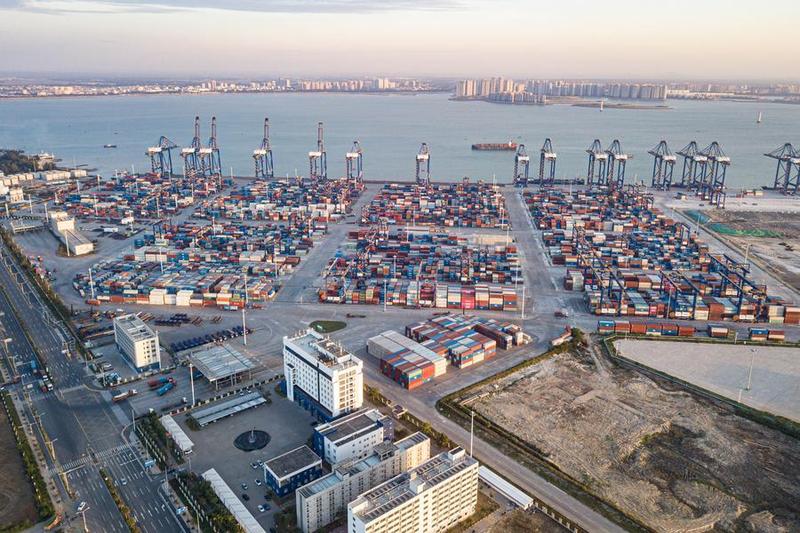
China will apply provisional import tariff rates lower than the most-favored-nation rates on 935 items starting on Jan 1, a move market observers and company executives said will further unleash domestic purchasing potential and create wider opportunities for global businesses.
In a statement released on Monday, the Customs Tariff Commission of the State Council, China's Cabinet, said the provisional import tariffs will be applied as part of an annual tariff adjustment plan, which will "increase the import volume of quality products" and "support China's pursuit of high-level opening-up".
For example, China will reduce tariffs on critical components and advanced materials, such as computer-controlled hydraulic cushions for presses and heteromorphic composite contact strips, easing costs for the high-end manufacturing sector and accelerating the development of a modern industrial system.
The new tariff adjustment plan will also support the country's green transition by reducing duties on resource-related inputs, such as recycled black mass for lithium-ion batteries and unroasted iron pyrites. To improve public health, it will lower tariffs on items including artificial blood vessels and diagnostic kits for certain infectious diseases.
Noting that these opening-up measures will help chart a clear path toward high-quality development, Anna An, president of the China unit of German industrial and consumer goods group Henkel, said that China's evolving policy environment is providing greater clarity and confidence for long-term investment and trade.
An said that Henkel continues to see the Chinese market demonstrating strong resilience and solid long-term growth potential, especially in areas such as expanding domestic demand and boosting consumption, innovation-driven growth and progress for achieving the country's dual-carbon goals.
To underscore its continued commitment to the market, the German company will step up the introduction of its high-tech products in China and continue to scale up local manufacturing operations in the years ahead, she added.
Zhou Mi, a senior researcher at the Chinese Academy of International Trade and Economic Cooperation, said that China dynamically adjusts its tariff rates annually in response to evolving external conditions, and these adjustments have sent clear policy signals and enhanced the stability of market expectations.
"By announcing next year's tariff schedule in advance, the policy will enable domestic importers and foreign exporters interested in the Chinese market to accurately anticipate future tariff levels, effectively assess costs, reduce uncertainty, and proactively plan and scale their supply capabilities," he added.
Xiao Jinfeng, foreign trade manager at Asia Vital Components (Dongguan) Co, a manufacturer of computer cases, servers and cooling fans based in Dongguan, Guangdong province, said the government's new tariff adjustment plan will lower the company's cost of importing storage-battery components and industrial valves, among other things.
"As we will add new production lines to drive upgrading and move into emerging areas such as advanced liquid-cooling solutions for cloud-based artificial intelligence data centers next year, high-end foreign products and technical services are certainly needed," she said.
Luo Zhiheng, chief economist and head of the research institute at Yuekai Securities, said the timely reductions in import tariffs on critical raw materials, high-end equipment and advanced material products — all commodities urgently needed for domestic industrial development and closely aligned with national strategic priorities — will help ensure the smooth functioning of China's industrial and supply chains.
Despite external headwinds against globalization and rising geopolitical risks, China has continued to open its doors wider. The annual Central Economic Work Conference, held earlier this month in Beijing, emphasized the need to steadily advance institutional opening-up and tap new space for demand growth to strengthen the domestic circulation.
According to the commission, to promote technological progress and foster the circular economy, China will introduce new national tariff subheadings in 2026 for items including intelligent bionic robots and bio-aviation kerosene. Following the adjustments, the total number of tariff lines will rise to 8,972, it said.
Contact the writers at zhongnan@chinadaily.com.cn