Berlin, Munich shows highlight bilateral cooperation potential







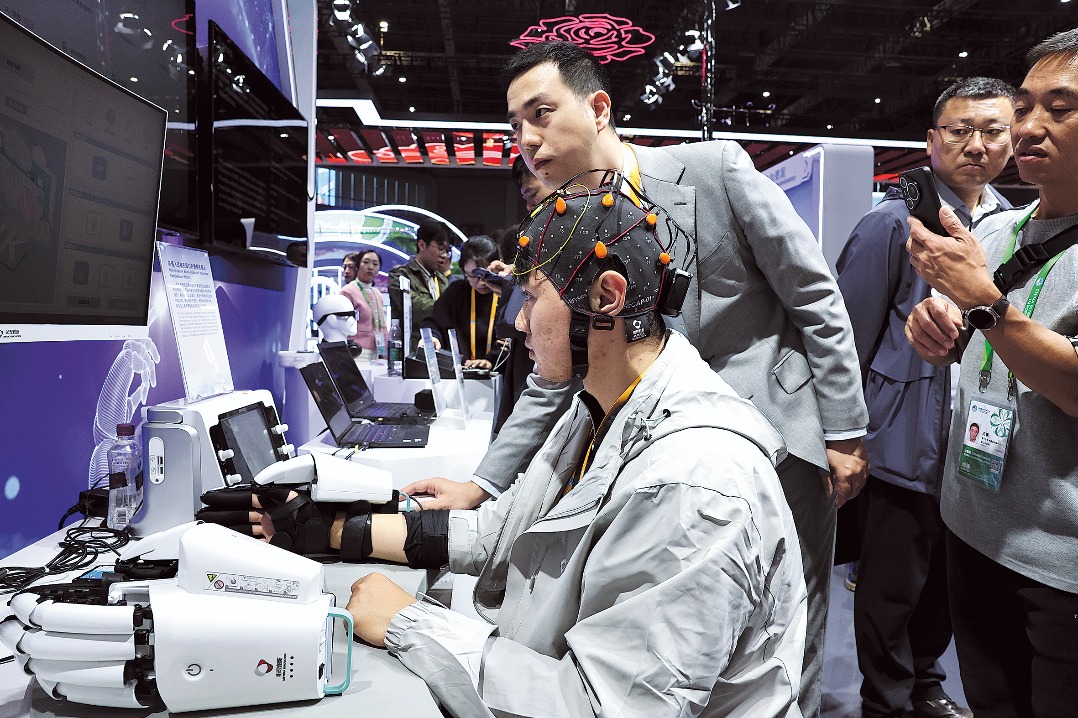
As Innovation for All 2025 was drawing to a close in Berlin on Tuesday, the International Motor Show Germany (IAA Mobility) 2025 opened in Munich. The two events serve as platforms to showcase industrial advances made in the information era.
Both China and artificial intelligence were to the fore at the two exhibitions. For example, this year's IFA attracted around 1,900 exhibitors, of which more than 700, or over one-third, were from China. Similarly, at IAA Mobility 2025, emerging Chinese brands such as BYD and Xpeng had such a strong presence that European media called it the "largest Chinese auto show outside China". AI stood at the core of Chinese products at both these events, be it robots, smart home appliances and wearables in Berlin or AI-equipped car models in Munich.
It was evident at both events that Chinese companies have overturned the outdated notion that "Made in China" stands for low-cost and low-quality products. Instead, their high-tech, user-friendly and innovative products on display left European audiences amazed.
This transformation should be seen as a mutual opportunity for both the European Union and China. For EU consumers, it means the ability to select, from a wide range of choices, the products most suited to their needs. That many of the newly unveiled products are almost tailor-made for the EU market strengthens that point: A four-legged sweeping robot with bionic tracks capable of climbing steep stairs is just the answer for the large number of multistoried homes in Europe, while AI-powered augmented reality translation glasses, offering real-time language translation and navigation, hold enormous utility in a continent where some 200 languages are spoken.
As German journalist Frank Sieren recently told The World, the auto industry today seems to be retracing the trajectory once followed by cameras and smartphones: innovation beginning in Europe, production shifting to Asia, and, eventually, innovation itself migrating eastward.
Contrary to Sieren's analysis, those media voices hyping China as "the biggest challenge to Europe's auto industry" appear rather short-sighted. In reality, the economic structures of the EU and China are not adversarial, but highly complementary. Over the decades, the EU's leading economies have become service-based. Germany, historically the EU's industrial powerhouse, saw industry's share of its economy fall from over 33 percent in 1991 to below 24 percent in 2009, now stabilizing around 26 percent. In contrast, the latest Chinese data show that industry still accounts for 38.3 percent of its economy.
Crucially, this capacity should not be viewed as fuel for trade frictions. While it is true that China's global share in automobiles is rising, investment flows tell a deeper story of mutual integration. In 2024, EU investment in China increased by $6.79 billion, while Chinese investment in the EU rose by $7.09 billion. Back in 2022, leading Chinese new energy and battery companies had already issued Global Depositary Receipts on the SIX Swiss Exchange, giving EU investors direct access to their shares. These examples show that the economies of China and the EU have long been intertwined in a relationship of mutual stakeholding, where shared prosperity serves both sides' long-term interests.
As IAA Mobility 2025 continues in Munich through Sunday, automotive firms from both China and the EU will keep unveiling their latest models and technologies to EU consumers. These exhibitions should not be framed as arenas of rivalry but as gateways for opportunity. In an interconnected world, where supply chains, technologies, and investments are interwoven across borders, the success of one side can enrich the other.