Aid program must return to its roots







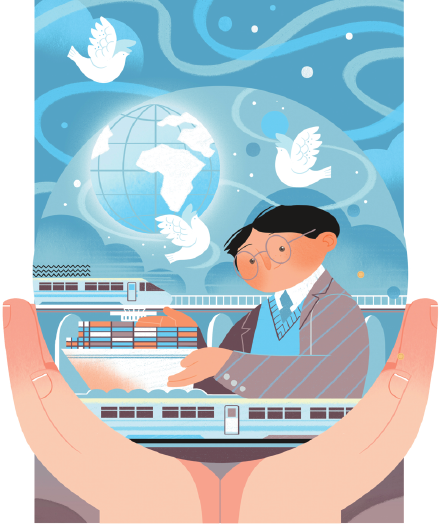
Foreign aid isn't dying; it's in deep trouble. Just look at Seville, where the United States — the world's largest development donor not long ago — didn't even bother to send a delegation to the global aid summit.
While Washington's development agency, USAID (United States Agency for International Development), is now slated for complete dissolution after seeing its budget slashed by 80 percent under President Donald Trump, Germany's development budget has fallen from 2021 to 2025, with humanitarian assistance halved. The United Kingdom and France have followed suit. Once proud champions of global responsibility are now quietly retreating.
What's behind this retreat? It's not just fiscal belt-tightening. Some claim it's disillusionment. Many voters, and politicians, have come to believe that aid doesn't work. They're not entirely wrong.
Despite decades of large reported aid — more than $200 billion annually in global aid in recent years — evidence of consistent success is underwhelming. Growth? Spotty. Poverty reduction? Inconsistent. Institutional development? Patchy, at best. It's tempting to blame waste, corruption, or poor execution.
But the real problem is deeper: much of what we call "development aid" isn't designed to promote development in the first place.
Let's be honest. A large chunk of aid has little to do with helping the poor and everything to do with donor priorities. Rich countries use aid to reward allies, fight migration, secure commercial deals, or polish their moral image by tackling global challenges like climate change and/or gender inequality.
There's nothing inherently wrong with these goals. But let's not pretend they're about spurring growth or improving lives. This misalignment explains the skepticism. When development outcomes are weak, it's often because aid wasn't really aimed there in the first place.
Moreover, if aid numbers are inflated by including large sums of money that are spent in donor rather than recipient countries, aid looks inefficient.
Enter China, which has rewritten the script on development cooperation. The country does not bother with the same rhetorical gymnastics. Instead of using aid to promote liberal norms or push political reforms, it funds what recipients ask for — usually infrastructure. Roads, ports, power stations. Concrete, not conditions.
While Western donors have shifted toward sprawling social agendas, China's model has put economic transformation back at the center. And many countries in the Global South are applauding it for that.
So, if Western aid is bloated and politicized, and Chinese aid is strategic, where does that leave us? Here's my proposal: it's time to reboot the aid system from the ground up, borrowing the best from both models while fixing their limitations.
First, there is a need to stop lumping everything together. Aid today is a catch-all term covering wildly different goals. We need to disentangle three things. First, humanitarian aid — life-saving but short-term interventions like disaster relief or refugee support — deserves its own budget line.
Let us not call it "development". Second, public goods — like pandemic preparedness or climate mitigation — should be funded multilaterally and judged by their global impact, not by whether or not they raise incomes in, say, Zambia. And third, development aid proper must return to its roots: long-term investments in infrastructure, education, and healthcare that empower countries to grow on their own terms.
China, to its credit, has kept its focus on infrastructure, a sector Western donors largely abandoned. But for aid to really work, it needs more than cement. It needs accountability.
In extreme cases, unconditional cash transfers to citizens can get aid to the people who need it most, without empowering corrupt elites.
The bottom line is that we can't afford to let aid become a victim of its own confusion. If donors want to preserve public support, they must be honest about what aid is for, and what it's not for. If they aim for everything, they achieve nothing. The solution is not to walk away from aid, but to give it a clearer purpose, a leaner structure, and greater accountability. China and Western donors both have valuable lessons to offer.
Let's stop pretending one model is perfect. Instead, let's combine the West's tools for transparency and evaluation with China's focus on visible development.
The author is chairman of International and Development Politics at Heidelberg University's Alfred Weber Institute for Economics and editor of Review of International Organizations.
The views don't necessarily represent those of China Daily.



Today's Top News
- China to apply lower import tariff rates to unleash market potential
- China proves to be active and reliable mediator
- Three-party talks help to restore peace
- Huangyan coral reefs healthy, says report
- PLA conducts major drill near Taiwan
- Washington should realize its interference in Taiwan question is a recipe it won't want to eat: China Daily editorial