Japan won't succeed in its dirty ploy to disown its war crimes







This year marks the 80th anniversary of the victory in the Chinese People's War of Resistance Against Japanese Aggression (1931-45) and the World Anti-Fascist War, an occasion that Japan should use to sincerely reflect on its history of aggression, acknowledge its war crimes, and take corrective measures to improve its relations with China.
But instead of doing that, Japan, especially right-wing forces in Japan, has been trying to reshape the narrative of World War II by, among other things, rewriting its wartime history to project Japan as a victim of the war instead of a perpetrator. The right-wing forces aim to disown Japan's wartime past, including the atrocities it committed in neighboring countries including China.
Rather than holding commemorations to reflect on Japan's heinous crimes before and during World War II, the right-wing forces are mourning the Japanese people who died or suffered during the war.
A key element of Japan's narrative is to show that it was a victim of nuclear attacks. The bombings of Hiroshima and Nagasaki are used as powerful symbols to portray Japan as the "only nation to have suffered atomic bombings", which obscures its role as an initiator of the war.

The G7 Summit held in Hiroshima in 2023 and the subsequent issuance of the "Hiroshima Vision" were products of Japan's efforts to reshape its identity — as a victim of World War II. Similarly, during an event to mark the 80th anniversary of the atomic bombing of Hiroshima on Aug 6, 2025, then Japanese prime minister Shigeru Ishiba emphasized Japan's unique status as the only victim of nuclear attack while avoiding any discussion on the reasons behind the bombings, thereby framing the event as a senseless tragedy.
Japan has systematically expanded the definition of who qualifies as a victim. The definition, according to Japan, now includes civilians who died in the Battle of Okinawa, victims of the Tokyo air raids, postwar orphans, detained laborers, family members of deceased soldiers and even fallen soldiers.
By asserting that all the Japanese people were victims of war, Japan's narrative sidesteps any acknowledgment of its military's atrocities on the people of neighboring countries. The designation of Aug 15 as "Japan's Day to Commemorate the War Dead and Pray for Peace" blurs the lines between perpetrator and victim.
Through its state-funded and secular memorial sites such as the Chidorigafuchi National Cemetery, Japan conflates the commemoration of fallen soldiers, including those who invaded other countries and committed atrocities, with civilian victims, blending their memories into a narrative of public mourning.
Japan's expansion of its victimhood narrative operates across three key dimensions: geographically, stretching beyond its mainland to former colonies by highlighting the suffering of overseas Japanese, such as prisoners of war detained in Siberia; temporally, extending into the postwar period to incorporate hardships like food shortages and social unrest under US occupation; and identity-wise, rebranding soldiers and colonizers as ordinary civilians, exemplified by the enshrinement of war criminals alongside other war dead at Yasukuni Shrine.
The ultimate goal of Japan's narrative restructuring is to transfer its responsibility for launching the war from the state to abstract concepts like militarism, and then disperse it across the entire population. This is Japan's ploy to decriminalize its history of aggression.
Another significant strategy of Japan's narrative involves playing the "Taiwan card". On Aug 6, Japan invited for the first time the Taiwan province to attend the atomic bombing anniversary ceremony in Hiroshima. While ostensibly framed as a humanitarian gesture, the move was in essence a calculated geopolitical strategy that exploited historical grievances to erode the political foundation of Sino-Japanese relations.
Japan attributes the responsibility for its wartime past to "militarist cliques" in the country, asserting that ordinary Japanese people at the time and the subsequent generations bear no accountability. By merging worshipping at Yasukuni Shrine — where class-A war criminals are enshrined alongside the regular war dead — with official peace memorials, Japan hopes to build an atmosphere of undifferentiated collective mourning, thereby blurring its militarist past.
Through anime, films and other media, popular Japanese cultural products frequently highlight civilian suffering during the war. While eliciting empathy, these narratives often strip away historical facts, diluting the accountability of those who launched the war.
In addition, certain textbooks in Japan have reduced references to issues such as "comfort women" and the "Nanjing Massacre", replacing them with vague statements like "all countries suffered casualties during the war", further obscuring historical specifics.
The implications of Japan's victimhood narrative will be profound. It will dilute the moral authority of countries that forged the anti-fascist front during World War II, including China, by trying to garner global sympathy.
By promoting itself as a peace advocate through events held to promote nuclear disarmament and diplomatic outreach, Japan is trying to disown responsibility for its war crimes.
But reconstructed history cannot whitewash Japan's colonial and war crimes. Instead, it will severely impede historical reconciliation across East Asia. As the world marks the 80th anniversary of the victory over fascism, Japan's distorted wartime narrative is hindering regional historical reconciliation.
The views don't necessarily represent those of China Daily.





Today's Top News
- China to apply lower import tariff rates to unleash market potential
- China proves to be active and reliable mediator
- Three-party talks help to restore peace
- Huangyan coral reefs healthy, says report
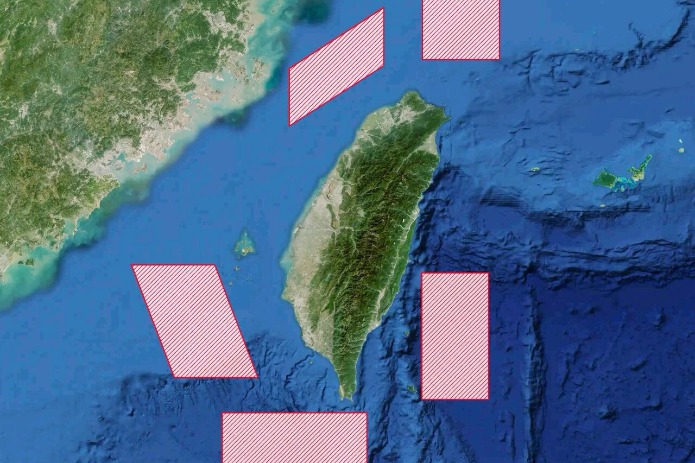
- PLA conducts major drill near Taiwan
- Washington should realize its interference in Taiwan question is a recipe it won't want to eat: China Daily editorial