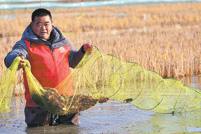
Agriculture, rural areas and farmers essential to national modernization







President Xi Jinping's festive greetings ahead of the eighth Chinese Farmers' Harvest Festival, which fell on Tuesday this year, were a clear signal that China regards food security as a core strategic issue. As rains, droughts and floods continue to test the country's agricultural resilience, Xi's message underscores both what has been accomplished and what remains to be done to ensure that its food bowl remains firmly in its hands.
The festival is the first national festival created specifically for the country's farmers. Initiated in 2018, the festival coincides with the autumnal equinox each year, which is one of the 24 solar terms of the Chinese lunisolar calendar. It usually falls between Sept 22 and 24 during the country's agricultural harvest season.
Despite natural disasters such as droughts and floods, China managed to secure a stable summer crop this year. The production of early rice increased, and yet another bumper grain harvest is anticipated. These achievements reflect that China has achieved basic self-reliance in staple grains, such as rice and other major cereals.
However, China remains a net food importer, especially of agricultural goods where domestic production is insufficient and demand exceeds domestic supply.
It is thus necessary to modernize both agriculture and rural areas to ensure food security. To that end, China must deepen its inputs in science, technology, equipment and policy to raise the overall agricultural production capacity and efficiency. And priority should be given to policies that strengthen agriculture, benefit farmers and enrich rural areas. This means enhancing agricultural R&D and widely adopting mechanization. The use of resilient seed varieties, improving water and soil management and disaster-response are also fundamental requirements to ensure that agriculture lays the foundation for social stability, modernization and national rejuvenation.
Furthermore, strengthening agricultural infrastructure is critical. A bumper harvest depends not only on the quality of seeds but also on the quality of farmland, irrigation facilities, water conservancy, pest control, storage and transportation and more. How prepared the farmland is, how good the irrigation and drainage facilities are, and availability of agricultural technology will all contribute to reducing losses and boosting efficiency.
But production is only part of the equation. The state of the rural economy is also important. Agriculture's modernization requires that processing, logistics, storage, commercialization, rural markets and value chains work better. Farmers' incomes must rise not just through higher yields but also through value added by downstream industries, rural enterprises and better market access. The goal is for agricultural modernization and rural vitalization to go hand-in-hand.
Equally important is protecting farmers' legal rights and interests. President Xi emphasized the need for policies that strengthen agriculture, benefit farmers and enrich rural areas. Legal protection — over land tenure, fair returns, contracts, access to inputs and redress for disaster losses — is essential. Without secure rights and shared benefits, farmers become vulnerable, and their eagerness to invest or adopt innovations could weaken.
Xi also linked agricultural modernization with efforts to build a beautiful and harmonious countryside — a place desirable to live and work in. This requires enhanced environmental protection, better public services, support for the local rural culture and improved living conditions. As China upgrades its agricultural capacity, it must also ensure that rural life improves, not just economically but socially, culturally and environmentally.
As Xi urged, multiple measures should be taken to boost employment and incomes for farmers, while advancing all-around rural vitalization.
By accelerating the modernization of agriculture and committing to protect farmers and rural life, China is demonstrating its resolve to make rural development and environmental harmony integral elements of its modernization. That is not only essential for China — it offers lessons to many countries seeking stable, sustainable food security in an unpredictable world.
Food security is multifaceted. It requires not just planting more grain, but also resilient infrastructure, better systems and stronger production chains, as well as improved welfare and protection of the rights of those working on the land. The integration of agricultural modernization with rural vitalization and building a beautiful countryside means that China's rural areas will not lag behind but become important contributors to the country's modernization.



Today's Top News
- China to apply lower import tariff rates to unleash market potential
- China proves to be active and reliable mediator
- Three-party talks help to restore peace
- Huangyan coral reefs healthy, says report
- PLA conducts major drill near Taiwan
- Washington should realize its interference in Taiwan question is a recipe it won't want to eat: China Daily editorial