Shanghai exhibition tells vivid stories of war heroes







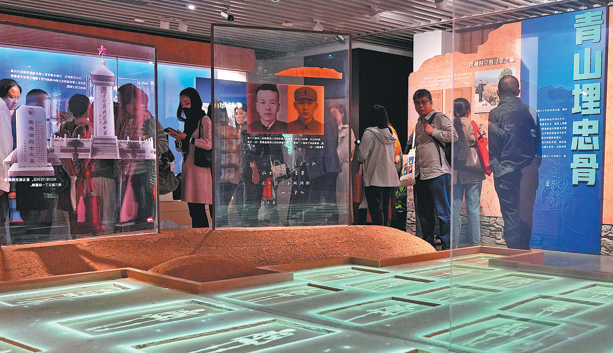
An exhibition featuring 362 artifacts unearthed from three provinces, shedding light on the life trajectories of war heroes through technological archaeology opened at the Memorial Hall of the First National Congress of the Communist Party of China in Shanghai on Monday.
To commemorate the 80th anniversary of the victory in the Chinese People's War of Resistance Against Japanese Aggression and the World Anti-Fascist War, the exhibition brings to life three war stories from battles that took place in Fangshan county in Lyuliang city, Shanxi province; Suning county in Cangzhou city, Hebei province; and Quanjiao county in Chuzhou city, Anhui province, highlighting the profound spirit and contemporary relevance of the great wartime efforts, according to the memorial.
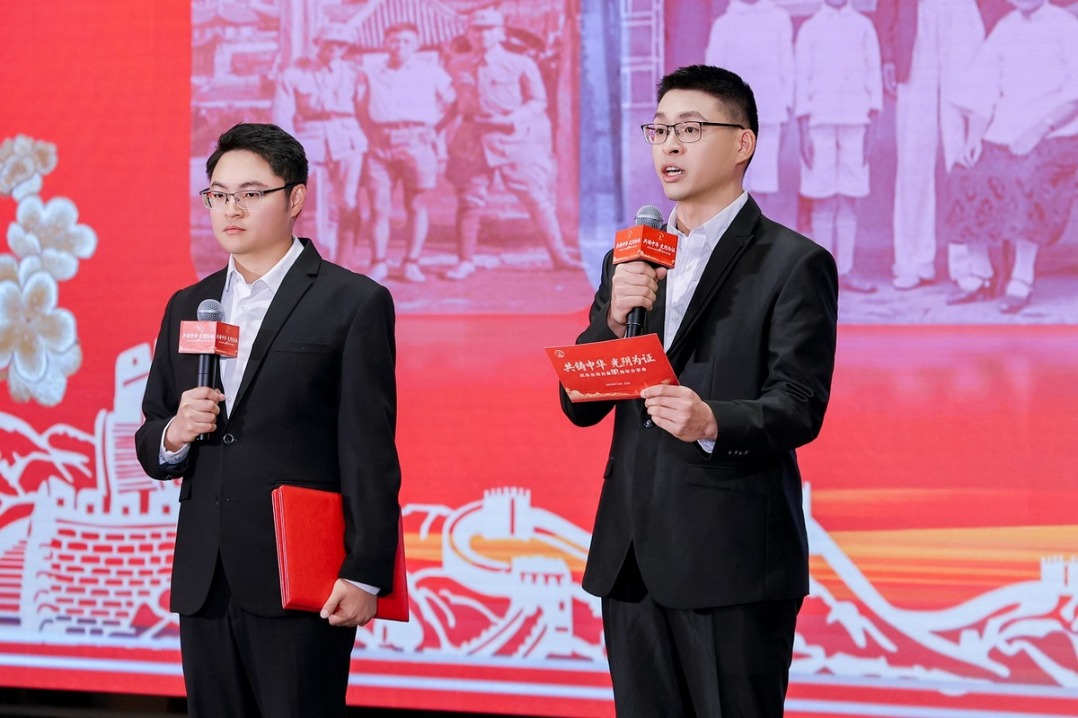
"This exhibition is unique as we chose a very small narrative angle to tell the stories, using ordinary yet great individuals to reflect the CPC's pivotal role as a cornerstone in the national resistance," said Qu Yutong, who works for the memorial's research department.
"Through technological archaeology, history acquires depth and technology gains warmth, allowing the great wartime spirit to be presented in a more tangible way," said Qu, who is also curator of the exhibition.
In a valley in Fangshan, the remains of 49 martyrs were uncovered. Evidence of bullet wounds, amputations and severe infections were found, revealing the brutal conditions and sacrifices of that time.
In the exhibition hall, the excavation site of the martyrs' graves has been recreated to scale using sand table models, complemented by technologies, such as holographic imaging and 3D printing, to witness the powerful process of the martyrs' stories coming to light.
In addition, modern technology has enabled some of these once-anonymous heroes to be identified. In 2022, a family member named Cui Yuqi traveled to Fangshan, fulfilling the wishes of his late grandmother and father to find his uncle, martyr Cui Haizhi. Ultimately, the remains labeled M19 at the village site were confirmed to be Cui Haizhi, and he was finally "reunited" with his family after decades.
Artifacts such as buttons, bullets, belts, bowls, iron spoons and toothbrushes were found in the graves. The deeds of Cui Haizhi after joining the army were also brought to light in a long poem penned by another martyr. The poem told the story of Cui's transformation on the battlefield from a new recruit who was frequently absent-minded to a strong revolutionary soldier.
Another part of the exhibition showcased artifacts from a battle in a village in Suning, where hundreds of soldiers and villagers were killed in 1942.
"After the war, villagers didn't bury the bodies of the martyrs, but instead laid them on door panels and reed mats. The mats and panels decayed over the more than 80 years, but the iron nails remained, weighing more than 15 kilograms," Qu said.
One martyr clutched a small round mirror with a photo of a young woman at the time of his death. The exhibition features both the original and color-restored images of the photo, which will assist in identifying the martyr and locating his family, the exhibition's organizers said.
In the immersive tribute space of the exhibition, which will run until December, a chestnut tree from the archaeological site in Quanjiao was used as a design reference.
"Through the 'tree of life' and the big numbers showing the military and civilian casualties during the war, the exhibition conveys the theme of the undying spirit, guiding visitors to reflect, remember and carry on the legacy," Qu said. "The earth beneath the tree comes from the three locations involved in the exhibition's stories."
The technological archaeology techniques employed come from Fudan University's molecular archaeology lab. Since 2015, a team led by Wen Shaoqing from the lab has dedicated its efforts to identifying the remains of martyrs and reuniting them with their families. The team has completed DNA tests on more than 1,600 suspected martyr remains and over 100 of their relatives.
"With the help of cutting-edge techniques, visitors to the exhibition can see how DNA identification gives names back to some nameless martyrs, how strontium isotope analysis traces their origins and journeys, how pathological trauma analysis reconstructs the brutality at the battlefields, and how craniofacial reconstruction brings their faces back across time," Wen said.
zhouwenting@chinadaily.com.cn