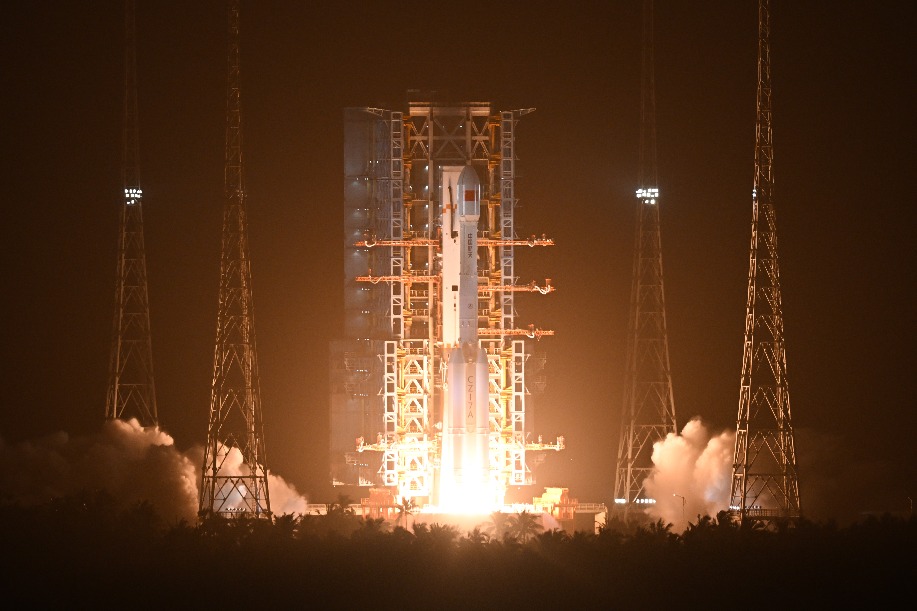
China boosts commercial space sector







The China National Space Administration has recently set up a new internal department to facilitate the development of the country's commercial space sector.
The establishment of the department of commercial space operations represents the first instance of a dedicated government agency being established for commercial space activities.
In addition to the new department, the administration has also published an action plan that lists work to be completed by the end of 2027 to foster the commercial space sector.
The action plan integrates the commercial space industry into the national space development strategy, aiming to achieve the commercial space sector's high-quality development by the end of 2027.
It outlines 22 key measures across five areas: boosting innovation, optimizing resource utilization, promoting the use of commercial products and services, improving management and government services, and strengthening full-chain safety supervision.
Next year will mark the 70th anniversary of the founding of China's space industry.
During most of the past seven decades, state organs like the CNSA and the Chinese Academy of Sciences and major State-owned contractors such as China Aerospace Science and Technology Corp controlled all of the country's space programs, ranging from rocket building to manned flights and lunar expedition.
However, private enterprises have risen over the past several years as a new force in China's space circle, largely as a result of favorable policies and concrete support from the government.
A number of private players have become involved in the satellite sector, generating huge demand for commercial launch services.
To date, five private Chinese companies: i-Space, Galactic Energy, Space Pioneer, LandSpace and Orienspace have conducted orbital launch missions with their own carrier rocket.
The latest news in the private space sector is that LandSpace, a Beijing-headquartered private rocket maker, plans to launch its first reusable rocket, the ZQ 3, in the coming weeks in a bid to catch up with private space company SpaceX, based in the United States.