'Oriental gem' makes wetland comeback
Years of conservation efforts pay off as crested ibises flourish once more in Yangxian







Editor's note: As protection of the planet's flora, fauna and resources becomes increasingly important, China Daily is publishing a series of stories to illustrate the country's commitment to safeguarding the natural world.
When only seven wild crested ibises were recorded in Yangxian county, Shaanxi province, in 1981, it was thought they were the last of their kind.
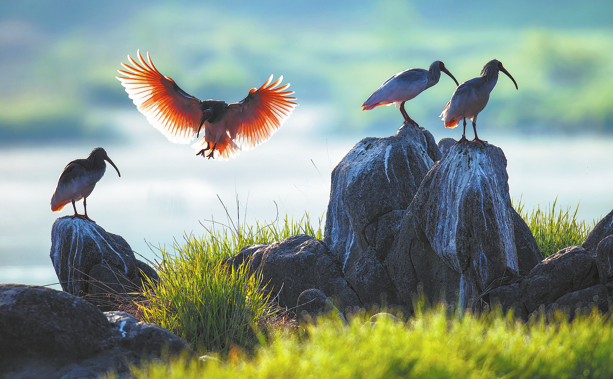
Immediate action was taken to save these long-legged wading "oriental gems" from extinction, and after years of conservation efforts, the formerly critically endangered bird species has a global population surpassing 10,000, with roughly 6,000 of them in Yangxian.
Crested ibises have a striking appearance, standing at around 75 centimeters, with a white to salmon-pink plumage, and a dense white crest sitting atop the head.
This significant achievement in conservation has come about due to the consistent efforts of local authorities to enhance in situ conservation for the species, according to Wang Chao, a senior expert with the Hanzhong Crested Ibis National Nature Reserve. Hanzhong is a prefecture-level area that oversees Yangxian.
Soon after the discovery of the seven wild crested ibises, local authorities introduced a slew of measures to protect the species, including banning blasting excavation and the use of pesticides and chemical fertilizers, Wang said.
He added that enhanced conservation measures were, and still are, implemented during the breeding season.
During this period, observation shelters are established, and continuous 24-hour monitoring is conducted to protect the birds from natural predators and human interference, he said.
These measures have significantly contributed to successful natural breeding, thereby directly increasing the population size of the species.
Thanks to the improved natural environment, many other endangered bird species once absent from the area, such as the white-tailed eagle and glossy ibis, have now made their appearance in Hanzhong, he said. Currently, the number of bird species that winter in Hanzhong stands at about 400, compared with the previous number of 300 before conservation efforts.
Wang said that the ongoing protection of the crested ibis in Yangxian has resulted in not only ecological benefits, but also social and economic gains.
The local organic agriculture industry has experienced rapid growth, he said.
Wang's remarks were endorsed by Hua Ying from Caoba village in Yangxian.
Crested ibises were a common sight for villagers prior to 1975, before the species gradually vanished from the village, according to the 54-year-old.
The bird showed up in the village again in 1993 when seven individuals were observed, he said. Now, the number of crested ibises that live around the village has jumped to roughly 700.
"Now we can sometimes even sight crested ibises when sitting at home," he said.
While the restriction measures for crested ibis conservation contributed significantly to the bird's population recovery, at first, villagers' living was greatly affected, he said.
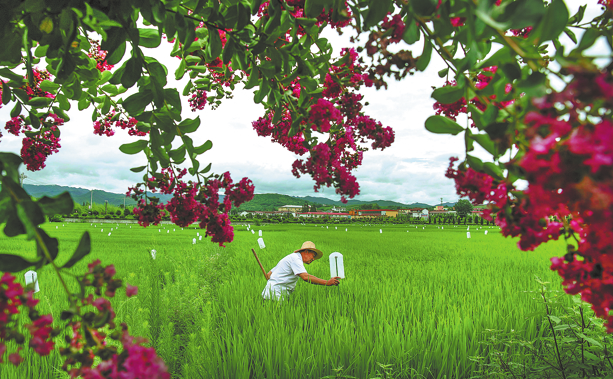
The avoidance of pesticides and chemical fertilizers, Hua said, not only caused a significant drop in agricultural output, but also resulted in produce with poor color and smaller grains, which in turn led to low market acceptance.
Against this backdrop, the National Forestry and Grassland Administration introduced two programs in Yangxian to help villagers benefit economically from crested ibis conservation: one focused on organic rice production, and the other on developing agritourism.
After years of practicing green farming without the use of pesticides and chemical fertilizers, many local farms meet organic standards, he said.
Hua said that he has witnessed the price of regular local rice rise from 2 yuan (28 cents) per kilo to 6 yuan and even exceed 20 yuan.
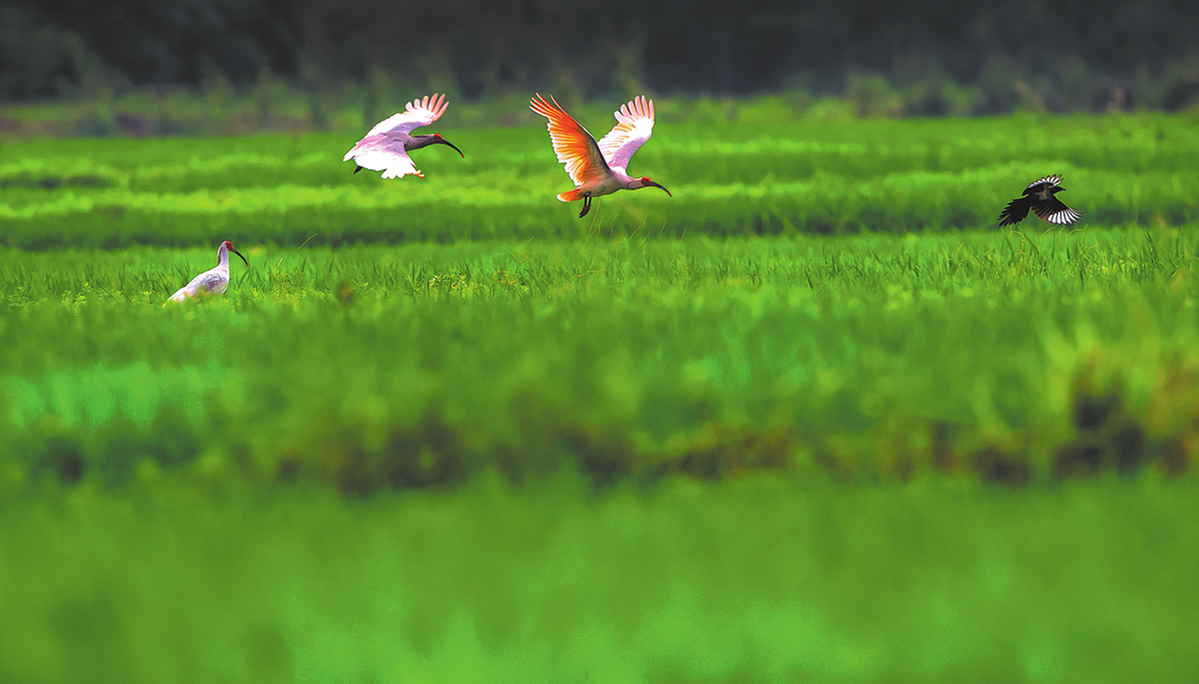
The villager said that while at first the growing crested ibis population attracted more tourists and provided villagers with income, there was an adverse impact on the birds themselves, as tourists sometimes approached them too closely for photos, disrupting their habitat.
In an effort to tackle this issue, Hua founded the Yangxian County Bird Watching Association in 2006. Beyond being engaged in direct conservation work, the association trained a team of tour guides specifically to facilitate responsible birdwatching.
He said these guides ensure that tourists keep a safe distance to avoid disturbing the crested ibises, while also instructing them on how to capture quality photographs.
Hua said bird-watching as a business can generate a fair amount of income. While guides are paid for their services, bird-watchers will spend on accommodation and meals. Many of them also buy organic agricultural produce when they leave.
The guiding fee for standard birdwatching groups is 200 yuan per day for up to four people and 300 yuan for five or more, Hua said.
For group study tours, however, a guide must possess a much broader range of knowledge, including knowledge of Yangxian's avian wildlife, natural landscapes, culture and history. These groups command a daily rate of 1,200 yuan, he added.
He said Yangxian welcomes at least 5,000 people who come to watch crested ibises annually.
"This has truly benefited villagers," he said.
The soaring crested ibis population, however, has created new conservation challenges. Staff at the Hanzhong Crested Ibis National Nature Reserve said they are put under "huge pressure" in their rescue and monitoring work.
In recent years, as the population of the species keeps expanding, the reserve now annually receives over 200 sick and injured crested ibises for treatment, said Zeng Jianwen, a ranger engaged in rescue work in the reserve.
Rescue efforts peak twice a year: from June to July and from December to February, he said.
The summer period involves fledglings from the current year who, due to their underdeveloped survival skills, often become malnourished from starvation. The winter months, however, bring harsh conditions that typically cause sickness and injury in older, weaker birds.
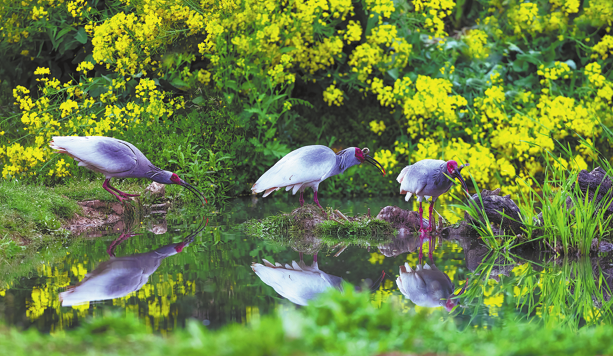
When necessary, sick or injured crested ibises are transported to the reserve's rescue station for treatment and rehabilitation. They are released back into the wild only after they have fully recovered and are deemed capable of surviving on their own.
Zeng said the rescue work is a pivotal part in crested ibis conservation and a key measure to maintain the long-term, stable development of the population.
"Moving forward, we will continue to refine our rescue and protection strategies based on accumulated experience, enhancing the survival adaptability and overall resilience of the crested ibis population, thereby facilitating the steady recovery of this endangered species," he said.
Wang, the senior expert at the reserve, said that the "huge pressure" he and his colleague face was highlighted in a recent two-month survey launched in August to determine the current crested ibis population.
While over 100 people participated, only about 30 were from the reserve, and the rest were mobilized from various sectors of society.
Their efforts to locate the birds' night roosting sites identified over 150 locations where at least five ibises gather, he said. These sites were used for further monitoring for a week in late September to determine group sizes and, crucially, the number of fledglings. This figure is vital as it indicates whether the wild crested ibis population is growing or declining.
He said that roosting sites with no more than four crested ibises are less significant for the monitoring work. However, they choose not to monitor these locations also because of a lack of personnel.
To overcome the shortage of monitors, they divided the 150-plus sites into several zones based on geographic proximity. Monitoring was then conducted zone by zone, Wang said.
Although monitoring itself only needed to begin at 4:30 pm and be completed before dark, the teams had to depart shortly after lunch, he said. A single vehicle would transport a group of monitors, dropping one off at each assigned location. This ensured that the last monitor could reach their remote site by 4:30 pm, as many sites are widely dispersed and accessible only by unpaved roads.
With the growth of the crested ibis population, he said, an issue of environmental carrying capacity saturation has emerged. This has forced the birds to disperse outward.
The Hanzhong Basin, where Yangxian county is located, is bordered by the Qinling Mountains to the north, posing a significant challenge to northward expansion, although dispersal in that direction has still occurred, he said.
Some of the birds have been found in Sichuan province in the south, Gansu province in the west and Ankang city, also in Shaanxi, in the east, he said. Ankang has become the primary dispersal area, and from there, the birds have expanded further to Shiyan in Hubei province.
While the natural dispersal continues, the country is also forging ahead with its efforts to release artificially cultivated crested ibises, in the hope of restoring the species' wild population, Wang said.
The crested ibis was once widely distributed in more than 20 provinces in China, as well as areas including Siberia and the Korean Peninsula. "Now that the population has reached a certain size, the country is implementing a reintroduction program to restore the species to its historical range," he said.
Wang said captive populations have been established in 13 provincial regions in China, and initiatives to introduce them into nature have been carried out in six of them.
"These efforts aim to promote the reestablishment of the bird's historical distribution and restore its migratory habits," he said.
houliqiang@chinadaily.com.cn