Veterans' war sacrifices never to be forgotten
China's victory over invasion inspires modern quest for peace, prosperity








Despite time blurring his memories, 96-year-old veteran Wen Yunfu is overwhelmed with emotion recalling his time resisting the Japanese invasion in the 1940s.
Born in a village in North China's Hebei province, in his childhood Wen witnessed the horrific behavior of Japanese invaders. He said the Japanese invaders came to his home village around 1937 and implemented the brutal "Three Alls" policy — burn all, kill all, loot all.
He joined the Eighth Route Army in 1945 and became a member of the Communist Party of China the same year. He was assigned to an arsenal in the province to manufacture hand grenades and firearms during the Chinese People's War of Resistance Against Japanese Aggression (1931-45), the main eastern battlefield of the World Anti-Fascist War.
"We were in hardships at the time with poor manufacturing conditions, thus we could only produce simple weapons to resist the Japanese invaders. I never would have imagined that our country would be able to grow into such a power when I was making firearms back then," he said.
Gently touching the military medals hanging from his chest, he said he is deeply delighted and proud of China's development, and cherishes the hard-won peace. "China now has a very powerful army, so we don't fear war. We ordinary people can live a good life in peace."
Resistance
On Sept 18, 1931, Japan meticulously devised and executed an accident in Northeast China, with Japanese soldiers blowing up a section of the Japanese-built South Manchuria Railway near Liutiaohu outside Mukden, or Shenyang as it's called today.
The Japanese laid the blame on the Chinese forces. The accident marked the start of imperial Japan's invasion of China and a prelude to the start of World War II in the Eastern Theater, according to the State Council Information Office.
Japan escalated the invasion of China into a full-scale one in 1937. On the night of July 7 that year, the Japanese troops, who were conducting military exercises near Lugou Bridge, or Marco Polo Bridge, asked to enter Wanping county, a former county of Beijing using the excuse of looking for a missing Japanese soldier. The Chinese forces refused the demand and the Japanese launched an attack, shelling the county. The whole country then engaged in a war of resistance.
From 1931 to Japan's unconditional surrender on Aug 15, 1945, Chinese forces and civilians paid a heavy price in blood. Among the innumerable resistance battles the Chinese forces undertook against the Japanese invasion, the Hundred Regiments Offensive by the Eighth Route Army, led by the CPC, is one of the most heart-stirring and morale-boosting battles.
The Hundred Regiments Offensive Memorial Hall stands at the peak of Shinao Mountain in North China's Shanxi province. From Aug 20, 1940, to Jan 24, 1941, the Eighth Route Army initiated a tactical campaign against the Japanese invasion in North China involving 105 regiments.
The military operation was the most extensive and protracted offensive by the Eighth Route Army in the war, according to Xinhua News Agency.
Zhang Weiping, deputy director of the Party history research office of Yangquan city, told Xinhua that the country faced great danger and hardships against the Japanese at the time.
The country suffered successive defeats, and pessimism and arguments undermined the morale of the military and civilians. The Japanese imperial army also implemented the "prison cage policy" by establishing a system of railways, roadways and fortified positions to obliterate the Eighth Route Army's foundation, Zhang said.
According to Xinhua, the Eighth Route Army took part in 1,824 battles in cooperation with local armed forces and civilians from Aug 20 to Dec 5, 1940, during the period of the Hundred Regiments Offensive. These battles killed over 20,000 Japanese soldiers and 5,000-plus troops of the Japanese puppet regime.
A large number of Japanese strongholds and positions were annihilated by the Eighth Route Army during these battles, weakening the Japanese and boosting the confidence and morale of Chinese forces and civilians.
"Several major battles like the Hundred Regiments Offensive (in North China) and the three Battles of Changsha in Hunan province (1939-42) were successes in the then gloomy situation of the World Anti-Fascist War, which were heartening and inspiring to the anti-fascist alliance and peace-loving people at the time," said Zhai Jiaqi, a researcher from the Institute of Party History and Literature of the CPC Central Committee.
Inspiring victory
With Japan unconditionally surrendering on Aug 15, 1945, the victory has had far-reaching significance to the Chinese nation and people, with the unyielding spirit, perseverance and courage remaining in modern times. For Chinese people, the war is worth remembering, and martyrs and civilians who were brutally killed in the war should be commemorated and honored, as their sacrifice contributed to the Chinese people winning their peace and dignity.
"The Chinese People's War of Resistance Against Japanese Aggression was the earliest and longest war in the World Anti-Fascist War, during which the Chinese people made great sacrifices," said Hu Heping, executive deputy head of the publicity department of the CPC Central Committee, at a news conference in Beijing.
He said that based on partial figures, over 35 million Chinese soldiers and civilians were killed or injured during the war. The conflict cost direct economic losses of about $100 billion and consequential losses of over $500 billion in today's money, he said, adding that the battlefield in China had tied down and hit the principal forces of the Japanese army, with over 1.5 million Japanese soldiers killed.
"China has paid the price in blood, but won a splendid victory. We should remember the history, commemorate martyrs and innocent civilians who lost their lives in the war. Remembering the war lets us Chinese people cherish peace, but not be afraid of aggression. The world will be prosperous with sustainable development in peace, and people of the world will live in happiness," said Ji Jianliang, director of the publicity and education division of the Party History Research Office of the CPC Changsha Committee.
Zhao Xueqing, niece of war martyr Zhao Wei, who lives in Yangquan city, Shanxi province, said "hero" is not just a word for books, but one to describe her uncle who sacrificed his young life in the war against Japanese invasion. "I think my uncle valued national dignity and victory over his own life. In modern life, we do not face the flames of war, but we should take social responsibility while pursuing our own dreams," said the 59-year-old, adding that her uncle's patriotism and dedication to the nation will always inspire her and remind her of cherishing peace.
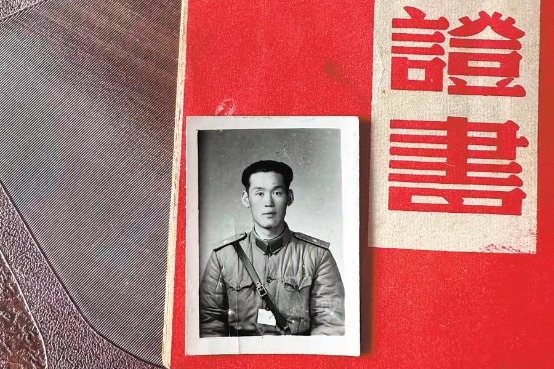
Unfolding the certificate of martyr Xie Hanwen, 32-year-old Zhang Ruowen, great-granddaughter of Xie, expressed her wish for world peace. She lives in Leiyang city, Hunan province.
"The peaceful life we have was won through the blood of martyrs and the Chinese people in the war," she said. "I hope the world's conflicts can be settled through dialogue and communication. And as a young citizen of modern China and a member of the Communist Party of China, I wish to give positive energy to the people surrounding me."
chengsi@chinadaily.com.cn




- Veterans' war sacrifices never to be forgotten
- China's new-generation Qingzhou cargo spacecraft set for maiden flight next year
- Chinese scientists use allergy-like immune response for cancer therapy
- Marine ecology off South China's Hainan Island remains favorable, report says
- Beijing to see first major snow of the season
- Fire-hit homeowners to get HK$100,000 subsidy