Wondrous Xinjiang: High on the plateau, guardians keep watch over pristine wilderness







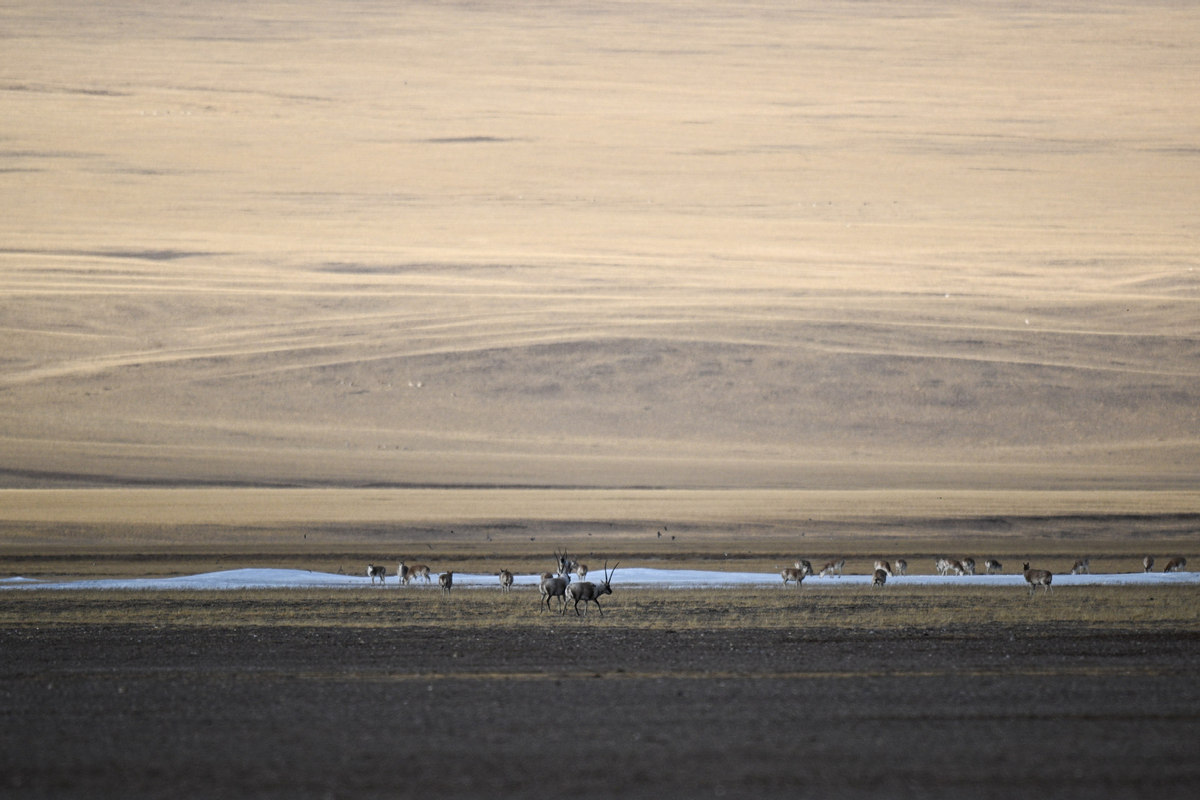
URUMQI -- Before dawn breaks over the no-man's land, a patrol team is already on the move to ensure protection of one of China's most remote and ecologically vital sanctuaries.
Shang Peng, leader of the team and head of the publicity and education section for the Altun Mountain National Nature Reserve Administration, drives across the familiar high-altitude meadow as the first light touches the horizon. At nearly 4,800 meters above sea level, the air is bitingly cold.
"The grass here is excellent. We should see Tibetan antelopes soon," he said. True to his prediction, faint shapes soon emerge in the distance, moving across the barren landscape and stirring up dust.
"The ones in front are Tibetan antelopes, with wolves following behind," Shang said, his eyes sharpened by a decade of experience in this vast wilderness.
This is the Altun Mountain National Nature Reserve, a 45,000-square-kilometer haven situated in the southeastern corner of the Xinjiang Uygur autonomous region, northwestern China. Averaging 4,580 meters in elevation, it connects with the Hoh Xil National Nature Reserve of Sanjiangyuan National Park in Qinghai and borders Xizang's Changtang National Nature Reserve to the south.
"Our primary task is to protect the plateau ecosystem and its iconic ungulates, such as the wild yak, Tibetan wild ass, and Tibetan antelope," explained Gong Junsheng, deputy director of the reserve administration.
Established in 1983, the reserve is managed by a team of about 70 people. It is a land of stark contrasts and rich biodiversity, featuring one of the world's highest deserts, ancient karst formations, alpine lakes, and volcanic landscapes.
The reserve now serves as a crucial gene bank, hosting 17 species under top-level state protection, 338 species of wild animals, and 387 species of plateau plants. Among them, the Tibetan antelope, often called the "plateau elf," is a conservation success story.
Early December marks their mating season. Shang's team is out to observe wildlife and conduct routine inspections. Not far away, groups of antelopes chase one another in spirited courtship displays. "Terrific. We estimate around 8,000 in this area alone," Shang said, carefully documenting the scene with his camera.
Since 2010, the Tibetan antelope population here has roughly doubled, now exceeding 65,000. The wild yak count stands at approximately 12,000.
Hundreds of kilometers to the east, on the fringes of the Kum Kol Desert — one of the highest deserts on Earth — herds of wild yaks gather to drink from giant sand springs, which well up from the ground like massive natural funnels.
Protecting this land with a rich diversity of species, which also includes snow leopards, black-necked cranes, and Tibetan brown bears, is a formidable challenge. The rangers speak of the animals with intimate knowledge, yet play down the brutal conditions they endure as oxygen levels drop to barely half those at sea level, blizzards strike without warning and temperatures plunge to minus 40 degrees Celsius.
"The terrain is complex and distances vast. In summer, marshes can turn travel to distant stations into a journey of several days," said Tomurbatu, head of a reserve inspection station.
To meet these challenges, the administration has built a comprehensive management system combining fixed posts, seasonal patrols, and mobile teams. They have increased patrols, deployed infrared cameras and drones, and dissuaded hundreds of attempted illegal entries.
For rangers like Erkin Jume, who patrols over 400 kilometers daily, the improvements are tangible. "We see more wildlife every year," he said. "Before, we slept in tents or cars. Now, with better-equipped stations, the reserve feels like a second home."
These efforts are part of a broader push for green development and biodiversity conservation in western China, supported by strengthened policies and planning.
The reserve administration has invested significantly in infrastructure, including a preliminary patrol road network. Future plans focus on enhancing scientific research and monitoring to ensure this high-altitude sanctuary continues to thrive for generations to come.




- Wondrous Xinjiang: High on the plateau, guardians keep watch over pristine wilderness
- Ningxia students recreate masterpiece with paper-cutting
- China's railway network hits record 4.28 billion trips
- HK blasts 'despicable' Western smears after Jimmy Lai verdict
- Shanghai, New York deepen partnership at river-themed dialogue
- Teen donates to preserve war truths in Nanjing