Breakthrough in BMI tech aids patients
Trial participants control robotic dog, power wheelchair by thought alone







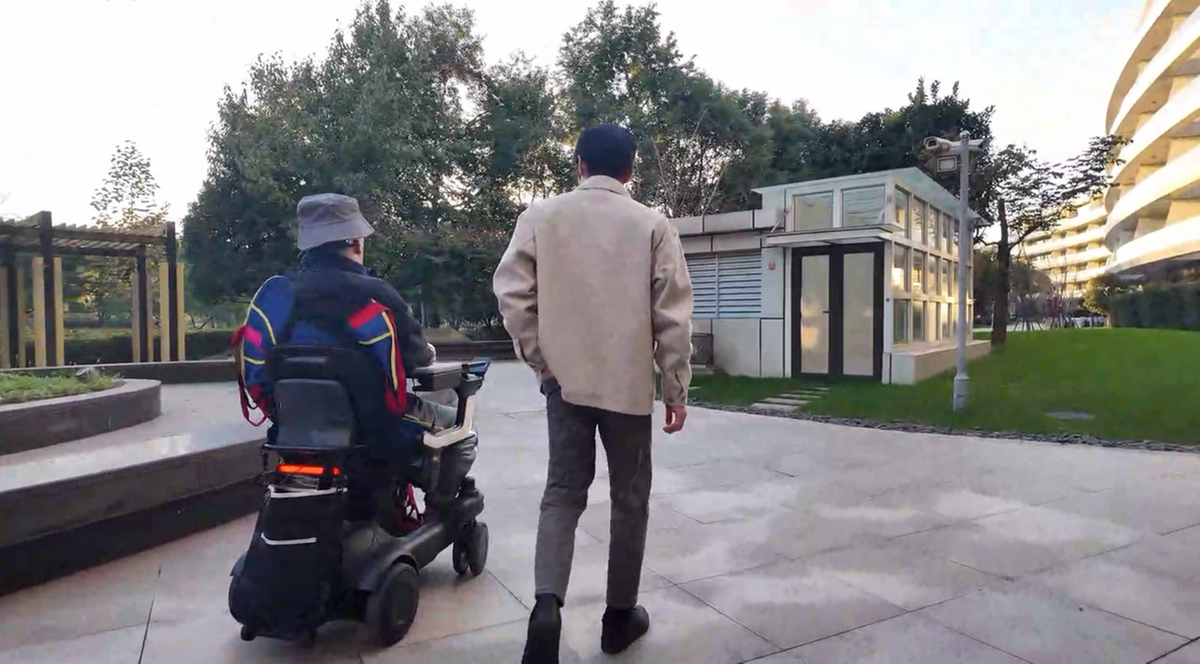
Two Chinese patients with high-level paralysis have successfully used brain-machine interface technology to perform tasks using only their thoughts, including controlling a power wheelchair, directing a robotic dog to retrieve deliveries, and operating a robotic arm to grasp a cup and drink water.
The achievements were announced on Wednesday at a media briefing held by the Center for Excellence in Brain Science and Intelligence Technology of the Chinese Academy of Sciences in Shanghai.
The patients, both in their 30s, received BMI system implants developed jointly by the center and a corporate partner in June and October, respectively.
According to the research team, this marks the first time globally that a power wheelchair and a robotic dog have been controlled solely through thought. The robotic arm used in the trials is a cost-effective model, in contrast to the more expensive systems developed by companies such as Neuralink, owned by tech billionaire Elon Musk. The project aims to promote large-scale applications for people with disabilities and other users.
Compared with the research team's first BMI implant case in March, whereby a patient controlled a computer cursor to play video games, the new cases represent a major advancement. The patients are now interacting with the physical world in three dimensions, enabling levels of self-care, employment and social participation that were previously unattainable.
One of the patients is now working as an intern product sorter, using brain control to participate in online data annotation by verifying the accuracy of artificial intelligence systems used in vending machines.
"Our research is advancing BMI technology toward practical clinical applications," said Zhao Zhengtuo, a leading scientist on the research team, which includes researchers from the CAS center, Shanghai Huashan Hospital and an industry partner. "With an open mindset, we are collaborating with various smart devices and application platforms to jointly promote cutting-edge BMI innovation in our country."
One of the patients suffered a spinal cord injury from a fall in 2022 that resulted in paralysis. After receiving the BMI implant in June and undergoing two weeks of training, he was able to control electronic devices such as computer cursors and tablets. Seeking to move beyond virtual control and interact physically with the world, he prompted the team to expand applications to power wheelchairs and robotic dogs.
The expansion required multiple technological breakthroughs, including high-fidelity neural data compression and a hybrid decoding model capable of extracting useful signals in noisy environments. Researchers also addressed challenges related to "cross-day stability" by using neural manifold alignment to maintain reliable decoder inputs despite environmental noise and physiological fluctuations.
Speed is a critical aspect of the technology, researchers said. By customizing communication protocols, the team reduced the end-to-end delay from neural signal acquisition to command execution by external devices to under 100 milliseconds — faster than the body's natural neural delay — creating a seamless control experience.
The patient who controls a power wheelchair with his thoughts described the experience as intuitive, similar to controlling a video game character without consciously thinking about joystick movements.
The implants were inserted through a 5-millimeter cranial puncture, the smallest reported globally. The implant itself is also the world's smallest, about half the size of Neuralink's device.
Poo Muming, an academician with the Chinese Academy of Sciences and scientific director of academics at the CAS center, said all three patients involved in the trials remain in good health following rigorous ethical and technical reviews.
"Future goals include achieving finer control, such as playing the piano with mind-controlled fingers," Poo said.
Zhao said he hopes the implant procedure will eventually become as simple and minimally invasive as an ear piercing, expanding access to a broader patient population and opening the door to nonmedical enhancement applications.
"We expect costs to be highly affordable, similar to purchasing an electronic product," he said.
The team anticipates scalable applications for restoring motor and language functions within three years, breakthroughs in sensory restoration and regulation of neuropsychiatric disorders such as Parkinson's disease and depression within five years, and highly minimally invasive systems enabling both medical and consumer uses within a decade.
zhouwenting@chinadaily.com.cn







- Breakthrough in BMI tech aids patients
- Xinjiang invests heavily in water conservancy project construction
- Experts: Lai not freedom fighter, but a pawn of the West
- China planning to raise age limit for blood donors, shorten the minimum interval
- Breakthrough in BMI tech aids patients
- Chinese technique for making ultrathin metal films named top 10 scientific breakthroughs