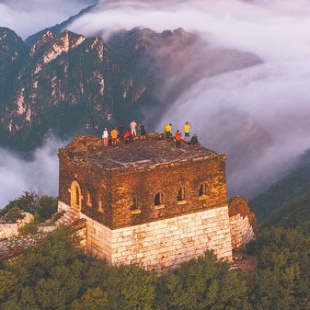



Life and labor revealed at Jiankou Great Wall
Excavation work at watchtowers unearths weapons, inscriptions and food remains, offering insights into the daily routines of Ming-era garrisons, Yang Feiyue reports.








Though half-collapsed, its central chamber surrounded by a corridor remains. Among its debris lay a cast-iron cannon from the fifth year (1632) of the last Ming Emperor Chongzhen's reign.
The cannon measures 89.2 cm long, with a caliber of 8.5 cm and a barrel depth of 73.5 cm, weighing approximately 112 kilograms. Inscriptions, though corroded, are still legible.
"This is the first large firearm unearthed at Jiankou," Shang says.
"It not only provides crucial evidence for studying Chinese cannon-casting technology but, more importantly, shows clear characteristics of Western-style 'red barbarian' cannons — a smaller caliber and longer barrel. This is significant material for studying the exchange of Sino-Western military technology," he explains.
Matching the cannon's dimensions to existing artillery platforms on the wall confirmed it was operational equipment for the defenders.
If architecture and weapons form the Great Wall's "skeleton", the most significant finds have come from archaeobotany, revealing its "flesh and blood".
Using flotation of the earth from the watchtowers' hearths — where soil from the hearths is mixed with water to separate the lighter ash and burnt seeds from the heavier materials — researchers yielded a trove of carbonized plant remains, and lab analysis later identified nine types of crops and 25 wild species among them.
"These seeds allow us to reconstruct life on the Jiankou Great Wall," Shang explains.
First, they reveal the garrison's diet, which primarily comprised wheat and millet from local dryland farming, supplemented by diverse legumes and other grains, showing a rich and adaptable food structure, he says.
Second, analysis of charcoal indicates fuel sources like pine and chaste trees, reflecting the local environment and use of resources.
The medicinal herbs point to healthcare strategies for trauma, chronic illness, and disease prevention, shedding light on the complexity of Ming military logistics and medicine.
The findings illustrate the resilience and complexity of the frontier military economy, Shang says.
Additionally, radiocarbon dating of the crop remains indicates continuous human activity and cooking at the site from the late Ming through the mid-to-late Qing Dynasty (1644-1911).
"This addresses a common question about the Qing attitude toward the Great Wall," Shang points out.
"The general belief is that the Qing did not maintain it, leading to its abandonment. But here at remote Jiankou, people were still living and using these structures well into the mid and even late Qing period. This extends our understanding of the Great Wall's active timeline."
Complementing the plant evidence are animal bones from Watchtower 117, featuring 53 specimens from animals, such as donkeys, pigs, cattle and roe deer. Cut marks from butchery on 22 of the bones indicate they were food waste.
"The animal bones show the garrison's menu included not just domesticated animals but also wild game, likely hunted locally," Shang says, suggesting meals of stews or perhaps even roasts over a fire.
This project represents a significant shift, fully integrating archaeological research with heritage conservation from the outset, cultural heritage officials say.
The Jiankou Great Wall is one of Beijing's significant archaeological achievements in recent years.
Over the past five years, more than 400 archaeological excavation projects have been carried out in the Beijing area, covering a total area of over 400,000 square meters, says Liu Zhengpin, an official from the Beijing Municipal Cultural Heritage Bureau.
Important archaeological findings have been made, which have substantially enhanced the academic influence and public engagement of Beijing's archaeological work.
Liu emphasizes that the principle of "conservation first" must be consistently upheld, and calls for systematically developing and improving the framework for the protection of underground cultural relics, strengthening exchanges and mutual learning among civilizations, fostering cultural confidence, and effectively enhancing the reach and influence of Chinese civilization.
Shang believes that putting archaeology at the forefront helps deepen the preliminary investigation for the conservation project and thus provides a solid scientific foundation for targeted preservation measures.
"This seamless integration of excavation and conservation minimizes disciplinary gaps and allows for more effective protection of the Great Wall site," he says.