Researchers tame wild mushroom in Yunnan







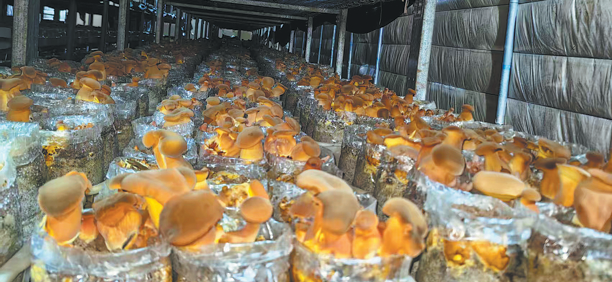
A mushroom long prized in Southwest China, but feared for its potential toxicity, is being grown safely and at scale, marking a breakthrough for both food safety and rural incomes.
The lurid bolete, known locally in Yunnan as jianshouqing, is a boletus mushroom that is famous for turning blue when bruised and oxidized. While some varieties are edible, others are toxic, making accidental poisoning a recurring concern during wild mushroom season.
Researchers at the Kunming Edible Fungi Research Institute have successfully cultivated a non-toxic variety, offering consumers a safer alternative to foraged mushrooms. The edible strain, Buchwaldoboletus xylophilus, has been verified as nontoxic by Ningbo Customs, an independent testing authority in this field, according to Zhang Junbo, an associate research fellow at the institute, which is part of All China Federation of Supply and Marketing Cooperatives.
"Jianshouqing is a general term for several boletus mushrooms in Yunnan," Zhang said. "Some are edible, some conditionally edible, and some poisonous. The variety we have selected and cultivated is confirmed to be safe."
Beyond safety, Zhang said the cultivated mushroom closely matches its wild counterpart in nutritional value, taste and aroma, a key factor in winning over consumers accustomed to the wild variety.
The scientific advance is moving from the lab to the market. In April, the institute signed a technology transfer agreement with a local company in Wenshan Zhuang and Miao autonomous prefecture, providing expertise in variety breeding, genetic markers for intellectual property protection, and high-yield cultivation techniques.
The company is building 10 greenhouses capable of producing mushrooms year-round, alongside eight seasonal greenhouses that will operate between April and October. Large-scale production is expected to begin by the end of December, according to Wang Xiangfei, chairman of Wenshan Dianzhen Mushroom Industry Co.
Each greenhouse is expected to yield 3.4 metric tons per crop cycle, with total annual output projected at about 360 tons, far exceeding the unstable and seasonal yields of wild mushrooms, he added.
Artificial cultivation also breaks a key constraint of the wild market. Fresh wild lurid bolete are typically available only from July to October, while cultivated mushrooms can be supplied throughout the year, Zhang said.
For farmers, the shift carries significant economic implications. High-value mushrooms like lurid bolete have short growth cycles and high profit margins, making them more lucrative than many traditional crops, he added.
Wang's company operates its own cultivation base while supporting nearby farmers, supplying mushroom bags free of charge and purchasing the harvest at pre-agreed prices. Small batches grown by farmers have already been sold to Kunming's main wild mushroom trading market, where demand exceeded supply.
Local agricultural officials said the model offers a new pathway for rural development. Chen Jinyue, a senior agronomist with Wenshan's agriculture and rural affairs bureau, said cultivated lurid bolete can deliver incomes several times higher than conventional farming.
Beyond fresh sales, Chen said there is potential to develop processing industries such as drying, pickling and mushroom sauces, supporting related sectors including packaging, logistics and e-commerce.
Large-scale cultivation could also create local jobs in harvesting and processing, encouraging migrant workers to return home, while opening the door to mushroom-themed agricultural tourism, he said.
What was once a seasonal delicacy with hidden risks is now becoming a controlled, year-round industry, reshaping both how the mushroom is eaten and how it supports rural livelihoods.
Contact the writers at yanyj@chinadaily.com.cn