Human-centric AI evolution







Hybrid solutions can provide effective ways to make technology safer and more inclusive
The "AI+" initiative, a cornerstone of China's upcoming 15th Five-Year Plan (2026-30), calls for the deep integration of artificial intelligence across all industries. As an AI tech company, we are striving to make AI accessible to everyone and ensuring it benefits all of the society.
Public large language models offer vast knowledge, but their reliance on the cloud raises inherent privacy and data security concerns. With rare access to private data on personal devices or corporate networks, these models often struggle to fully grasp users' needs. In this sense, public AI alone is insufficient to drive broad adoption.
A fascinating solution is Hybrid AI, which integrates cloud-based public AI with private AI — models deployed locally on devices, edges or in private clouds. This approach leverages the strengths of both: the vast knowledge of public AI and the security and personalization of private AI, which learns from local data. We believe this hybrid model is the most effective path to democratizing AI.
Individuals can access Hybrid Personal AI from an entry point on their multiple devices, such as PCs, tablets, smartphones, glasses, pins and even rings. These AI-native devices, equipped with locally deployed AI models, connected to an open application ecosystem, are supported by heterogeneous computing, while ensuring user privacy and data security. Moreover, a Personal AI Super Agent can orchestrate across wearable and ambient devices to "see what you see, hear what you hear and memorize what you have experienced".
Hybrid Personal AI leverages portable devices and personal trusted computing hubs, using personalized algorithms and models to continuously learn from users' habits and anticipate their intentions. This allows it to "think as you would think, and act as you would act", and ultimately become a Personal AI Twin.
In Hybrid Enterprise AI, data and knowledge are imperative. Leveraging the computing power of hybrid AI infrastructures, enterprise AI initiatives are expected to start by collecting various types of data from within companies, reorganizing into professional knowledge, and using AI models and agents to turn the data and knowledge into insights, outcomes or more intelligent business processes. Enterprises can then crystallize these into repeatable, scalable solutions for horizontal functions and vertical industries, where domain agents can be developed. What's more, there will also be an Enterprise AI Super Agent that can orchestrate all the domain agents and ultimately evolve into an Enterprise AI Twin.
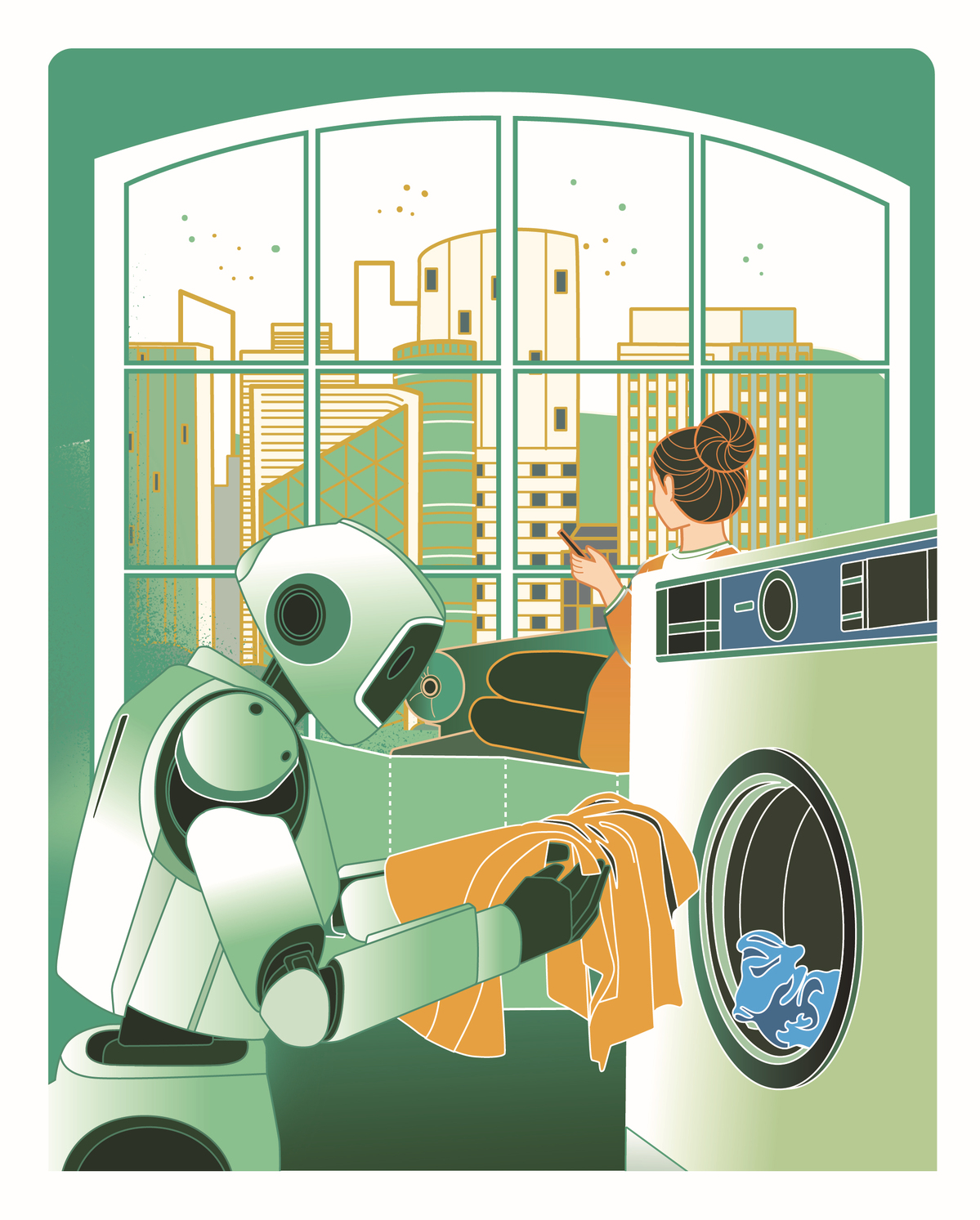
The innovation of large language models extends far beyond creative tasks such as generating images and videos. More profoundly, it is restructuring human-AI interaction. AI agents, powered by large language models, can now proactively assist or even replace humans in completing tasks, fundamentally shifting the relationship with technology from "humans adapting to machines" to "machines serving humans".
In this new paradigm, devices will no longer be isolated. A personal AI Super Agent will integrate them into a human-centric collaboration network. This will not only change how we use AI devices but also restructure entire industries, to unlock significant growth potentials.
For businesses, as general AI becomes an intelligent foundation, transformation will shift from piecemeal solutions to a holistic restructuring of the entire value chain. Human-AI collaboration is the new normal. Lenovo has already deployed internal AI agents across sales, research and development, and supply chain management. The Enterprise AI Super Agent, "Lenovo Lexiang", provides services from consulting to customer support. Since its launch, the super agent has not only improved employee efficiency but also increased our order conversion rate in China by 30 percent, showing AI can be a powerful driver of business growth.
The "AI+" transformation is fundamentally different from the "Internet+" era of a decade ago. While the internet is about "connectivity" — creating data footprints of both humans and machines to improve resource allocation efficiency — AI is about "human-centricity", with machines acting as cognitive entities that can decide and execute to serve human's needs.
This new human-machine relationship is a double-edged sword. On one hand, it's a powerful new productive force because AI offers enormous efficiency, freeing people from mundane, inefficient work to focus on more creative pursuits. On the other hand, it also brings new risks and challenges such as privacy breaches, AI-generated fakery and fraud. In addition, uneven access to AI could also widen the digital divide, exacerbating social and economic imbalances.
This new era demands a new perspective. The critical question for governments, businesses and individuals is how to maximize AI's benefits while minimizing its harms. We must foster innovation while effectively managing risks to ensure AI is safe, inclusive and fundamentally good.
It is our responsibility to champion "Human-Centric AI", which means designing AI to serve human needs, respecting ethical and legal boundaries, and democratizing access. AI should not only drive economic growth but also support disadvantaged groups and promote sustainable development. By aligning technological goals with human-centric values and building a robust system of governance through multiparty collaboration, we can transform a "technology community" into a "community of values".
Only by making human-centric intelligence the cornerstone of innovation can we ensure the surging tide of AI nourishes prosperity, rather than floods our civilization. To this end, Lenovo established a Responsible AI Committee in 2022 and, in November 2024, launched a "Human-Centric AI Development and Governance Initiative", which now has 50 partners, including renowned tech companies and universities.
We will continue our commitment to advancing this initiative and more partners are welcome to participate. By working together to build "Smarter AI for All", we can unleash the full potential of human-AI collaboration and secure a brighter, more sustainable future for humanity.
The author is the chairman and the chief executive officer of Lenovo Group. The author contributed this article to China Watch, a think tank powered by China Daily.
The views do not necessarily reflect those of China Daily.
Contact the editor at editor@chinawatch.cn.