|
|
 |
 Raymond Zhou:
By jingo, they're mad!  Op Rana:
Consumerism and politics of waste   Ravi S. Narasimhan:
Lessons from SARS have to be applied  Alexis Hooi:
Beyond the death and destruction  We've come a long way, still miles to go
(China Daily)
Updated: 2008-12-19 07:47
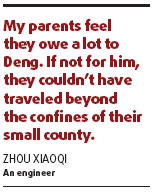
They were paying respect to the man who led them out of poverty and helped the country rise like a phoenix. Exactly 30 years ago, the Party decided to launch its reform. Deng, the main drive behind that decision, has since been called the "chief architect" of the country's reform and opening up. "My parents feel they owe a lot to Deng. If not for him, they couldn't have traveled beyond the confines of their small county," said Zhou Xiaoqi, a 28-year-old engineer. His parents have traveled from their Hubei province home to spend the winter with Zhou, working for a hi-tech firm in Shenzhen for the past four years. Born in the early 1980s, Zhou knows little of the seclusion and shortages of products his parents still talk about. But he said: "I do remember meat was a luxury when I was a kid. We used to save the best stuff for guests or festivals." Today, like many office workers his age, Zhou enjoys dining out with friends and singing at karaoke bars. As one of the four special economic zones Deng decided to set up in 1979 to drive forward reforms, Shenzhen has been transformed from an obscure fishing village to a gleaming metropolis. It is now seen as a window to China's economic reform.
From rags to riches Xu Shenqiu used to be a teacher in Shandong province when China ushered in the reform and opening up. In the late 1980s, he followed his friends into business, and within a few years he had amassed a fortune by running a department store in Jilin province. Now Xu, 54, and his wife are on a two-week trip to Antarctica. "Perhaps this is my parents' unique way of celebrating 30 years of reform and opening up," said their daughter, Xu Yuan, 27, a student of journalism at Japan's Doshisha University.
"When my father started, he was just dreaming of a more exciting life. But he ended up with a much bigger fortune than he could have imagined," she said. Journey ahead But there are people who still have to struggle for a living despite the rapid economic growth, especially because the global financial crisis has dealt a big blow to China's exporters and manufacturers. Wang Gang, 22, had to return home in a rural area of Henan province in October because the electronics firm he used to work for in Shenzhen closed. Usually, he would have returned during Spring Festival loaded with gifts for his family. But this time, he was forced to return empty handed because his wages had been cut in half. "My pay used to be at least twice of what I made from farming. I even bought my father a motorbike last year." In Wang's home county of Zhengyang, his six-member family grows crops on 0.3 hectare. "Even if we plant gold, our income would at best be meager." The wide income gap between the rich and the poor and urban and rural residents, along with building in capability of withstanding financial risks and achieving sustainable development will continue to pose a challenge to the country for years, said Liu Yunxian, a researcher with the Executive Leadership Academy in Shanghai's Pudong. "In decades to come, there's a lot China needs to do to maintain fairness and social harmony and improve people's livelihood," he said. "The reform and opening up have brought China's 5,000-year-old civilization to a new height, but this is not the end." 
|
主站蜘蛛池模板: 淳安县| 安岳县| 原平市| 定日县| 喀喇沁旗| 廉江市| 舞钢市| 南川市| 西华县| 开化县| 德惠市| 弥渡县| 济宁市| 靖远县| 平定县| 惠安县| 易门县| 和龙市| 安乡县| 郴州市| 湖州市| 噶尔县| 莱西市| 文山县| 临夏市| 南汇区| 焉耆| 南华县| 张家界市| 灵丘县| 刚察县| 伊吾县| 城固县| 汝南县| 商城县| 辉南县| 镇赉县| 来安县| 武川县| 西安市| 湛江市| 乐陵市| 平陆县| 临汾市| 宜丰县| 中阳县| 额敏县| 阜康市| 新宾| 广丰县| 阜城县| 阳高县| 荥经县| 拉萨市| 石楼县| 南昌县| 张掖市| 宜都市| 班戈县| 姜堰市| 韶关市| 旺苍县| 福海县| 南宁市| 那曲县| 高密市| 沛县| 唐海县| 苍山县| 赫章县| 兴隆县| 巴南区| 马龙县| 裕民县| 柳河县| 浦城县| 胶南市| 渝中区| 绿春县| 景德镇市| 屯昌县| 兴和县|