Economy
Rural-urban healthcare gap to be stitched up
By Shan Juan (China Daily)
Updated: 2010-12-09 15:58
 |
Large Medium Small |
|
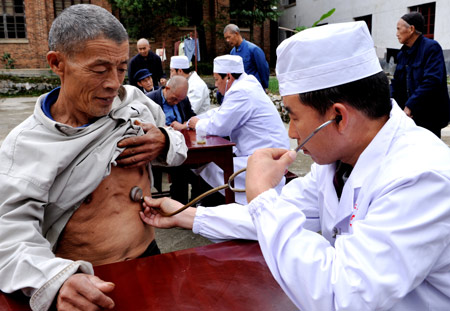 |
| Medical personnel from Gaosha Township Central Hospital in Dongkou county, Hunan province, conduct medical checkups for residents of the township's suburbs on Oct 20. [Photo/China Daily] |
ZHENGZHOU - The central government is set to bridge a long-existing rural-urban gap in health service delivery by establishing a unified network allowing all Chinese equal access to high-quality preventive care.
Under the project, every Chinese on the mainland is expected to enjoy a package of free clinical preventive services, including health education, vaccinations, child and maternity healthcare, and chronic disease management funded by central and local governments.
It is reportedly the first time the central government has systematically and heavily invested in the healthcare sector, which experts said marked a shift from focusing on disease treatment to prevention.
"That's more in line with a global trend to highlight prevention in health service delivery and is particularly significant for the huge rural population in the country, who had little access to such services before," said Wu Ming, a professor at Peking University's school of public health.
Under the project, launched last year, grassroots health institutions, including privately owned village clinics, are responsible for delivering services to local residents while the government will foot the bill at an annual average of 15 yuan ($2.25) a person.
"The exact input may vary regionally, according to the local economic situation, but in general will surely be constantly increasing," Vice-Minister of Health Chen Xiaohong said at an evaluation conference on Wednesday.
"It's a huge investment by the government, for prevention work is a long-term task that needs at least a decade to bear fruit," Wu said.
Sarah Barber, team leader for health policy and system development of the World Health Organization's Beijing office, said that over the long run, preventive care does have an economic bonus, and it was a great move for China to change the incentives to keep people healthy.
She also recognized a major problem concerning the project.
Currently, the allocated money will not follow the individual but their hukou, or the place where their residency is registered. That might leave China's more than 100 million migrant workers who seek employment in cities out of the services, she said.
It also affects the fund's efficiency as places exporting large numbers of migrant workers might get the money while not delivering the service, experts said.
Wu, however, said it was more feasible at present to give out the money based on hukou.


Ma Xiaohong, 36, said she and her family benefited greatly from the project.
The resident of Xigao village, Yiyang county of central Henan province, delivered her first baby at home in 1998 without any medical checkups during pregnancy.
"Most of my fellow villagers delivered a baby at home in those days, and we didn't know that routine examinations make for a healthy pregnancy and a healthy baby," she told China Daily on Tuesday.
Last year, when she conceived again, the doctor at the village clinic reached her with free maternity health education and checkups.
"That also helped to lower the local birth defect rate from 69 out of 100,000 to 28 out of 100,000," said Liu Gendang, who heads the local health bureau.
Vice-Minister Chen encouraged creativity by health authorities while searching for the right model based on local situations.
"The test to come now is how to further adjust the models for service delivery and increase coverage," Barber said.
She expected to see other challenges, including human resources, staff training, and proper deployment and distribution of quality medical workers, particularly at the grassroots level.