Chinese businesses want a wider door to the US
Updated: 2011-09-28 14:32
By Tan Yingzi (China Daily)
|
|||||||||||


|
 |
|
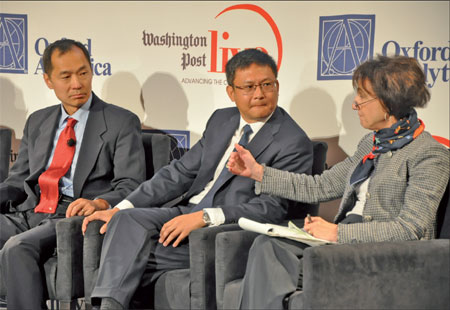
Zhihang Chi (from left), vice-president and general manager of Air China, North America; Lixin Cheng, president of ZTE North America; and Charlene Barshefsky, former US Trade Representative, interact during the Global China Summit on Tuesday in Washington. [Photo/China Daily] |
WASHINGTON - As Chinese investors are making efforts to seek business opportunities in the United States and help create local jobs, the US government needs to adopt a more open attitude toward the new wave, Chinese business leaders said at a public forum in Washington on Sept 27.
Dozens of top experts, senior government officials and business leaders attended the Global China Summit hosted by the Washington Post Live. China Daily is an official media partner of the summit.
It featured Henry Kissinger, former US Secretary of State and author of the recently released book On China; David Miliband, former Foreign Secretary of Great Britain; Robert Rubin, former Secretary of the US Treasury; Tung Chee Hwa, founding chairman of the China-US Exchange Foundation; and Mingjian Bi, senior advisor to the China International Capital Corp.
The topics focused on ongoing social and economic changes in China and its influence on the rest of the world.
Senior executives in charge of the American market for Chinese companies ZTE and Air China made rare appearances as panelists during the one-day gathering. They sat next to former US Trade Representative Charlene Barshefsky and other international business consultants to discuss conducting business in America.
"It is getting easier and easier to do business in China as the country is becoming more and more open to business," said Chi Zhihang, vice-president and general manager of North American operations for Air China, China's national flag carrier of civil aviation.
"I think the US has the tendency of becoming less and less open to business."
Chi, born in China and now a naturalized US citizen, earned his master's and doctorate degrees from MIT's Sloan School of Management.
He said 20 years ago it was difficult to get a passport in China, but relatively easy to get a visa to the US. Now, it is just the opposite.
He said Chinese companies often find non-business-related issues pop up when they come to America to do business, such as getting a visa.
"My biggest challenge in doing business here is that I cannot get enough people (Chinese passengers to fly to America)," he said.
The lavish spending Chinese tourists could bring huge revenue to the American tourism industry and create a lot of US jobs if it was easier to enter the US, Chi said.
But because of the complicated visa application procedures and exhausting waiting periods, many Chinese travelers give up traveling to America.
Cheng Lixin, president of the North America region of the ZTE Corp, is facing more challenging problems.
Shenzhen-based ZTE is one of the leading global providers of both telecommunications equipment and handset devices. It has already experienced failures investing in the sensitive US telecom industry because of national security concerns.
"The most important thing for us is communication," he said. "Telling Americans who we are, why we are here and what we can bring to America."
Supervising 14 offices in nine states, Cheng often flies across the US to actively communicate with the public about ZTE to earn their trust and understanding.
"Focus more on the local governments," he suggested to Chinese companies. "They are more pro-business and practical than the federal government."
Barshefsky, now senior international partner at the law firm WilmerHale, echoed the concern on the visa application process, saying its reviewing system is "entirely irrational" and should be changed.
But she said it is easy to do business in America and the number of cases that fail to pass the screening of CFIUS (Committee on Foreign Investment in the United States) is very small, only about 13 percent of the total applications.
"Unfortunately some of them are from Chinese companies," she said.
She offered several pieces of advice for potential Chinese investors: start smaller, understand the US regulatory process, be creative in finding solutions for investment problems and partner more often with American companies, which will provide additional credibility to the Chinese entity and some comfort in respect of national security.
Though there are increasing concerns of trade ties and complaints about the business environment in each other, the economic partnership between China and the United States is "working," said Chee Hwa Tung, founding chairman of the China-US Exchange Foundation and former chief executive of the Hong Kong Special Administrative Region.
"It's working, but there is a lot more work to be done so that its full potential can be realized," he said.
Related Stories
Opportunity for US firms 2011-09-27 16:40
Aviation could lift China, US economies 2011-09-27 14:45
Alibaba's HiChina unit to seek US listing 2011-09-27 10:17
1st Chinese cargo flight lands in US 2011-09-24 13:46
- Chinese businesses want a wider door to the US
- Imported iron ore supplies decline in China
- Legend bulks up to get ready for listing
- Trade zone projects on border 'going well'
- Liquor makers ordered to stabilize prices
- China's auto exports surge
- China propels Huawei's sales
- Where next for the ChiNext?