Positions at foreign firms less attractive
Updated: 2011-10-26 11:26
By Wu Wencong and Li Jing (China Daily)
|
|||||||||||


|
Li Min / China Daily |

Professionals opt to join State companies, report Wu Wencong and Li Jing in Beijing.
Vincent Chen is ready to change jobs, moving from a world-famous foreign aircraft manufacturer to a State-owned aviation group. And three colleagues are going with him.
A 27-year-old engineer, Chen often complained to friends about his low salary compared to others in the same field, but it is not the 20 percent pay increase that makes him so determined to quit.
"It depends on where I can get to in the State-owned company. If I work hard, the chances are that I'll get a generous bonus at the end of the year," Chen said. "Counting on a fixed wage won't do, you know."
Over the past 18 months, about half of Chen's colleagues in Beijing have left their jobs. Seventy percent ended up in State-owned enterprises.
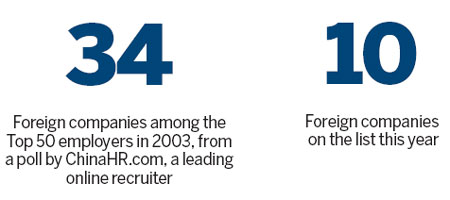
Chen's case is part of a wider trend seen by some headhunters and human resources consulting firms: multinational companies are losing luster as the most attractive career destinations for young and senior professionals in China.
"Chinese firms are luring talented managers and executives away from multinational corporations by offering generous compensation, more decision-making power and a faster career track," said a report published in June by The Korn/Ferry Institute, the world's largest executive search firm.
For years, multinational companies have been vigorously tapping into China's vast market and benefiting from the country's fast economic growth. They have attracted numerous Chinese professionals with competitive salaries, handsome benefits business training opportunities, and the possibility of an overseas assignment. All seem to be irresistible for ambitious Chinese professionals eager to improve their social and career mobility.
"What they (multinational companies) seem not to have anticipated is that Chinese companies might poach their critical managerial talents," the report said.
The pre-IPO lure
|
|
"I recently lost an employee who went to a Chinese enterprise for four times the pay," said a global food and beverage company's head of talent recruitment for greater China who was quoted in the Korn/Ferry report. "And there is no way we would ever match that."
While a good salary provides motivation for switching jobs, the prospect for financial gain when a Chinese company goes public is even more enticing. Such initial public offerings have made many people millionaires overnight.
The Korn/Ferry Institute surveyed 43 senior executives and managers working in China and found 45 percent of them would consider joining a pre-IPO Chinese company. Others switched from foreign companies to State-owned companies for a better sense of security, even if it meant a smaller salary.
Betty Xin, 26, of Beijing quit her job at a foreign investment bank as soon as she decided to get married last year. She joined a Stated-owned securities company, at the cost of about 30 percent of her income. "I was exhausted at the previous job, working six days a week, half of them over 12 hours a day.
"Working for a foreign company is not as cost-effective as it used to be," Xin said. "The tempo of work is more intense, but the pay does not rise accordingly. Competition is fierce, so colleagues are scheming against each other, making me completely exhausted both physically and mentally.
"Now my working hours are fixed at 9 am to 5 pm, five days a week. And I can finally have a life!"
Meanwhile, the global recession has forced many multinationals to give priority to reducing operational costs, which means the employees have to face shrinking salaries and bonuses, or even being fired, according to the institute.
In contrast, Chinese companies, especially those owned by the government, are known for offering stable positions and pay.
Besides, Chen said, there are many barriers to Chinese employees being fully accepted by some foreign companies.
"We don't get access to many files and materials," Chen said, "and it has nothing to do with rank. Co-workers in Europe at my level can read those files any time they wish."
Related Stories
Two SOEs top list of dream employers among grads 2011-07-05 10:54
More efforts needed to help grads find jobs 2011-05-26 13:08
Grads urged to go west for jobs 2011-05-26 11:12
Fewer high school grads fight for university place 2011-05-04 15:09
- Positions at foreign firms less attractive
- Lenders will issue bonds to aid SMEs
- Micro credit providing a lifeline
- Sinopec lifts diesel output to ease severe shortages
- Chinese satisfied with nation's banks: Poll
- Illegal land use gives year-end GDP boost
- Farmers, Nestle in milk payment row
- Scandal-hit Wal-Mart stores reopen