Future is bright for thin-film energy cells
Updated: 2011-12-30 07:37
By Du Juan (China Daily)
|
|||||||||


|
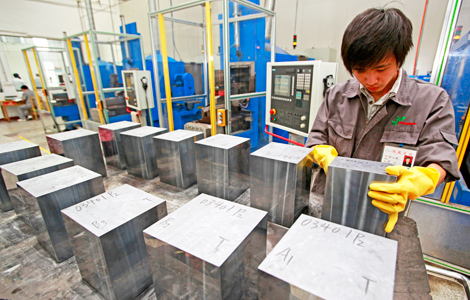
A quality inspector checks polysilicon ingots at Phoenix Photovoltaic Technology Co Ltd. Zhao Yuwen, vice-chairman of the Chinese Solar Energy Society, said the unit cost of thin-film solar cells is 10 to 20 percent higher on average than that of polysilicon cells. [Photo / China Daily] |
CHANGXING, Zhejiang -The gloomy solar-cell market and a rising number of trade disputes within the industry means that the time is ripe for the development of thin-film photovoltaic (PV) panels, according to Li Hejun, president of Hanergy Holdings Group Co Ltd.
Hanergy, one of the few privately owned Chinese generators, said it will establish seven thin-film PV cell production bases next year, a move that will increase the company's total production capacity to 2 gigawatts (gW) by the end of 2012.
After putting two 300 megawatt (mW) capacity production bases into operation in Shuangliu, Sichuan province and Heyuan, Guangdong province earlier this year, the company opened a third - with a production capacity of 250 mW - on Dec 25 in Changxing, Zhejiang province.
Li said anti-dumping cases and anti-subsidy investigations into Chinese solar cells, initiated by the United States and India, have put the polysilicon solar cell industry under pressure, and that will lead to a structural reorganization of the solar energy sector.
Unlike the US probe which will only focus on silicon solar panels, India is likely to also include thin-film PV cells in its petition, However, Li said that he didn't think the cases will influence the company's expansion plan.
"The company is aiming to build an entire production chain because we are a power-generation company, rather than simply a manufacturer of solar cells," said Li.
The company has no export business and analysts said that means the probes won't affect it.
Zhao Yuwen, vice-chairman of the Chinese Solar Energy Society, said the high production costs are still a major obstacle to the development of the thin-film PV cell industry.
He said the unit cost of thin-film solar cells is between 10 and 20 percent higher on average than that of polysilicon cells.
"The thin-film PV cell industry is still at a fledging stage and the market is not mature enough," he said.
An insider,who works at one of the country's top three solar companies but declined to give his name, said that investing in the thin-film PV cell industry is still risky and requires a strong capital foundation.
"Suntech Power Holdings Co Ltd suspended its research into the sector in 2010 because of the high cost and other reasons," he said. "Recently, there have been reports that that company has restarted the research. Their technology is similar to that of First Solar Inc, the world's largest producer of thin-film solar cells."
According to Zhao, the average energy-conversion efficiency rate of thin-film PV cells is 6 to 7 percent in China. However, while First Solar achieved a record high of 17.3 percent in one of its tests, Suntech still lags behind.
Hanergy claims that its conversion efficiency rate could be 10 percent when the new production bases become operational.
The company also has plans to build factories in the provinces of Heilongjiang, Shandong, Jiangsu and Hainan next year.
On Nov 2, China Development Bank Corp agreed to extend the company a credit line worth 30 billion yuan ($4.7 billion) over the next five years to help the company build photovoltaic and hydroelectric power stations both at home and abroad.
Bank Sarasin & Cie AG, the Swiss private bank, published a report on the solar sector that said the world's top thin-film PV cell companies are rapidly expanding their capacities. By 2013 each of the top 10 companies will have a minimum production capacity of 500 mW.
"With companies such as First Solar, Sharp, ShowaShell, GE and Hanergy as front runners, thin-film technologies should be able to achieve average annual growth rates of 32 percent up to 2013," the report said.
Li Shengmao, domestic senior industrial researcher at the CIC Industry Research Center, said the distributed generation of new energy is gradually getting more support from the Chinese government, which is beneficial for the development of the thin-film PV cells industry, because it can better meet demand than the polysilicon cells sector.
According to the center's statistics, if China employs thin-film PV solar cells in roof construction, it will create a market of between 100 billion yuan and 130 billion yuan for the thin-film cell industry.