Cooperation key to solar success
Updated: 2011-12-30 07:37
By Liu Yiyu (China Daily)
|
|||||||||


|
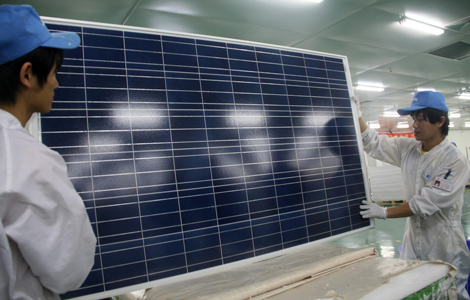
Workers at a photovoltaic panels factory in Nantong, Jiangsu province. China has the largest manufacturing capacity in the solar sector globally, and 60 percent of solar-panel production capacity. [Photo / China Daily] |
Chinese firms winning due to low labor costs and advantages in supply chain
WASHINGTON - Though the US International Trade Commission (ITC) approved an investigation into charges of unfair Chinese trade practices in the solar energy sector on Dec 2, industry experts said that rather than confronting each other, China and the US should cooperate based on their respective advantages in solar power.
"Chinese and US solar companies can cooperate on research and development (R&D) to further improve conversion efficiency, the economics of photovoltaic technologies and joint manufacturing activities to lower the unit cost of solar panels," said Kevin Tu, senior associate of China energy and climate policy at the Carnegie Endowment for International Peace.
"Chinese solar companies lead the world in the downstream portion of the photovoltaic value chain, especially solar panel manufacturing," Tu added.
The ITC took the first step toward imposing added tariffs on Chinese solar imports, voting unanimously on a petition by Bonn-based SolarWorld AG that called for anti-dumping and countervailing duties. The commission will now hold a full investigation.
China rejected the preliminary ruling that imports of Chinese solar panels are harming the domestic industry, saying the decision shows the US "inclination to trade protectionism".
GCL Solar Energy Inc, China's leading polysilicon and wafer maker, which has been investing in solar projects in the US, said the US solar companies have advantages in technological innovation but some of them are far from commercial.
The Chinese solar power investor, which has about 400 megawatts of projects in the pipeline in the US market, said it sourced panels from international suppliers in China, the US and Japan.
"Chinese makers win the competition not because of subsidies but thanks to their low labor costs, advantages from large-scale production and a convenient supply chain," said Liu Yumin, president of GCL Solar Energy Technology Holdings Inc.
China has the world's top manufacturing capacity in the solar industry, with 60 percent of the solar-panel production capacity.
There are more than 1,600 government-supported incubators and science parks in China and most new government R&D funds will invest, at least in part, in clean technology, according to a report by Cleantech Group, a research company focusing on clean technology innovation.
"We do see that Chinese solar companies are increasing their R&D spending, such as Suntech, but for the time being, the US still has an advantage in technological innovation," said David Cheng, director of the research and advisory units at Cleantech Group.
"In the US, the solar industry is driven by a dynamic private capital market, while in China, the government is the major supporter."
In the past five years, venture capitalists have pumped more than $7 billion into dozens of solar start-ups developing cutting-edge technology, most of them in Silicon Valley, according to data from GTM Research, a leading solar industry research company, and Ernst & Young.
"US solar companies excel in the upstream portion of the photovoltaic value chain, especially in polysilicon production, due to their leading role in R&D and low retail power prices in the US," Tu said.
China invested about $60 billion overseas in 2010, nearly twice as much as in 2008, with clean energy a major target. While much of that spending goes to buying local production capacity or increasing market share, the smart money is on innovation, according to the estimates of the Rhodium Group, a New York-based advisory firm.
In a 2010 Reuters poll of 41 US venture capital investors, more than three-quarters said the US would be the best market for clean technology over the next five years. The poll also found that 88 percent believed the US would be the best place to base such businesses in the same time period. China was ranked number two.
"In addition, as the expansion of the solar industry needs government subsidies in both countries, it is important for both governments to initiate bilateral talks to discuss what are mutually acceptable practices in terms of subsidizing each country's domestic solar industry," said Tu. The China-US solar dispute would hurt the industry as a whole, said Tu.
The US Commerce Department launched an investigation last month into complaints that Chinese companies were dumping subsidized solar panels in the US. A final ruling is due in July.
If the complaint is upheld, the US government could impose punitive tariffs of up to 100 percent on these products.
Despite the dispute, both governments have been advocating collaboration in the clean-energy field, with the US-China Clean-Energy Research Center set up in 2009 to facilitate mutual exchange.
Last year, the two sides decided to co-invest $50 million in a joint project on energy-efficiency technologies led by the Lawrence Berkeley National Laboratory over the next five years.
China has gradually become the place to conduct trials of new clean technologies thanks to its support policies.
Small US companies such as LP Amina Inc, which wants to commercialize its new clean-energy technology, have completed their first demonstration projects in China.