Comments()
  Print
Print  Mail
Mail  Large Medium Small
Better treatment
Most beverage bottles are made of PET, or polyethylene terephthalate, that can be recycled, maintaining its value and reducing the waste going to landfills, to make new bottles.
According to Mao Da, an expert in solid-waste management at Beijing Normal University, PET, which is also used in pharmaceutical products, is one of the most valuable of the some 40 plastics.
|
|
|
|
 |
According to Chang, unlike the small workshops, which transfer the plastic bottles into clothes and bags, all the plastic bottles they get will be made into bottles again.
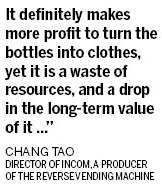
"It definitely makes more profit to turn the bottles into clothes, yet it is a waste of resources, and a drop in the long-term value of it, since the clothes will take 100 years to degrade," said Chang. "Turning the waste plastic bottles into new bottles shows respect to nature."
People believe they have the waste recycled as long as the empty bottles are handed to scavengers, which Chang said is not necessarily true.
Of the 20-some tons of waste bottles produced in the capital annually, Chang said, only about 3 to 5 tons end up in Chang's recycling station - most of the rest ends up in small workshops.
Besides wasting resources, the underground workshops are seriously polluting the environment, Mao said.
To reduce cost, the illegal workshops simply clean the bottles with groundwater and discharge the polluted water onto the ground, polluting the soil.
Chang said even in the capital, there are some 300 such workshops around the Sixth Ring Road.
"The land around the workshops has turned barren from the alkaline water they discharge into the ground without neutralizing treatment," said Chang. "No residents around the workshops dare to drink the local water for fear of poisoning.
"They are doing more than devaluing the resources," he said.
According to Chang, the capital has a very progressive attitude toward recycling, and the technology, once popularized, will greatly encourage people to recycle at or around shopping malls, subways or by the roadside.
Jobs replaced
According to Mao, China, unlike other countries, has continued to rely on scavengers for waste recycling and resource utilization, and the State-run recycling stations are gradually disappearing from the country.
"The scavengers have greatly eased the nation's task in trash disposal," he said.
However, despite their contribution, he believes the junkmen are driven by profit, and their recycling work sometimes pollutes and wastes resources, he said.
Chang agrees. "Many empty bottles we collected from individual scavengers are filled with stones or dirty water, to increase the weight for extra profit," he said. "Replacing them with the intelligent machine will ensure a sufficient supply of empty bottles of higher quality."
But worries arise over how to deal with the unemployment of people who make their living collecting copper wire and coke cans, because they will be replaced by machines.
According to Chen, there are some 200,000 scavengers in the city and the development of the machines could suddenly cost them their incomes and possibly even result in social disorder.
However, Ren Lianhai, a professor at Beijing Technology and Business University's environmental science and engineering department, said the possibility of social unrest is low.
"This is a very flexible group of people," he said. "Besides, to deploy the machines nationwide will require time, which will be long enough for them to find a new job or go to another city for the waste."
Ren said there are for the moment labor shortages in a number of fields in the city.
"The machines have been put to use in some countries for years, like Brazil and Japan," he said. "It would be beneficial for the country's recycling economy in the long run."
zhengxin@chinadaily.com.cn

 Michelle Obama addresses at Democratic National Convention
 Slides of Yanbian: place, people and prosperity
 Washington to remain focused on Asia-Pacific
 RQFII target blue chips amid bear market
 Australian recall for top two exporters
 China fears new car restrictions
Copyright 1995 - 2010 . All rights reserved. The content (including but not limited to text, photo, multimedia information, etc) published in this site belongs to China Daily Information Co (CDIC). Without written authorization from CDIC, such content shall not be republished or used in any form. Note: Browsers with 1024*768 or higher resolution are suggested for this site.
License for publishing multimedia online 0108263 Registration Number: 20100000002731