 |
|
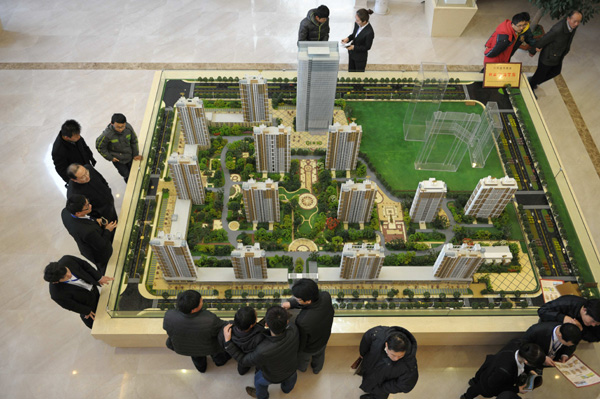
A property sales site in Rizhao, Shandong province. The tax reforms for the real estate and construction industry are mos likely to be announced in the first quarter of this year. [Photo provided to China Daily] |
New system of taxation unlikely to ease burden
Replacing business tax with value-added tax may not exactly ease the tax burden of Chinese real estate companies, said a taxation expert from global consultancy firm PricewaterhouseCoopers.
China started a pilot program to replace business tax with VAT in early 2012 and so far the reform has expanded to many industries with some exceptions like real estate, finance and consumer services. The aim of the reform is to introduce the internationally prevalent VAT and reduce the tax burden for enterprises.
There is no "credit mechanism" for the existing business tax, and all costs have to be absorbed by the business. The VAT, on the other hand, only taxes the "value added" at each stage of the supply chain, which generally allows businesses to credit any VAT incurred on business costs. However, the VAT rate is generally higher than the business tax, and it really takes a while to figure out how much the companies pay more or pay less eventually.
Alan Wu, PwC China national indirect tax leader, said the tax reforms for the real estate and construction industry are most likely to be announced in the first quarter of this year. Though indications are that the new policy would be implemented from the third quarter, experts said in all probability the implementation would not be later than the end of this year.
Wu said that most of PwC's real estate and construction clients are apprehensive that the switchover to the VAT system would lead to more tax payments.
In theory this would not happen, he said. The rate for VAT, very likely to be 11 percent universally, is higher than the 5 percent business tax applied in the real estate industry. But developers and construction companies could use invoices of input tax items, such as labor cost and material cost, for deductions. Once this is done, the base for taxation would be greatly reduced.
However, in practice developers and construction companies could find it hard to get many of the items for deduction. A major problem is the cost of acquiring land, something that accounts for bulk of the costs in China. Wu believes that the government will not allow the cost of the land to be used for deductions, because under the current practice companies do not pay any business tax or VAT for the land they purchase.

Copyright 1995 - . All rights reserved. The content (including but not limited to text, photo, multimedia information, etc) published in this site belongs to China Daily Information Co (CDIC). Without written authorization from CDIC, such content shall not be republished or used in any form. Note: Browsers with 1024*768 or higher resolution are suggested for this site.
License for publishing multimedia online 0108263 Registration Number: 130349