|
 |
|
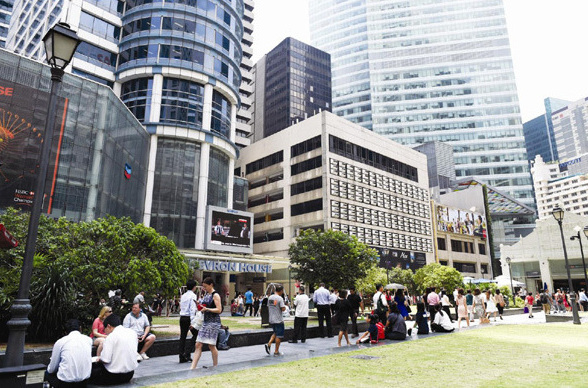
Office workers walk around during the lunch break in the financial district in Singapore. The total daily turnover of yuan foreign exchange transactions in the city-state doubled to $31 billion the year after it became an offshore yuan center in late 2013. [Photo/China Daily] |
In a little more than two years, the number of offshore yuan centers has multiplied, helping investors in more countries skip a step in their currency transactions when doing business with the Chinese mainland.
Offshore yuan centers in Singapore, Bangkok and Kuala Lumpur, along with planned centers in Seoul and Qatar, complement centers further afield in cities such as London, Zurich and Nairobi, which all facilitate the use of the yuan in global trade and finance.
There are now 14 offshore yuan centers globally and six of them are in Asia. Outside Hong Kong and Macao, in Asia there are centers in Taipei, Singapore, Kuala Lumpur and Bangkok, which joined the group in January. Negotiations are underway to make Seoul into one.
In Singapore, the total daily turnover of yuan foreign exchange transactions doubled to $31 billion the year after it was named as an offshore yuan center in late 2013, according to the Asia Securities Industry & Financial Markets Association.
For the time being, these centers can send yuan back to the mainland based on quotas granted under the Renminbi Qualified Foreign Institutional Investor program. Hong Kong's quota is 270 billion yuan ($43.5 billion), and Taiwan's quota is 80 billion yuan, while Singapore can repatriate 50 billion yuan, according to Fitch Ratings data.
The change in the accessibility of the yuan in the past couple of decades has been significant.
In the early 1990s, foreigners in the Chinese mainland had no legal access to the yuan, not even to buy simple goods on the streets of Chongqing or Tianjin. Instead, they had to rely on foreign exchange certificates.
This system was phased out in 1997. By then, China had been working for four years on how to make its national currency more accessible.
Less than two decades later, not only is it quite easy for foreigners to access the yuan either in China or outside, but it is also the fifth most-used currency in global trade.
There is more than 1.8 trillion yuan deposited in yuan-denominated bank accounts around the world and the International Monetary Fund is considering including the Chinese currency among the handful of currencies it uses for its international reserves.
"We are in the middle of that (review by the IMF), but you can see where the direction of the currency has been going," Markus Rodlauer, a deputy director and mission chief for China with the IMF, said at a press briefing last month.
Decades of slow and careful steps toward both facilitating access to the yuan and spreading its use well beyond the country's borders are now paying off. The yuan is increasingly visible and is part of the national reserves of countries that have currency swaps with China.
"Is the capital account closed? We have RQFII. We have Stock Connect. We have Qualified Domestic Institutional Investor. We have a lot of holes happening there. The China (Shanghai) Pilot Free Trade Zone is something we have spent a lot of time trying to understand," said Sherry Madera, minister counselor and director for financial, business and professional services and technology with the United Kingdom Trade & Investment at the ASIFMA 5th Offshore RMB Markets Conference in Hong Kong last month.
What was needed, Madera said, was "much more openness to bring more offshore RMB onshore".
The RQFII and the QDII programs both allow for investments in yuan and the movement of the currency in and out of the country.
"From a very, very close perspective... I would suggest that it is pretty open already," said Madera. "If you are looking at getting involved in trading with RMB, there are quite a lot of vehicles and elements that you can utilize right now."
The other side of this particular equation, access to the yuan market outside of China, is also growing rapidly. The number of offshore yuan trading centers with deals in place to provide clearing services is growing rapidly.
For the time being, the largest offshore yuan center in the world is Hong Kong.

Copyright 1995 - . All rights reserved. The content (including but not limited to text, photo, multimedia information, etc) published in this site belongs to China Daily Information Co (CDIC). Without written authorization from CDIC, such content shall not be republished or used in any form. Note: Browsers with 1024*768 or higher resolution are suggested for this site.
License for publishing multimedia online 0108263 Registration Number: 130349