 |
|
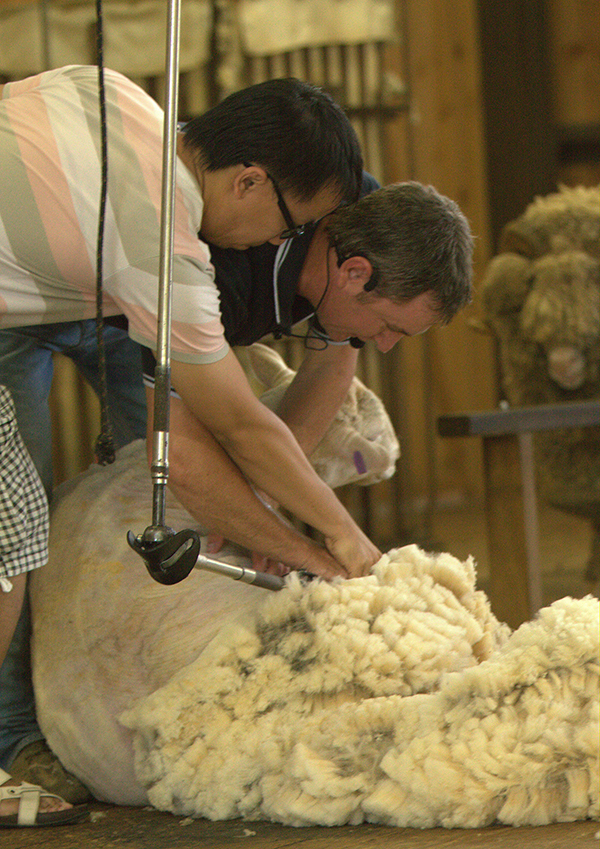
An Australian farmer shears a sheep with the help of his Chinese assistant. [Yan Xiangqun/For China Daily] |
When biting winter winds whip through the paddocks of the 170-year-old Lal Lal sheep farm in Australia's central Victoria this year, a Chinese wool tycoon will be trying to help revive an ailing industry. He's also hoping to overturn skepticism toward foreign investors.
Wen Qingnan, who bought Lal Lal in 2014, plans to build shelters for newborn lambs inside an unused hay shed to help boost survival rates by as much as 40 percent. He's also expanded the flock. Such measures may help restore wool profits in a country that is the world's top exporter. Over the past two decades, farmers were hit hard by cheaper alternative fibers and saw output shrink.
But not everyone welcomes infusions of foreign cash. A surge in Chinese investments in agriculture is fueling concern about lost local control of prized farm land in Australia, a major shipper of everything from beef to wheat. It's a theme gaining importance among rural voters before a national election scheduled for July. Wen, who runs the largest processor of raw wool in China, is convinced Australians will come around.
"The public attitude toward foreign agriculture investments will change once they see more and more investors are making contributions to the local economy and communities," said Wen, president of Jiangsu province-based Tianyu Wool Industry (Zhangjiagang Free Trade Zone) Co. "I feel confident that exchange and sharing of ideas and techniques will be beneficial to everyone."
Australia has led the world in fine wool output almost since high quality merino flocks were established there in the 1800s. But exports have declined 44 percent since 1981 and are forecast to slip even further this year, partly because wool is more expensive to produce than cotton or synthetic fibers. Many farmers are losing money.
By scanning all ewes to check for multiple pregnancies and by providing additional feed and shelter, Wen aims to improve lamb mortality rates. In Australia, an estimated 10 million die after birth each year, animals that could profitably produce more wool. At Lal Lal, Wen's target is to increase survival rates 30 percent to 40 percent. He also expanded his flock to about 12,000 sheep after purchasing 1,600 animals since October.
Wen is seeking to share his techniques with farmers throughout Australia, part of efforts that may help defuse concern over agriculture deals. In the most recent fiscal year, government data show proposed investments by entities in China and Hong Kong jumped almost fourfold to A$2.5 billion ($1.8 billion), based on those approved by the Foreign Investment Review Board.
"Where transactions work well and are successful is where foreign investors, particularly Chinese investors, are engaging with their local community," said Meredith Paynter, Sydney-based head of the food and agribusiness sector practice at law firm King & Wood Mallesons. Paynter advised on the 2015 acquisition of an Australian dairy company by a joint venture that included China's New Hope Dairy Holdings Co.
Foreign investment is vital to developing agriculture, especially because the estimated shortfall between the capital needed and domestic funds available may reach A$850 billion by 2050, according to Australia and New Zealand Banking Group Ltd.
The lack of local funding hasn't dimmed perceptions that overseas investors will undermine local food security. About 60 percent of Australians oppose foreign deals in agriculture, while 56 percent say the government allows too much investment from China, according to a 2014 Lowy Institute poll.
Earlier last month, Shanghai Pengxin Group dropped its A$317-million bid for cattle rancher S. Kidman & Co., amid opposition from the Liberal-National coalition government. Kidman's landholdings span 101,000 square kilometers (39,000 square miles), or about 1.3 percent of Australia's land mass. The Labor Party says the government risks sending the wrong signal to overseas investors. The coalition holds a 51 percent to 49 percent lead over Labor, according to a Fairfax-Ipsos poll published May 21 by the Sydney Morning Herald.
In a tight election race, the rural vote is crucial for Prime Minister Malcolm Turnbull, whose junior coalition partner, the National Party, has been a vocal critic of foreign investment in farms.
At Lal Lal's red-brick Federation-era homestead, located a 90-minute drive west of Melbourne, wool growers and buyers from as far away as Uruguay have visited to discuss production methods. Wen is also inviting local producers to China.
The decline in Australia's wool exports is largely a result of meager farm earnings, Wen said in an e-mailed response to questions. Small sheep farms lost 0.4 percent on their total capital employed in the five years to fiscal 2014, according to the Australian Bureau of Agricultural and Resource Economics and Sciences.
"I strongly believe the general public reception will change if we work together and create more wealth in Australia," Wen said.


Copyright 1995 - . All rights reserved. The content (including but not limited to text, photo, multimedia information, etc) published in this site belongs to China Daily Information Co (CDIC). Without written authorization from CDIC, such content shall not be republished or used in any form. Note: Browsers with 1024*768 or higher resolution are suggested for this site.
License for publishing multimedia online 0108263 Registration Number: 130349