 |
|
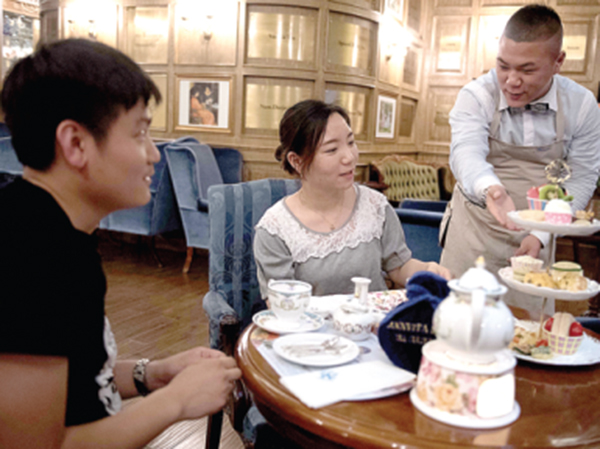
A staffer of Annvita tea salon in Sanlitun, Beijing, serves classic English high tea set menu to guests. [Photo/China Daily] |
The 24-year-old tea lover Lian Xiaoying convinced her husband to treat her and a group of friends to a British style afternoon tea experience at the Annvita English Tea Company salon in Beijing's central district of Sanlitun.
The group of friends was catching up with each other while sipping a fruity tea and nibbling on cucumber sandwiches and English scones before dinner time.
"I really enjoy drinking tea, that's why my husband decided to bring us here. It is peaceful and classy," said Lian while holding a delicate porcelain cup. "We don't normally do afternoon tea because it is expensive. However, it is a nice treat once in a while."
The tea salon captures the real essence of a Victorian living room, with its elegant dark wood furniture, blue velvet curtains and the sound of classical music playing in the background.
The imported teas are served in porcelain teapots while snacks arrive in three-tiered cake stands.
In recent years, the British tradition of afternoon tea has become increasingly popular in China, with more local consumers indulging in the luxury experience.
In the mid-'90s, Taiwanese-born Ann Chiang, owner of the Annvita English Tea Company, travelled to England where she fell deeply in love with the traditional way British people enjoy tea.
She then dreamt of one day starting her own afternoon tea brand in China.
After carrying out some market research, she came to the conclusion that the teahouse market in China was mainly directed at male consumers and that there was room for new tea-drinking options.
"I then felt very relieved to not see in China any of the British afternoon teahouses with the elegant concept that deeply touched me years ago in England," said Chiang. "That's when I decided to enter the market with this unique British afternoon teahouse concept".
In 2011, Chiang gave dimensions of reality to her dream, opening her first Victorian style tea salon in Shanghai to promote the concept of a true British afternoon tea in the country.
Now, Annvita has 45 outlets, of which eight are fully owned by the company and 35 are authorized stores. The tea chain is present in 30 cities across China, including Beijing, Shanghai and Wuhan, Hubei province.
This year, the company plans to open three fully owned stores and five authorized stores, in line with its target to open up to three owned retail stores and up to 10 authorized stores every year.
Although the company prefers not to disclose its annual figures, it forecasts a steady annual growth of 10-15 percent in coming years, thanks to the increasing demand from younger Chinese.
"Chinese consumers are getting used to the pattern of afternoon tea with cake and desserts," said Chiang. "And customers who favor foreign tea are increasingly younger and better educated."
Most of Annvita's customers are office workers in the 25-45 age-group, particularly women.
The company's bestsellers include the traditional British tea varieties of Earl Grey, British Rose and Darjeeling tea in the price range of 200 ($29.9) to 568 yuan for a pot.
The chain sources its tea leaves from Britain, Germany and Taiwan.
The sudden popularity of British afternoon tea has been marked by its exclusive character since small quantities of foreign tea are currently being imported into China.
China imported 22,900 tons of tea in 2015, which was only 7 percent of its export volume, according to Frost and Sullivan.
Last year, tea imports into China increased to $258 million, up 15 percent from 2014, due to growing consumer demand for imported tea beverages, according to a report by IBIS World.
The popularity of afternoon tea in China has become an important source of revenue for high-end hotels.
Since its inauguration in 2007, the Ritz-Carlton in Beijing has been serving a selection of teas and snacks such as sandwiches and English scones with jam and clotted cream for the afternoon tea aficionados.
"These guest experiences help secure market share and may boost sales at the hotels," explained Lisa Wang, a public relations manager at the Ritz-Carlton Beijing. "We generate substantial revenue from afternoon tea and our revenues continue to increase year over year."
And there is still growing potential for the imported tea tradition as a larger number of Chinese consumers are willing to try it.
For Wang, an increasing number of Chinese people regard afternoon tea as a social statement, or as a treat beyond the routine of lunch or dinner.


Copyright 1995 - . All rights reserved. The content (including but not limited to text, photo, multimedia information, etc) published in this site belongs to China Daily Information Co (CDIC). Without written authorization from CDIC, such content shall not be republished or used in any form. Note: Browsers with 1024*768 or higher resolution are suggested for this site.
License for publishing multimedia online 0108263 Registration Number: 130349