


 Comments()
  Print
Print  Mail
Mail  Large Medium Small
Finland's diverse Metso Group operations set for bright future in China, one of its biggest markets
|
 |
|
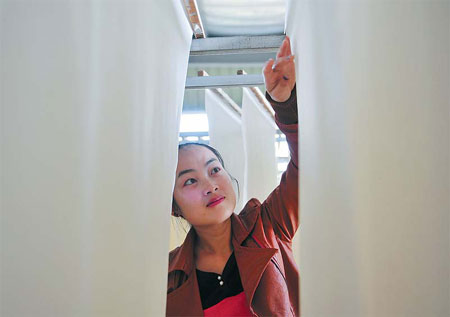
A worker examines paper quality at a paper mill in Chaohu, Anhui province. Chinese papermaking companies made only 260 million yuan ($41 million) in profit in the first half of this year, down nearly 120 percent year-on-year. [Photo/China Daily] |

There is an old joke often told by their wives that Finnish men are among the most quiet creatures on earth. They can sit there and read newspapers all day long without uttering a single syllable. But 49-year-old Pasi Laine, president of Metso Group's Pulp, Paper and Power, positively defies the description.
His speeches are testament to a very personal brand of dry humor and he happily intervenes in other people's heated conversations with a most inquisitive mind, asking: "What are you talking about?"
With a fascination for big things, especially enormous machines, Laine obtained a degree in engineering from Helsinki University of Technology in 1988. He proudly weighs more of practice than rigid management books and, further, insists he will never change his style because he regards himself as a one-off, someone quite unique.
It is frequently heard that Laine is such an easily approachable president that a big boss with a similar position and the same style is scarecely found elsewhere.
Another joke about Finnish men is that they possess engineering brains. From the impeccable logic in Laine's daily conversations, it is almost believable. When asked about the future growth of the Chinese pulp and paper industry at a time of slowing economic growth, he replied, after a minute's thought: "Your country will grow."
Market fluctuation
According to the financial reports of papermaking companies followed by Shenyin Wanguo Securities Research Co, Chinese businesses in the sector made only 260 million yuan ($41 million) in profit in the first half of this year.
Metso regards Andritz from Austria and Voith Paper from Germany as its major competitors in the pulp and paper sector.
Andritz (China) Ltd was established in 2002 and now has more than 1,500 employees. Its sales amounted to 3 billion yuan in 2010.
"The entire papermaking industry has been on a downward trend. Negative growth of the papermaking companies' sales revenues indicates that the industry is loss-making," said a research report by Guangdong-based Dongguan Securities Co.
"I haven't heard demand in the pulp and paper industry is going down. It is a little bit lower than it used to be. I'm sure it will grow very soon in China," was Laine's prompt retort.
"It's normal in this kind of industry where investments are heavy," he said, adding that when consumption and demand go down, sales goes down and prices also drop.
"But as we have heard, demand will be up again ... as the Chinese economy continues to grow and packaging, printing and writing will continue to grow. When the demand is higher, the price will go up again. So it's just a question of time when the Chinese pulp and paper industry will be profitable again," he said.
In early August, the State Council issued specific energy-saving and emission-cutting policies during the 12th Five-Year Plan (2011-15). That affects the papermaking industry.
"We should always bear in mind that economic growth should go with environmental protection. Environmental protection policies should be implemented in the context of promoting consumption, investment and exports," said Environmental Protection Minister Zhou Shengxian.
To Laine, the new policies provide opportunities in several ways.
"Old products and facilities consume more energy. The Chinese pulp and paper industry has the option to close some old plants while meeting market demand and build new ones. Then, of course, the new ones will consume a lot less energy than the old ones. So it's an opportunity (for us with new technology and products)," he said.
Also, Metso, engaged as it is in mining, pulp and paper, and new energy technologies, has always been devoted to research and development regarding energy efficiency solutions, so it has the ability to make new machines to reduce energy consumption.
Moreover, the company has a power business. It can help customers use bio-energy, biomass energy products and CO2 emission byproducts, which it does. The biomass technology is very new and has entered the Chinese market in a timely way, just as the nation has announced a determination to go green, said Laine.
Conversion from coal
For the Chinese market, the first step Metso will take is to help customers change from coal boilers to bio-boilers. Laine said the process is already under way in Europe and will be completed in China over the next five to 10 years.
"The cost of converting coal boilers to bio-boilers is actually not very much, not more than 20 million euros," said Laine.
He said the challenge here is "the supply of the biomass materials", adding, "You need to have enough biomass and enough competitiveness in the biomass market. That will take some years."
For new power plants, the investment is, of course, higher but, depending on government decisions, it is possible that the biological or other new energies will be subsidized, according to Laine. The companies can make better profits from clean energy than non-clean energy. Then the investments look like having a brighter future, he said.
Finland-based Metso started its cooperation with China's pulp and paper industry a long time ago and has generated a lot of connections.
"We started one joint venture in China 25 years ago and they own about 75 percent of that. Then we bought some paper machine factories in Shanghai about 10 years ago. We have also been investing in several service centers," said Laine.
The Mesto Group has already set up a technology center at a cost of 200 million yuan in the Shanghai Waigaoqiao Free Trade Zone to complement its various businesses in China. The technology center's operations area is 29,500 square meters and its headcount is expected to reach 650 by the end of next year from the 400-plus currently employed.
The entire group has more than 30,000 employees worldwide and a wide network of manufacturing, sales and service outlets. The China operation accounted for 777 million euros of its total global revenue of 6.65 billion euros last year.
The group has seven fully owned factories, three service centers, three joint ventures with local partners and 15 legal entities under its umbrella.
China has been the most important market to Mesto over the past few years because about 80 percent of the newly installed paper and board capacity is in China. The level of investment in China has declined but it is still the world's biggest market by new investment for the Finnish company.
"The most modern machines are installed here in China. Actually, you have two kinds of pulp and paper companies. You have the old ones that might be challenging regarding energy efficiency and pollution. But you have also got the ones that have been installed with facilities that are state-of-the-art. They are more modern than the ones in Europe or North America," he said.
shijing@chinadaily.com.cn
Copyright 1995 - 2010 . All rights reserved. The content (including but not limited to text, photo, multimedia information, etc) published in this site belongs to China Daily Information Co (CDIC). Without written authorization from CDIC, such content shall not be republished or used in any form. Note: Browsers with 1024*768 or higher resolution are suggested for this site.
License for publishing multimedia online 0108263 Registration Number: 20100000002731