Critics worry dozens of approved urban rail projects are unfeasible
The city of Shijiazhuang, a three-hour drive from Beijing, received some long-awaited news on Sept 5. The city, capital of North China's Hebei province, got the go-ahead to build its first subway from the National Development and Reform Commission, or NDRC, China's top economic planning agency.
"Subway construction has far-reaching significance for Shijiazhuang," said Jiang Deguo, the city's mayor. "It will help complete the city's transportation system."
|
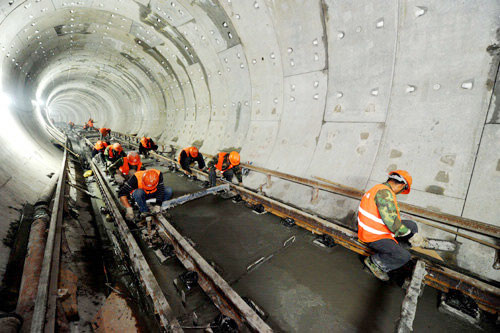 The Hangzhou subway is under construction on April 10, 2012. [Photo / bjreview.com.cn]
|
Shijiazhuang residents have long desired a subway system because rush-hour congestion has made life miserable. Alongside the expansion of Chinese cities and urban population growth, transportation infrastructure has been deteriorating in a number of cities, and subway construction is widely perceived as a panacea.
Shijiazhuang was not the only city to welcome news from the NDRC. On Sept 5, the agency announced on its website the approval of plans and feasibility reports for 25 urban rail projects in cities including Taiyuan, Lanzhou, Guangzhou and Xiamen. The projects will cost more than 800 billion yuan ($126.88 billion).
Related reading: China approves 25 urban rail projects
The announcement marks the second round of government-driven investment fever this year. In August, the NDRC approved a batch of investment projects mainly focused on cement, iron and steel, construction, communications and equipment manufacturing sectors.
For Zhou Li, a professor at Tsinghua University School of Economics and Management, investment in urban rail projects is worthwhile since it boosts the economy and improves residents' well-being.
"On the one hand, it has a leverage effect, which will benefit downstream enterprises related to subway construction and hence help sustain economic growth. On the other hand, it will improve urban transportation conditions, which is quite an urgent need for many cities," said Zhou.
Benefits
Four years ago, the Shijiazhuang municipal government submitted a petition to the NDRC on rail construction. The blueprint revealed plans to build three subway lines at a cost of 43 billion yuan. Among the total, 40 percent, or 16.88 billion yuan, would be earmarked by the local government, and the rest would come from bank loans.
The petition was initially denied, likely because of the NDRC's and the central bank's concerns over bank loan risks and the fact that the Chinese Government had already launched a 4-trillion-yuan stimulus package in 2008.
However, the NDRC continued to receive applications for subway construction as more and more cities faced growing traffic congestion.
China's rail transportation development lags behind developed countries, said Wang Mengshu, an academic at the Chinese Academy of Engineering and assistant chief engineer of the China Railway Tunnel Group Co Ltd.
"In Tokyo and Paris, about 70 to 80 percent of the population chooses to commute through the rail system while the percentage in China's most developed cities such as Shanghai and Beijing is only 40 percent. The per capita track length in Tokyo is 20 cm while it is only 2.1 cm in Beijing. Without a doubt, China needs more rail construction to solve its transportation woes," said Wang.
Another benefit to rail construction is economic growth. China has seen its economy slow down since the last quarter of 2010. There are three driving forces for economic growth: exports, investment and consumption. Under the circumstances of dwindling exports and sluggish domestic demand, investment has once again become a key tool for economic growth, said Zhou. In light of this, the NDRC approved urban rail projects in 25 cities.
This move marks the government's latest effort to maintain growth, according to a report by Minsheng Securities.
Generally speaking, the NDRC considers three factors when assessing applications for subway construction: urban population, GDP and local finance. Nearly 50 Chinese cities qualify for subway construction based on the criteria, and 40 of them have already applied to the NDRC. By 2020, the total track length of China's rail system will amount to 5,500 km. With a current cost of 400 million yuan ($63.44 million) per km, the total cost is expected to reach 2.2 trillion yuan.


Copyright 1995 - . All rights reserved. The content (including but not limited to text, photo, multimedia information, etc) published in this site belongs to China Daily Information Co (CDIC). Without written authorization from CDIC, such content shall not be republished or used in any form. Note: Browsers with 1024*768 or higher resolution are suggested for this site.
License for publishing multimedia online 0108263 Registration Number: 130349