 |
|
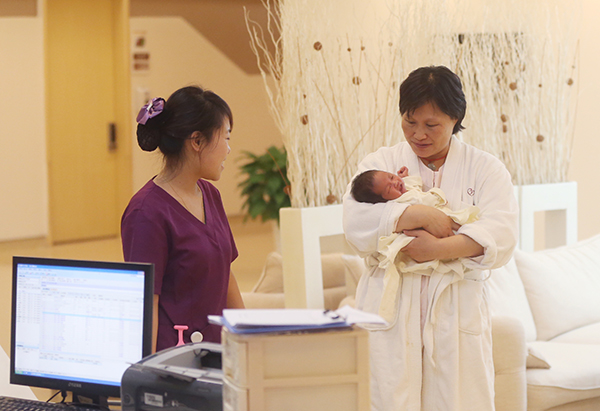
A baby born at a private maternity hospital in Beijing. More and more well-off Chinese are turning to privately owned hospitals for their high-end conditions and services. [Wang Yuyi/For China Daily] |
Take your regular blood test, for example. A long waiting line can't be avoided at the public hospital. The nurse will pull over your arm abruptly, tie a thin rubber tube around the upper part of the limb brusquely, pat down the inner side of your elbow, thrust the needle in, withdraw it and press a cotton ball on the wound before you can make any facial expression.
The whole process is often done without speaking. The only time a nurse might mumble something is if a patient really takes his time and doesn't roll up his sleeves quickly and efficiently. The only merit of the whole affair is the relatively low cost.
Fearing the glaring eyes of the doctors and nurses in the public hospitals, I turned up to a foreign investment-funded clinic for some small checkups.
Of course, like any other clinic in the West, an appointment is a must, even for a blood test. A nurse first measured my heartbeat, blood pressure and body temperature. Then a general practitioner interviews me and asks about recent ailments or worries. When I am sent to the room to take the actual blood test, the nurse there adopts the same procedure as in the public hospital. But the biggest difference is this: there's no hurry with anything. If I have any questions, I can talk to the nurse pronto and the response is always patient and considered.
Of course, it costs more. Much more. Including the consultation with the GP, a simple single blood test can cost as much as 1,800 yuan ($273).
During a previous medical trip to Australia, I was even more impressed by the services provided there. Before my arrival, a one-hour telephone consultation was arranged. The doctor then asked for details of my health and any concerns I had over the phone, patiently.
The question list was so long and extensive that for some, I didn't see any relation to my problems at all. All the necessary medical checkup results, which had been already taken in China, were allowed to be sent to my Aussie doctor via e-mail. In that sense, no more checkups were needed upon my arrival.
After the first two-hour face-to-face appointment with my doctor in Australia, I was immediately introduced to my nurse who taught me how to take my prescriptions. A folder was given to me with a schedule of my daily pill taking.
An ice bag was provided to take the drugs that needed to be stored in the fridge. And even an informational DVD was included, in case I forgot how to take the drugs. Most importantly, I was encouraged to call the doctor or nurse immediately if I felt uncomfortable or had any concerns.
The best thing was that the fee was almost the same as that in China, excluding accommodation and traveling expenses.
While overseas medical trips are only an option for the very well-off, it has gained growing popularity among the younger Chinese generations. According to a recent survey released by market consultancy Analysys International, medical trip products provided by experienced agencies are even more cost-effective when compared with public hospitals. They are increasingly popular among the generations born between the 1970s and 1990s whose attitudes and experiences have been broadened by travel and who are comfortable and proficient in English.
Chinese people's growing attention to their personal health and their higher requirements at the service level have also prompted the expansion of the overseas medical tourism market, as Analysys International found in its survey.
This is closely related to the ongoing third consumption upgrade, in which Chinese consumers are increasing budgets for more expensive products such as housing, cars and computers.
Throughout the third consumption upgrade, the medical and healthcare industry is one of the fastest-growing sectors. These include education, entertainment, culture and travel, as defined by the Ministry of Commerce.
Unlike the previous upgrade, which included mostly products such as textile, home appliances or steel, this wave entails more industries associated with services. As the tide moves on, I hope the Chinese medical services can move faster and catch up.


Copyright 1995 - . All rights reserved. The content (including but not limited to text, photo, multimedia information, etc) published in this site belongs to China Daily Information Co (CDIC). Without written authorization from CDIC, such content shall not be republished or used in any form. Note: Browsers with 1024*768 or higher resolution are suggested for this site.
License for publishing multimedia online 0108263 Registration Number: 130349