Boom in artificial intelligence projects promises to energize Chinese startups
Every year, about 9 million students in China sit for the gaokao, the national college entrance test. Intensive preparations for a year mark the run-up to the annual test, arguably the world's toughest, that determines which university a student will go to eventually.In four years, all this will likely change. Not just students, even robots, powered by artificial intelligence, may ace the test.
Such is the pervasiveness of the technology that large investments are pouring into AI firms in China.
iFlytek Co Ltd, a Shenzhen-listed AI company, is developing a robot that will seek to beat 80 percent of Chinese students and become eligible, theoretically, for admission into a top-level university in 2020.
Hu Yu, the rotating president of iFlytek, said the scholarly robot project, unveiled in December, is making brisk progress.
"Our artificial intelligence system enables robots to accomplish tasks like reading and comprehension as intelligently as a 6-year-old," Hu said.
 |
|
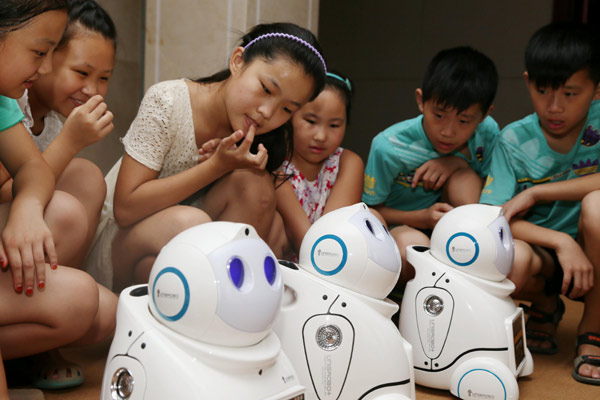
Students watch intelligent robots developed by a Beijing company for use in education, elderly care, household chores and security purposes. [Photo provided to China Daily] |
For example, when a computer "reads" out a story about a duck catching fish, with some words removed and others replaced with names of other animals like pig and cow, the scholarly robot can fill in the blanks with the right words.
It can also recognize that the main character of the story is a duck, not a pig.
iFlytek's efforts are part of a broader AI wave sweeping China. Since supercomputer AlphaGo defeated a world champion in the ancient strategy game Go earlier this year, AI has become one of the most popular fields for investments.
"This boom in AI is chiefly driven by advances in big data technology," said Luo Jun, CEO of the Asian Manufacturing Association.
"The massive consumer base and 650 million internet users in China, which means a huge volume of online data, presents the most promising opportunities for local enterprises to compete head to head with international giants."
Baidu Inc, the Chinese internet search giant that has obtained a permit to test its self-driving cars in California earlier this month, said it would double down on its bet on a venture capital firm focusing on AI. Its initial investment fund will be $200 million.
Alibaba Group Holding Ltd and Tencent Holdings Ltd are also eyeing the sector. Both of them have cloud computing units. They have also invested in AI startups.
For its part, iFlytek has set up a 1-billion-yuan investment fund, to boost the overseas presence of its voice-recognition technology.
According to a report by Beijing-based research firm iResearch Consulting Group, there are roughly 100 AI startups in China. As of December 2015, 65 of them had received 2.9 billion yuan ($434 million) from venture capitalists.
Fueling the trend is the Chinese government's three-year initiative to discover and nurture potential global leaders in AI through financial support. Priority has been accorded to application of cutting-edge technologies in smart home appliances, self-driving vehicles, robots and security products.
"By 2025, most consumer electronics products will be AI-enabled, and have 'eyes' and 'brains' to interact with the environment and make decisions," Yu Kai, CEO and founder of Horizon Robotics, a Beijing-based startup focused on building chips to power AI, said at a conference earlier this year.
The firm, set up by the former Baidu veteran, has raised an undisclosed amount of investment from Yuri Milner, the well-known Russian investor behind internet giants such as Facebook Inc and Alibaba.
Zhao Ziming, an analyst at Beijing-based internet consultancy Analysys, said though AI is still nascent, Chinese firms have demonstrated strong capabilities in voice- and image-recognition technologies.
iFlytek, for instance, prevailed in the 2016 Winograd Schema Challenge, a well-recognized global competition to test machine intelligence.
"But the relatively poor technology infrastructure among Chinese traditional industries may be an obstacle for rapid application of AI. It is important to remain sober-minded amid the tide," Zhao said.


Copyright 1995 - . All rights reserved. The content (including but not limited to text, photo, multimedia information, etc) published in this site belongs to China Daily Information Co (CDIC). Without written authorization from CDIC, such content shall not be republished or used in any form. Note: Browsers with 1024*768 or higher resolution are suggested for this site.
License for publishing multimedia online 0108263 Registration Number: 130349