Comments
  Print
Print  Mail
Mail  Large Medium Small
Though 15 years have passed since Hong Kong's return, it still continues to be an important conduit for the mainland's interactions with the outside world.
In the run-up to the return, Hong Kong had an important role to play as the mainland was boycotted by most Western nations. All of the mainland's economic, cultural and even political exchanges with the outside had to be routed through Hong Kong, a city under British control. Even after the mainland adopted the reform and opening-up policy in 1978, the mainland relied on Hong Kong for medicine imports and exports for long.
 |
|
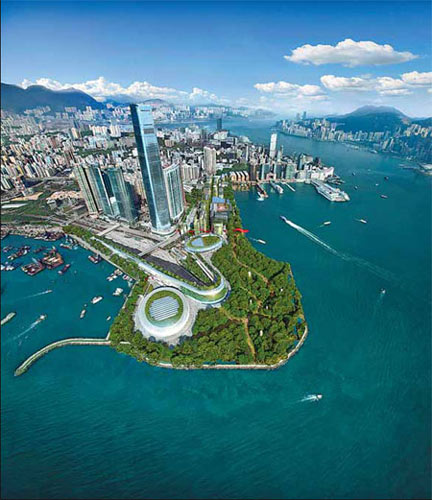
The future look of West Kowloon Cultural District of Hong Kong, which will be designed as the "City Park". It will have a continuous water front, iconic cultural venues, tree-lined streets and intimate lanes. [Provided to China Daily] |
But with economic development gathering momentum in the mainland, Hong Kong's role is no longer that unique, says Wang Zhenmin, dean of the School of Law at Tsinghua University and an expert on mainland-Hong Kong relations.
Wang says that Hong Kong's role as the main source of cash for the mainland is also weakening. At the same time the city still continues to be the biggest source of foreign direct investment for the mainland.
Peng Qinghua, director of the Liaison Office of the Central People's Government in the Hong Kong Special Administrative Region, says that Hong Kong enterprises had invested a cumulative $526.71 billion in the mainland as of last year. The amount also accounts for 45.1 percent of the total FDI in the mainland over the same period, and also created more than 10 millions jobs.
Wang says that in the early days of the opening-up, the money from Hong Kong provided strong financial support to the country's economic development, and more importantly, gave confidence to foreign investors to make investments on the mainland.
"Hong Kong is still the biggest overseas investor for most provinces and regions, but its share in the total FDI in some South China provinces, such as Guangdong, is dropping," says Wang, citing his research results.
What observers and officials, however, agree is that Hong Kong will continue to play a bigger part in the mainland enterprises' plans of going international.
According to a report by Xinhua News Agency in December, nearly 65 percent of the mainland enterprises' overseas investment was made in Hong Kong or through Hong Kong.
For these enterprises, Hong Kong also provides many advantages like easier merger and acquisition deals, financing and logistics services, and professionals who are well-versed in different cultures and languages, he said.
More than 97 mainland companies have set up regional headquarters in Hong Kong and another 151 had opened regional offices as of June last year, So says.
Hong Kong's role has also become more diversified, says Peng of the liaison office.
"Compared with the past when mainland cities tried to secure investment from Hong Kong, they now go to Hong Kong to look for cooperation opportunities in the service industry, learn about Hong Kong's experiences in urban construction and social management, and headhunt professionals or have local talents trained in Hong Kong," he says.
Many mainland enterprises also raise funds from international investors in Hong Kong. According to Peng, the city is now the biggest overseas financing platform for capital-hungry mainland enterprises, as mainland enterprises have gathered funds of HK$3.19 trillion ($412 billion) by getting listed in Hong Kong since 1993.
Hong Kong is also the template for the mainland in many fields, including laws and culture, according to Wang.
"When the mainland wanted to reform State-owned enterprises and establish a modern enterprise system, it decided to learn from Hong Kong as there was no company law in the mainland till then. The government also had no idea how to establish, regulate and supervise securities markets."
Wang at Tsinghua University says the influence of Hong Kong has extended beyond economics to other sectors like law education. "Back in the 1990s, university professors and lecturers in the mainland usually had no offices on campus. They received students at home, and students often could not find professors," says Wang, who studied in Hong Kong in early 1990s.
Wang returned in the 1990s when Tsinghua University, one of the country's renowned higher education institutes, decided to re-establish its School of Law. He says that most of the work was patterned on Hong Kong experiences, including building offices for each professor and lecturer and establishing its own law library.
"Tsinghua University's law school was the first to learn from Hong Kong on the mainland, and was subsequently followed by many other law schools," he says.
xindingding@chinadaily.com.cn
 Young golfers enjoy the rub of the green
 Mushroom cultivation bases established in Ningxia
 Shanghai Disneyland starts soft opening on Saturday
 Teapot craftsman makes innovation, passes down techniques
 Top 8 iOS apps recommend for Mothers
 Japanese animator Miyazaki's shop a big hit in Shanghai
 Top 5 smartphone vendors worldwide
 Chinese and foreign graffiti artists decorate trolley in Guangzhou
 China's manufacturing activity expands at slower pace

 71st anniversary of victory over Nazi Germany marked around world
 Canada getting on top of Alberta wildfire, Fort McMurray off limits
Copyright 1995 - . All rights reserved. The content (including but not limited to text, photo, multimedia information, etc) published in this site belongs to China Daily Information Co (CDIC). Without written authorization from CDIC, such content shall not be republished or used in any form. Note: Browsers with 1024*768 or higher resolution are suggested for this site.
License for publishing multimedia online 0108263 Registration Number: 20100000002731