

 Comments
  Print
Print  Mail
Mail  Large Medium Small
In the years since Hong Kong's return to China, students from other parts of the country have been traveling to the special administrative region in large numbers to study and work. [... But it is valuable learning experience on the mainland]
Recently, however, as the distinction between Hong Kong and the mainland has become less pronounced, an increasing number of mainlanders are opting to return to the mainland instead of continuing in the city. Among them are people who have lived and worked in Hong Kong for many years.
According to statistics from the Hong Kong Association of Mainland Graduates, about 13,000 students arrive in Hong Kong for tertiary education each year. The figure includes both undergraduates and postgraduates. In total, about 4,000 to 5,000 - some 40 percent - find jobs and stay in the city after they graduate.
 |
|
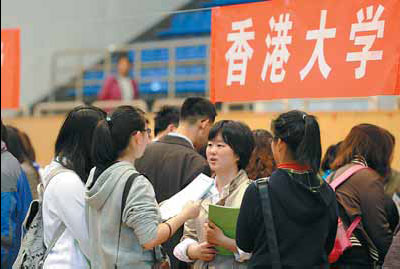
Mainland students and their parents attend a tertiary education fair which featured universities from Hong Kong and Macao, in Nanjing, Jiangsu province, on April 7. [Photo/Xinhua] |
Although many students travel to Hong Kong with great expectations, the reality is often different and many do not stay for long.
Audrey, who did not want to reveal her full name, earned an undergraduate degree from Zhejiang University and arrived in Hong Kong in 2005. She graduated from the Chinese University of Hong Kong with a research master's degree in biology.
She returned to the mainland after working as a research assistant for about a year. Now, she works for a biotechnology company in her hometown of Hangzhou, Zhejiang province.
She says her relatively modest salary of about 6,000 yuan goes further in Hangzhou and she feels more comfortable than she did in Hong Kong.
"I don't have to rent an apartment as I can stay with my parents," she says. "Life in Hong Kong was more stressful because I had to work overtime very often. I can understand a little bit of Cantonese but can't speak it. I felt like an outsider."
She said she also felt under stress because of the high cost of living there. "I was homesick, with no sense of belonging in Hong Kong."
Zhang Ying, who graduated last year with a master of arts in linguistics from CUHK, didn't look for work in Hong Kong after she graduated.
She went back to her hometown and works at Wuhan Polytechnic University as an English teacher.
Zhang says she never intended to work in Hong Kong and did not even apply to stay under the Immigration Arrangements for Non-local Graduates program. The program allows applicants stay in the city to seek permanent employment for 12 months after graduation.
Zhang says she could not speak Cantonese and noted that there was too much competition in Hong Kong. "I am satisfied with my current job," she says. "Besides, I have both winter and summer vacations."
The two graduates are typical of many students who have chosen to return to the mainland after studying or working in the city.
"The universities in Hong Kong enroll more than 8,000 self-financed postgraduates every year, but only about 2,000 stay to work," says Geng Chunya, chairman of HKAMG.
Geng says the proportions of those who stay are significantly different between undergraduates and postgraduates.
Between 60 and 70 percent of students who graduate with a bachelor's degree initially choose to stay but, among graduates with a master's degree or higher, fewer than 25 percent remain after graduation.
Statistics from the office of student affairs at CUHK show that the employment rate in Hong Kong among the university's mainland postgraduates - those who have chosen to stay - declined by about 14 percent from 2010 to 2011 while the number returning to the mainland rose by 16 percent during the same period.
Raymond Leung, director of student affairs at CUHK, says mainland postgraduates have more difficulties than Hong Kong students when it comes to finding work in the city because they cannot speak Cantonese and are less familiar with life there.
Leung says that the prospects for economic growth on the mainland are good and salaries are rising while the cost of living in Hong Kong is increasing.
In addition, many mainland students who have stayed after graduation have said they do not plan to stay for long.
About 50 percent of graduates stay for up to a year after their studies end but only 20 to 30 percent continue into their second and third years and only 20 percent of those are still in Hong Kong after eight years, according to statistics from HKAMG.
Simon Zhao, director of the International Center for China Development Studies at the University of Hong Kong, explains that the main reason is the limited career opportunities in Hong Kong.
Businesses that do well in the city are predominantly focused on finance and the legal profession and salaries in other sectors tend to be low while the pressure is high.
He adds that mainland students have found it hard to adapt to local culture and have little sense of belonging.
However, the situation can be different back in their hometowns. They are regarded as the elite of society and their parents can help them, Zhao says.
In addition, Geng says emotional factors are also important - many return to the mainland because they find it difficult to find a spouse in Hong Kong.
fanfeifei@chinadailyhk.com
 Young golfers enjoy the rub of the green
 Mushroom cultivation bases established in Ningxia
 Shanghai Disneyland starts soft opening on Saturday
 Teapot craftsman makes innovation, passes down techniques
 Top 8 iOS apps recommend for Mothers
 Japanese animator Miyazaki's shop a big hit in Shanghai
 Top 5 smartphone vendors worldwide
 Chinese and foreign graffiti artists decorate trolley in Guangzhou
 China's manufacturing activity expands at slower pace

 71st anniversary of victory over Nazi Germany marked around world
 Canada getting on top of Alberta wildfire, Fort McMurray off limits
Copyright 1995 - . All rights reserved. The content (including but not limited to text, photo, multimedia information, etc) published in this site belongs to China Daily Information Co (CDIC). Without written authorization from CDIC, such content shall not be republished or used in any form. Note: Browsers with 1024*768 or higher resolution are suggested for this site.
License for publishing multimedia online 0108263 Registration Number: 20100000002731