BIZCHINA> Review & Analysis

|
BIZCHINA> Review & Analysis
|
|
Fitting China into your global footprint
(chinadaily.com.cn)
Updated: 2008-05-23 15:20 Exhibit 2: Product-based vs. competency-based approach
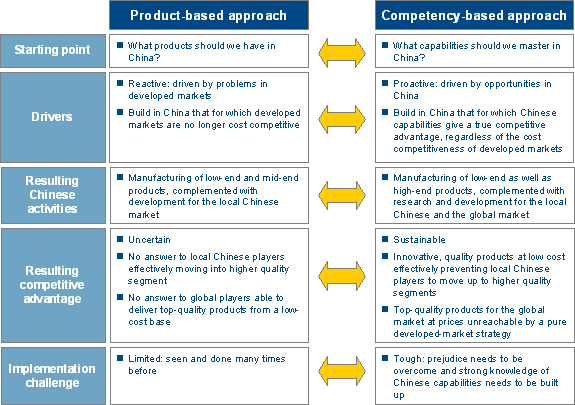 The competency-based approach ("what capabilities should we master"?) avoids many China nightmares that are otherwise encountered when following a product-based approach ("what components should we have"?). Indeed, further to a successful transfer of low-end and middle-end manufacturing and assembly to China, many companies find themselves squeezed by strong local Chinese and smart global players. After careful investment in a local manufacturing plant, they realize the best local Chinese players are also able to manufacture good-quality products. Furthermore, it is an illusion to think you will do it at the same cost as local Chinese players: they master the highly dispersed and opaque supplier, distribution and governmental network far better than you do. In order to hold off these Chinese players, you need to build on the best Chinese capabilities, and complement them with your well-mastered innovation skills. This is very hard to achieve if you pick simple products for production in China. On top of this, you will encounter increased price competition on the global market from companies that are effectively using lower-cost bases also for top-quality products. The competency-based approach offers several additional advantages over the product-based approach: Let's have a closer look at each of these. First, an analysis based on competencies encourages platform thinking, both in terms of components and processes. Platform thinking for components refers to the use and re-use of common modules across a variety of products. While this concept is not novel and already used in many industries such as automotive, is not always implemented effectively. Effective modularization starts by analyzing the functions the product fulfils. It then links these to the development and manufacturing competencies required to achieve these functions. The competency-based approach to the "China fit" question will greatly facilitate this analysis. Platform thinking applies also to processes and technologies such as precision machining and mechanical prototyping. These are often common to diverse products, product variants and business units. The know-how embedded in them can be re-used across the global organization. The competency-based approach to the "China fit" question will help you see more clearly into what these global platform processes and technologies are. The second advantage of the competency-based approach is that it points to potential early-mover advantages you can grab. Imagine you are a producer of advanced, low-volume products with stringent quality requirements, such as medical devices. You are considering developing and manufacturing these products in China. If you follow a product-based approach, you may quickly rule China out: you look around in China, notice that similar products are not yet available, and conclude that you would be an early mover with all concomitant risks. If you follow a competency-based approach, you may arrive at the opposite conclusion: you notice that a substantial number of the underlying competencies are already deployed in China, albeit in different product categories. From that perspective, a fair part of, say, a high-end respiratory device – hitherto not made in China – is quite similar to an advanced copier – already abundantly present in China. In other words, you will decide to exploit early-mover opportunities that you would otherwise have discarded as too risky. The third advantage of the competency-based approach relates to the protection of your intellectual property (IP). As you analyze the competencies embedded in your products, you can easily identify those that give you a differentiating and sustainable competitive advantage, as opposed to the "must haves" that are widely spread and well-mastered throughout your industry. For the former you will normally want to adopt special IP protection measures in China or keep parts of them in countries where IP protection is high and enforceable. Likewise, you can consider the benefits of outsourcing the latter. (For more biz stories, please visit Industries)
|
主站蜘蛛池模板: 同仁县| 灵台县| 铜川市| 清苑县| 阜平县| 安化县| 古浪县| 云和县| 于田县| 重庆市| 顺义区| 天祝| 淳安县| 兰考县| 芜湖县| 浮山县| 育儿| 安庆市| 永平县| 旅游| 尉氏县| 平泉县| 揭西县| 双桥区| 颍上县| 巴彦淖尔市| 卢龙县| 麻阳| 昌江| 从江县| 夹江县| 墨脱县| 什邡市| 临朐县| 庆阳市| 壤塘县| 桐庐县| 辛集市| 信宜市| 德惠市| 化州市| 陇南市| 龙井市| 龙州县| 鄢陵县| 凤山县| 驻马店市| 台东县| 灵石县| 尼勒克县| 霍城县| 巨鹿县| 桂东县| 尉氏县| 连云港市| 吴旗县| 萍乡市| 宁陕县| 视频| 五河县| 龙井市| 中方县| 台前县| 柳林县| 太白县| 灌云县| 新安县| 襄汾县| 南部县| 金寨县| 白银市| 历史| 衡东县| 澎湖县| 响水县| 阳山县| 石阡县| 西吉县| 探索| 札达县| 安西县| 绿春县|
