BIZCHINA> Review & Analysis

|
BIZCHINA> Review & Analysis
|
|
Fitting China into your global footprint
(chinadaily.com.cn)
Updated: 2008-05-23 15:20 4. Factor in cost savings at the end To close the decision-making loop, you have to go back from competencies to products. After all, the decision to carry out a certain activity in China is not made at the level of competencies but for a tangible project, product or component. For example, you don't start developing a precision machining competency unless there is a product you plan to manufacture which requires that competency. Therefore, assess the "China fit" not only of competencies but also of products. You can do so by linking the products with the competencies embedded in them, i.e. these that are needed to develop and manufacture the product (one way to assess the dependency of a given product on a competency is to estimate the impact of the competency on the cost of the product). In other words, a product with a high "China fit" is one that makes use mainly of competencies with a high "China fit", i.e. for which China offers a strong competitive advantage and that are securely available within China. The overall "China fit" of a product is the weighted average of the "China fit" of its embedded competencies (see Exhibit 4). Exhibit 4: Example of the "China fit" of a product and its embedded competencies
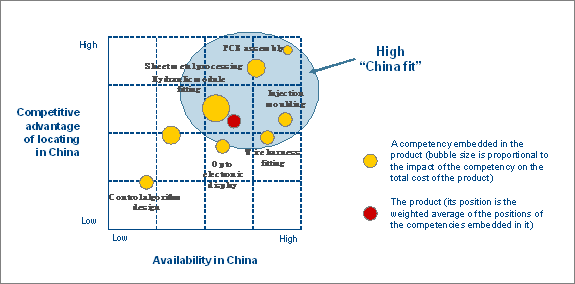 Finally, factor in the cost dimension. When comparing the "China fit" of different (future) products, product alternatives or R&D projects, compare the fit of each investment proposal with its cost savings potential. Transfer to China the proposals that come out best. Insights for the executive The "China fit" logic described above leads to a well-founded, powerful and easy-to-communicate overview of the products that could be developed and manufactured in China, and those that are better kept out. It also allows efficient comparison between alternative investment proposals. Once you have the overview, you are well equipped to focus further evaluation efforts on the alternatives that really make good sense in China. You avoid time-intensive and costly evaluation of alternatives with low potential. By linking products to the competencies embedded in them, you can define what competencies you have to develop, maintain or divest in China. From this you can easily derive your China growth strategy and the corresponding investment plan in both R&D and manufacturing. Deciding to transfer a product to China is no longer just a short-term offshoring decision, but a long-term investment in a sustainable competitive advantage. You can use the same approach for any other emerging market. The results are invaluable for the design of your global R&D and manufacturing footprint. Gert Bijnens is a Consultant in Arthur D. Little's Shanghai office, and a member of the Automotive and Manufacturing Practice. He focuses on growth strategy, innovation management and R&D in emerging markets. E-mail: bijnens.gert@adlittle.com Congjian Wu is a Manager in Arthur D. Little's Beijing office, and a member of the Automotive and Manufacturing Practice. He focuses on innovation and operations management. E-mail: wu.congjian@adlittle.com Nick Toone is a Senior Manager in Arthur D. Little's London office, and a member of the Automotive and Manufacturing Practice. He focuses on strategy and innovation in the manufacturing industry. E-mail: toone.nick@adlittle.com (For more biz stories, please visit Industries)
|
主站蜘蛛池模板: 崇左市| 淄博市| 耒阳市| 嘉鱼县| 开江县| 陇西县| 宁远县| 德惠市| 富锦市| 裕民县| 兴义市| 简阳市| 西城区| 嘉禾县| 黄石市| 承德县| 大余县| 文化| 深水埗区| 碌曲县| 义马市| 阜阳市| 米林县| 四会市| 固阳县| 萨迦县| 敖汉旗| 大冶市| 松原市| 平邑县| 金溪县| 包头市| 饶阳县| 玛多县| 四川省| 泸州市| 乌拉特前旗| 屯留县| 绵竹市| 阿鲁科尔沁旗| 南江县| 三门县| 灵璧县| 金阳县| 元江| 岳池县| 大关县| 揭西县| 客服| 明溪县| 承德县| 若羌县| 油尖旺区| 和田市| 交城县| 苏州市| 页游| 贺兰县| 枝江市| 阆中市| 简阳市| 河北省| 黑河市| 金坛市| 克山县| 常州市| 永康市| 靖边县| 金阳县| 玉环县| 花莲市| 西昌市| 嵊泗县| 邢台县| 五峰| 扎赉特旗| 蒙山县| 扶风县| 榆社县| 湖北省| 株洲县| 登封市|
