Economy
Male big spenders splash their cash
By Karen Yip and Bao Chang (China Daily)
Updated: 2010-07-12 10:03
 |
Large Medium Small |
|
 |
|
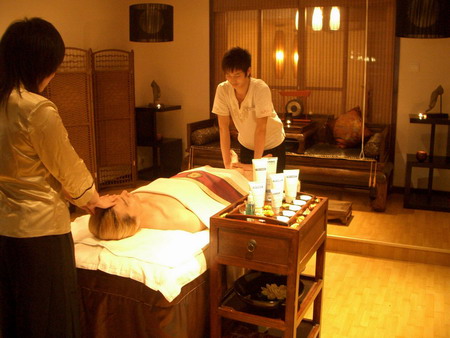
A male Chinese customer with dyed hair enjoys a treatment at Spa de Feng in Beijing. Wealthy Chinese males aged between 18 and 44 are becoming major consumers of luxury products and services. [Provided to China Daily] |
The young Chinese male's wardrobe is a veritable rainbow of colors these days and it comes with accessories such as a gold chain or a designer-labeled monochrome bag. A Humvee or other sports utility vehicle (SUV) completes the picture.
A total of 80 percent of wealthy male Chinese consumers are aged between 18 and 44, have an annual household income of more than 250,000 yuan ($36,898.74), are well educated and are open to the acquisition of luxury products, said Kunal Sinha, Regional Cultural Insights Director, Ogilvy & Mather Asia Pacific, Shanghai.
"The male Chinese market is huge and it's an untapped wealth. The key driver here is not only that they want to look good and have the money to splurge but it's also to express their masculinity.
"It's an expression of confidence in society and to show their wealth. Take the power suit as an example." Indeed, a tailored suit gives the impression of power, importance and confidence to the wearer. Other manifestations of masculinity include buying big cars. An estimated 20 new models of SUVs are expected to be launched in China this year alone.
 Demand for services and products outstrips supply in most cases. Spa de Feng, one of Beijing's few discreet spas for men, raked in good profits during its first month of operation after it was opened by owner Xu Feng four years ago.
"Previously, the proportion of my expat and local clientele stood at a 90 to 10 ratio. Today, it's a ratio of 40 to 60. It's a healthy evolution," said Xu.
On a good day, the four branches of Spa de Feng get a total of 40 clients with an average spending of 500 yuan per person per visit. The most-taken treatments are toning body scrub with marine crystals, signature four-hands massage, plant essential Swedish massage and tailor-made sea active face care.
New purchasing power
Thanks to creative marketing campaigns in recent years that have partly shaped ideas of success, lifestyle, desire and the enviable "look", consumer companies no doubt see the Chinese male consumer as another purchasing power to be actively pursued.
Glorified images of the alpha male - men who have a high social position, are confident among the fairer sex, know what they want and go for it, and are sensitive to effeminate traits - appear in glossy advertisements embodied by the usual suspects of Asian male megastars such as Liu Xiang (the mainland's Olympic 110m gold medallist), Jincheng Wu (a Japanese-Taiwanese model and actor), Daniel Wu Yanzu (a Hong Kong-based American Chinese actor), Rain (a Korean pop singer) and Jay Chou Jielun (a Taiwanese singer).
For men, it's really about using cosmetics to get ahead in their careers, a December 2008 survey by ChinaPolling showed. It revealed that almost 99 percent of male Chinese consumers regularly use cosmetics, with facial cleansers and body, hair and shaving care products being the most frequently.
The male skincare sector grew 500 percent on a compounded annual growth rate from 2001 to 2008, while the deodorant market grew 15 percent annually.
Like any young Chinese working professionals, Michel Jiang, 29, content manager at an information distribution firm, is aware of the importance of self-grooming. He spends 200 to 300 yuan on imported Japanese skincare brand Shiseido.
"For clothes, I usually go to the malls," he said. "Clothes are my biggest consumption. I buy brands such as Zara and I spend easily anywhere between 2,000 and 3,000 yuan per shopping trip." He has a stack of colognes but only uses them on special occasions.
Chinese men are making their presence known in other areas as well. They now comprise 27 percent of gold jewelry buyers, a 2009 survey by the World Gold Council revealed.
"I find that interesting. And out of the 27 percent, 30 percent of them bought gold for themselves to wear to impress their wives, girlfriends or in-laws," said Sinha.
Add these statistics to China's social situation - a gender imbalance, pursuit for wealth and prestige, fast-changing lifestyles and exposure to Western values - and it inevitably creates a paradise of business opportunities.
|
||||


"Hence the expectation of men to have apartments, cars, and stable careers. Added to that is the mistress market - young women who are willing to be mistresses to older men who have money."
Sinha continued: "The Chinese are generally exposed to luxury goods. What we found in many cities was that people are cash rich but there is a shortage of products and retailers."
For entrepreneurs, this means good business.
The highest number of Humvee buyers is in Taiyuan, in North China's Shanxi province, the country's largest coal mining center. They are seen as a status symbol and sign of ruggedness.
Beer consumption in China is currently at a low level when compared with Japan, America or Europe. "As a result, there are lots of opportunities here," Sinha said. China's average per capital consumption of beer stood at 22 liters annually; Consumption in Japan is 51 liters and in the US 82 liters.