Biz News Flash
Scout Beijing-Shanghai high-speed trains
(China Daily)
Updated: 2011-07-01 11:24
 |
Large Medium Small |
In the early morning half-light, two trains prepare to pull out of the stations at each end of the Beijing-Shanghai High-speed Rail line. There are no passengers, and the trains will travel at a stately speed of a mere 200 km per hour, or just 60 percent of full speed.
 |
|
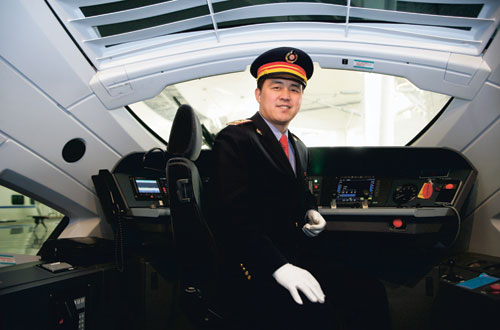
Li Dongxiao piloted the first high-speed train out of Beijing South Station?on June 30, 2011.?[Photo/China Daily] |
There is only one driver on each train, but the safety of the subsequent trains running the rest of the day will largely depend on their keen powers of observation as well as their years of experience.
These are the scout trains making test runs on the track every day to make sure that nothing goes wrong later when the first regular services pull out of their respective stations from Beijing, and Shanghai.
The security checks start at 5 am.
| ||||


The routine is nothing new to Li, who said the tradition of morning test runs and safety checks began as early as 2008, when the Beijing-Tianjin high-speed route started.
"We faithfully observed this empty-train test even during the trial runs. After all, the safety of our passengers is our first priority and we cannot expose a trainload of passengers to any risks," Li said.
Before each safety check, the drivers need to prepare a written forecast of any emergency they may encounter, and provide solutions to the problem.
Closed-circuit cameras installed along the track monitor conditions along the whole route, and if necessary, traffic controllers can shut the trains down and send enforcement officers to clear the tracks.
"Our working environment has improved so much," Li said, recalling a near accident he had on the tracks.
He remembered a day in 1996 when he saw a man walking along the track just out of Tianjin Railway Station. Suddenly, the man laid down on the track about 300 meters in front of the train. Li hit the brakes, and the train stopped just 10 meters away from the man.
It will be a lot harder for anyone to get anywhere near the tracks now. With the faster trains, many crossings between railway and road have been eliminated, and fencing has been erected along the length of the tracks.
"However, there are still factors that even technology cannot predict, such as weather conditions like a sudden rainstorm or gale, especially for a long route stretching across five provinces.
"Drivers have to be quick to respond, accurately determine any fault and then handle the situation properly."
Li himself has chalked up about 1 million kilometers on the tracks, accident-free.
Born in Tianjin, his childhood dream was to become a train driver, an ambition he held on to and pursued after graduating from a railway technical secondary school in 1998. He passed the examinations for the high-speed train drivers in 2008 and started piloting the Beijing-Tianjin bullet train runs.
He doesn't remember the number of test runs he has done on the Beijing-Tianjin line, but he knows every place where the train will encounter powerful crosswinds.
He has a mental map of every sharp turn, upward slope and downhill path along the route.
What makes the Beijing-Shanghai line challenging, Li said, is the distance and speed, which will tax the driver's concentration for a much longer time than the short Beijing-Tianjin route.
From early this year, Li and his team of experienced drivers had been training new blood. From just 58 pilots on the Beijing-Tianjin route, the current team has expanded to more than 600 qualified drivers.
All candidates go through stringent tests, and all must have a perfect safety record of at least 5,000 km. Thanks to experienced colleagues like Li, new drivers know exactly when and what to watch out for along the route, such as the steep slopes near Jinan, Shandong province.
And when a sudden squall or storm hits, they will remember the lessons they learned from Li Dongxiao.
| 分享按鈕 |