GM crops still wait for harvest
Updated: 2011-08-10 09:25
By Zhou Siyu (China Daily)
|
|||||||||||


A researcher explains genetically modified vegetables to a visitor in Wuhan, Central China's Hubei province. Jing Fei, an expert at Bohai University in Jinzhou, Liaoning province, said the government should postpone commercialization for as long as possible. [Photo / China Daily]
Limited land, water resources make new grain varieties "nevitable"
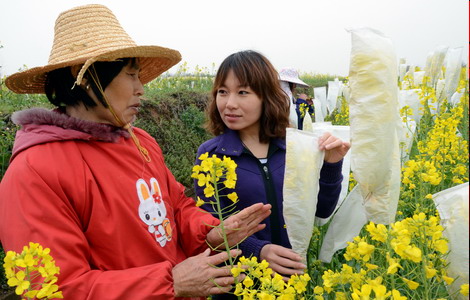
BEIJING - Genetically modified (GM) food in China is unlikely to be commercially available for large-scale planting for at least three to five years, said a top agriculture expert.
"Given the constraints on natural resources in China, particularly land and water, the government will definitely need transgenic technology to raise food production in the long term" Huang Jikun, director of the Center for Chinese Agriculture Policy at the Chinese Academy of Sciences, told China Daily in an exclusive interview.
China has increasingly turned to biotechnology to boost grain production.
In 2008, the government launched the National Transgenic New Variety Development Program, with plans to invest 26 billion yuan ($3.8 billion) in biotechnology research by 2020.
The crop closest to commercialization for staple food so far in China is rice, Huang said. GM maize is mainly used as animal feed.
But the new variety must still undergo at least two years of regional trials before it can be approved for commercial planting, under national regulations.
"The problem is that the Ministry of Agriculture does not have clear regulations on the procedures for regional trials of GM food crops," Huang said. That makes it difficult to predict a timeframe for commercialization.
In 2009, the Ministry of Agriculture issued safety certificates for production of two GM field crops: rice and maize. The move prompted heated debate in the domestic media, which raised public concern about food safety.
Fan Shenggen, director-general of the International Food Policy Research Institute, said there was still no evidence to suggest that GM food is harmful to human health.
However, the new GM crops do have an impact on the ecology and biological diversity, he said.
"We need to be cautious so as to make the maximum use of (GM plants') advantages while minimizing their negative effects on the environment," Fan said.
"China has great potential for further development in GM technology," he added.
GM technology does have advantages. It can boost production, reduce the use of chemicals and enhance nutrition, Huang said.
"Advanced biotechnology will help guarantee China's food security and benefit both farmers and consumers," he said.
To delay the commercialization of GM foods might also dampen scientists' enthusiasm for research and development, he said.
Still, some experts take a more guarded view of GM crops.
Jing Fei, a seed expert at Bohai University in Northeast China's Liaoning province, said there was no need for the country to approve the commercialization of GM food over the next few years.
While there was no proof that GM foods are harmful to human health, current medical technology can't absolutely guarantee the safety of these crops, Jing said.
"The government should postpone commercialization for as long as possible. This would not affect scientists, as long as the government continues its support for GM technology research," he said.
"With the current technology, China's food production can easily meet demand in the near future," Jing added.
But he admitted that given limited land and water resources, it was inevitable that China will start the cultivation of GM foods.
China's grain production rose for seven consecutive years through 2010. Last year's harvest was 546 million tons.
Weather permitting, the country can expect a bumper harvest this year, according to the National Development and Reform Commission, the top economic planner.
So far, the government has issued safety certificates for production of eight GM plants, including cotton, rice, maize, tomatoes and sweet peppers.
Cotton is the only plant allowed for commercial farming.
Related Stories
Debate rages on over production of GM products 2010-11-22 13:24
GM foods might has claimed thousands of lives 2010-09-13 10:36
China told to develop its own GM food 2010-08-23 09:20
Food official: GM crops safe 2010-07-21 11:02
- July slowdown, but economy is still on track
- China inflation in mild, controllable range
- Inflation reaches 3-yr high
- Sinohydro, ICE strive for $1.2b project
- GM crops still wait for harvest
- China Merchants Bank profits up 40%
- Tighter policies putting SMEs under pressure
- Chinese automakers hunt for sweet spot