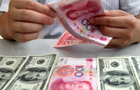
'Basically stable' yuan is goal for 2012
Updated: 2011-12-15 10:59
By Wang Xiaotian (China Daily)
|
|||||||||||


Authorities also plan reform of the exchange rate mechanism
BEIJING - China will keep the yuan's exchange rate "basically stable" in 2012 and further strengthen its reform of the rate-formation mechanism, said an official statement released after the annual Central Economic Work Conference closed on Wednesday.
|
 |
|
A ship loads cargo in Lianyungang port, Jiangsu province. The yuan's exchange rate against the dollar has gained 4 percent this year. However, it depreciated for the first time in November partly because of the country's narrowing trade surplus.[Photo/China Daily] |
"The authorities wish to have stable macro policies in the next year to avoid large economic fluctuations.
"However, the government probably will have to take more positive measures to shore up economic growth in the first quarter, including slowing the appreciation of the yuan," said Li Wei, economist at Standard Chartered Bank (China) Ltd.
He said that economic growth might drop below 8 percent and the unemployment rate could rise in the first quarter as manufacturing activity moderates.
The central bank might allow the currency to weaken "a little bit" in the first quarter by setting the reference rate against the dollar at 6.36, compared with 6.34 at present, to support economic growth, Li said.
"But China doesn't want to see large-scale yuan depreciation either, unless unemployment becomes a big issue," Li said.
"Through the whole year of 2012, there will be still a 2 percent appreciation of the yuan against the dollar."
By Tuesday, the yuan had touched the low end of its permitted daily trading range for 10 consecutive sessions. It was the longest run of trading days in three years in which the yuan had weakened.
The weakening of the yuan sparked widespread concern that the currency will depreciate further through next year as investors hedge risks by buying dollars as Europe's debt crisis continues and global economic uncertainties deepen.
Narrowing external surpluses and slowing capital inflows mean that the yuan no longer looks significantly undervalued, and the recent easing in appreciation pressures might push for an early change in the exchange-rate regime, according to Huang Yiping, managing director and chief economist for emerging Asia in the investment banking division of Barclays Bank PLC.
A new exchange-rate regime could pave the way for two-way currency fluctuations, improve the reference to a basket of currencies and slow the accumulation of foreign reserves, he said.
"This change will probably be driven by the authorities' broader agenda for yuan convertibility, for making Shanghai an international financial center and for inclusion of the yuan in the IMF's Special Drawing Rights basket," he said.
Huang expected the authorities to widen the yuan's daily trading band from the current 0.5 percent to 1 percent, allow greater two-way exchange rate fluctuations and make more use of the currency basket, allowing even greater volatility in the spot rate against the dollar.
The yuan's exchange rate against dollar has gained 4 percent this year.
However, it depreciated for the first time in November after 14 consecutive months of appreciation, easing by 0.39 percent.
On Wednesday, 12-month non-deliverable yuan forwards stood at 6.4390, compared with the reference rate of 6.3396, indicating that overseas investors expect the yuan to depreciate one year later.
In addition, Chinese banks' yuan positions for foreign exchange purchases, an indicator of capital inflows or outflows, fell for the first time in four years in October.
"Although we still expect annualized 5 to 10 percent yuan appreciation on a trade-weighted basis, adverse changes in economic and financial conditions could induce bouts of currency depreciation from time to time under the new regime," Huang said.
Credit Agricole CIB told investors on Wednesday in a note that they should bet on the dollar against the yuan in the forwards market.
"The Chinese economy is slowing, the trade surplus and export growth are in decline.
"This will add to market worries over an excessive slowdown of the economy and to bets the yuan might weaken if the trends continue," Dariusz Kowalczyk, a senior strategist at the bank, was quoted by Bloomberg as saying.
Related Stories
Detailed regulations on joining SDR expected 2011-10-29 11:44
US House Speaker reiterates opposition to China currency bill 2011-10-26 08:05
Construction of $36m railway halted in NE China 2011-10-25 11:56
Dialogue 'best way' to avoid trade war 2011-10-26 07:40
Time for China to dump US debt? 2011-10-20 06:50
Prominent sculptor drops work into sea, warning global warming 2011-10-23 15:58
- Better times ahead for equities, analysts say
- Tax reforms to have larger place on the agenda
- China's trade surplus to narrow to $150b
- Chinese shares fall below 2,200
- 'Basically stable' yuan is goal for 2012
- VC firms shrug off chill in the equity market
- Something's cooking for biofuel gutter oil
- Export stability seeked