Daily report on PM 2.5 density soon
Updated: 2011-12-26 17:11
By Xie Yu (China Daily)
|
|||||||||||


SHANGHAI - Pilot monitoring showed the density of PM 2.5 in Shanghai exceeded the national standards of grade II air quality from 2006 to 2010. A daily report on PM 2.5 level in Shanghai will likely be published from next year.
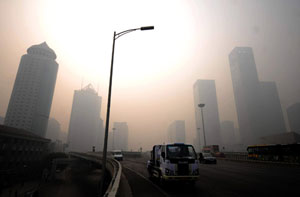
PM 2.5, known as the smallest and most hazardous airborne pollutant, is smaller than 2.5 microns in diameter. Getting these inside one's lungs is harmful. Since autumn, when consecutive smoggy days severely disturbed people's lives in Beijing and other big cities in China, it has become something of a household word associated with health concerns.
Shanghai Environmental Monitoring Center (SEMC) said on Friday that they have been carrying out pilot monitoring of PM 2.5 since 2005, and now had 24 monitoring spots in Shanghai. Monitoring results showed that the level of PM 2.5 failed to reach the national standards for grade II air quality.
The national standards refer to a draft standards released by the Ministry of Environmental Protection in November, which includes a five-grade classification of air quality on the basis of pollution indices, with grade I being the best and grade V the worst.
According to monitoring statistics released by SEMC, since 2005 to 2010, the average annual density of PM 2.5 was 0.044 - 0.053 milligrams per cubic meter, failing to reach the level of grade II air quality, which is 0.035 milligrams per cubic meter. The statistics also showed PM 2.5 density in Shanghai was about the same or down slightly in the last five years.
China currently uses PM 10, or particular matter under 10 micrometers, to measure air quality, but the government authorities have been urged to apply the more stringent PM 2.5 standard, which measures this finer matter that is considered more hazardous to people's health as it can go deeper into the lungs.
Shanghai Environmental Protection Bureau said last week that they will try hard to publish a "daily report" of the PM 2.5 density to citizens from next year, Shanghai-based Dragon TV reported, without giving more details, including the timetable.
Duan Yusen, chief forecaster with SEMC, said, technically speaking, the PM 2.5 monitoring was not that complicated.
"But the nation has not unified the standards and methods of monitoring PM 2.5 until now, and it takes time to prepare equipment and professionals," he said.
The Ministry of Environmental Protection said it has been considering revising the present standards, and a new index standard, including the measuring of PM 2.5 and ozone density, was scheduled to be fully implemented nationwide in 2016, with pilot projects conducted in certain regions ahead of the national deadline.
Cities in the Beijing-Tianjin-Hebei region, Yangtze River Delta and Pearl River Delta, as well as Southwest China's Chongqing municipality and provincial capitals, are requested to monitor PM 2.5 and ozone starting in 2012.
Related Stories
Plan to tighten air quality standards 2011-10-04 07:53
Air quality drops after Expo 2010-12-01 15:32
Beijing's Jekyll and Hyde fight for better air quality 2010-11-30 08:17
Poor air quality hits many big cities 2011-08-02 07:17
- Peninsula, finance top talks
- China to continue tax-cut efforts
- Weak markets pose fund investment risk
- New niche market: Affordable smartphones
- China launches super-speed test train
- PBOC urges less reliance on foreign credit ratings
- Group-buying firms look to Taobao
- Bank reserves 'may be cut again next year'