Comments()
  Print
Print  Mail
Mail  Large Medium Small
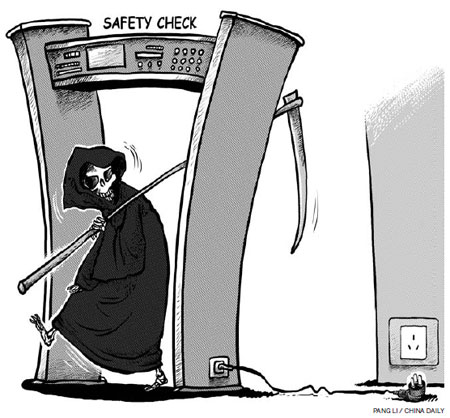
A total of 76 people have been killed in three accidents since Aug 13, according to State Administration of Work Safety reports.
In one of the worst accidents in recent years, 45 people were killed in a coal mine explosion outside Panzhihua city in Sichuan province on Aug 29. Thirty-six people traveling in a double-decker coach were killed when their vehicle collided with a tanker and caught fire on a highway in Shaanxi province on Aug 26. On the same day, three people were killed and five injured in Harbin, Heilongjiang province, when the ramp of a less-than-a-year-old bridge built at a cost of $300 million crashed on the pavement below. And in early August, seven cave-ins were reported from Harbin in just nine days in which two people were killed and two injured.
The accidents were caused either because of the use of substandard products to build infrastructure or because of violation of safety norms. It is to prevent such accidents that government regulatory agencies have to take measures in advance. To protect the life and property of users and consumers, regulators have to instruct enterprises engaged in construction projects to take all safety precautions and improve the quality of their products and services.
Government regulations are useful for several reasons. First, litigation can result in the punishment of an enterprise only after the damage is done and its neglect established in a court of law. In contrast, a regulator can pull up errant enterprises before any damage is done and make them pay for not fulfilling the precautionary requirements. This implies regulation is a much cheaper way of preventing accidents.
Second, a regulator may have a strong incentive to monitor enterprises' behavior if he/she is rewarded for identifying any violations.
Third, a regulatory agency will have greater professional knowledge if it usually specializes in one sector. Therefore, such regulatory agencies, with deeper professional knowledge and a strong incentive, can better protect consumers' life and property because they can detect violations of rules before an accident occurs .
Following this rationale, during its transition from centrally planned to market economy, China has gradually formed a number of regulatory agencies, including the State Food and Drug Administration; General Administration of Quality Supervision, Inspection and Quarantine; and the State Administration of Work Safety. Officials of these regulatory agencies, along with those of local governments, are usually given incentives to enforce the regulations.
It is well known that work safety has become one of the "one-item veto" areas for government officials' evolution. Once there is a problem in this area, local chief executive officials can be punished regardless of their performances in other policy areas. The decreasing number of accidents in China shows that incentives for officials do matter. The number of accident casualties last year was about 75,000, compared with 79,000 in 2010 and more than 100,000 in 2007. The number of accidents has also fallen - from more than 500,000 in 2007 to about 347,000 in 2011.
But though some officials have the incentive of enforcing regulation in a developing country like China, they can still be less effective than their counterparts in developed countries. Limited regulatory capacity and limited accountability in developing countries are among the major reasons why regulatory efforts are ineffective. For one, regulatory agencies in developing countries are usually short of resources, especially lack of trained professionals, to fulfill their duties. Besides, regulatory agencies in developing countries are also less likely to be held accountable for their action (or lack of it) and, therefore, make less effort than necessary.
Limited regulatory capacity and limited accountability both can be seen in the recent accidents in China. For example, the major reason why the double-decker coach and the tanker collided in Shaanxi is that both drivers violated the operational requirements (such as working more than the stipulated hours for drivers). In other words, the regulator failed to enforce the rules in advance, perhaps because of lack of professional knowledge.
Regulators can avoid such accidents if they fully realize the importance of operational requirements for safety.
Ineffective regulatory efforts can also be the result of lack of accountability. It has been reported that the main reason for the cave-ins in Harbin was displacement of underground pipelines after heavy rain.
Since a number of government agencies, including civil defense, sewerage, environmental protection, electricity and telecommunication departments, are responsible for different aspects of the underground infrastructure, it is very difficult for a regulator to coordinate with them and take swift decisions.
More importantly, the regulatory fragmentation makes it almost impossible to hold one government agency accountable for the safety of underground infrastructure. Besides, no single regulatory agency has the incentive to become accountable in such a complex situation.
Lack of regulatory capacity and accountability leads to unsatisfactory regulatory performance. Regulation can be made more effective in two steps. First, the government should spend more resources to train officials in regulatory agencies. Since regulatory efforts made in advance are more rewarding, training programs should especially focus on imparting professional knowledge to regulatory agencies' employees to enable them to identify lapses and neglects by enterprises, infrastructure operators and service providers in advance.
And second, the accountability issue can be addressed only if one regulatory agency in one sector is made accountable. Also, in more complex situations, the government should try offering regulators greater incentives to match the difficulties of coordinating across different regulatory agencies.
The author is a research associate at the East Asian Institute, National University of Singapore.
Copyright 1995 - 2010 . All rights reserved. The content (including but not limited to text, photo, multimedia information, etc) published in this site belongs to China Daily Information Co (CDIC). Without written authorization from CDIC, such content shall not be republished or used in any form. Note: Browsers with 1024*768 or higher resolution are suggested for this site.
License for publishing multimedia online 0108263 Registration Number: 20100000002731