Cross-border trade in renminbi will triple to $1.03 trillion in three years
A "renminbi bloc" has been formed in East Asia, as nations in the region abandon the US dollar and peg their currency to the Chinese yuan - a major signal of China's successful bid to internationalize its currency, a research report has said.
|
 |
|
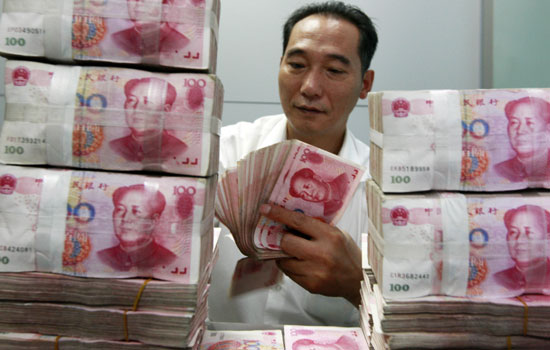
A clerk counts yuan notes at an Industrial and Commercial Bank of China branch in Huaibei, Anhui province. A "renminbi bloc" has been formed in East Asia, as nations in the region abandon the US dollar and peg their currency to the yuan, a sign of China's successful bid to internationalize its currency. [Photo/China Daily] |
The Peterson Institute for International Economics, or PIIE, said in its latest research that China has moved closer to its long-term goal for the renminbi to become a global reserve currency.
Since the global financial crisis, the report said, more and more nations, especially emerging economies, see the yuan as the main reference currency when setting their exchange rate.
And now seven out of 10 economies in the region - including South Korea, Indonesia, Malaysia, Singapore and Thailand - track the renminbi more closely than they do the US dollar. Only three economies in the group - Hong Kong, Vietnam, and Mongolia - still have currencies following the dollar more closely than the renminbi, said the report, posted on the institute's website.
The South Korean won, for example, has appreciated in sync with the renminbi against the dollar since mid-2010.
China has long vowed to raise its currency's global sway, along with the rise of its economy, which became the world's second-biggest last year.
The goal has seen significant development in recent years as the country promotes renminbi-denominated cross-border trade and gradually loosens control over its capital accounts.
As a result, Hong Kong has quickly risen to be the world's biggest offshore renminbi trading center, with about 600 billion yuan ($95 billion) in deposits.
According to the latest report by the Society for Worldwide Interbank Financial Telecommunication, or SWIFT, renminbi-denominated trade accounted for 10 percent of China's total foreign trade in July. The figure was zero just two years ago.
From July 1 to Aug 31, global payments in the renminbi rose 15.6 percent, according to SWIFT, as payments in other currencies fell 0.9 percent on average.
The renminbi had a market share of 0.53 percent in August and has overtaken the Danish krone to become the 14th-highest global payment currency, the member-owned cooperative said.
Cross-border trade settled in renminbi will triple to 6.5 trillion yuan ($1.03 trillion) within three years as relations with the world's second-largest economy grow, Royal Bank of Scotland Group PLC was quoted as saying by Bloomberg on Oct 9.
Settlements will grow 12 to 20 percent this year, reaching $1.03 trillion in two years, up from $330.8 billion in 2011, said Janet Ming, head of the China desk for RBS in Europe, Middle East and Africa.
"We're seeing a lot more customers starting to practice in renminbi," Ming was quoted as saying by Bloomberg. "For most companies and banks, China and India is where the growth is. If you're dealing with China, ignoring renminbi is not the right thing to do."
Wang Jianhui, chief economist with Southwest Securities Co Ltd, agreed. "Investors are looking for new reserve currencies at a time when both the dollar and euro are under pressure. This is a good opportunity for the yuan," he said.
The Royal Bank of Scotland predicted in a report on Monday that renminbi will become a fully convertible currency in 2015.
The PIIE said that renminbi could rise to the status of an international currency in 10 to 15 years if the country can reform its financial market and allow greater access for foreigners via capital account liberalization.
Forming the new renminbi bloc is the result of China's rise as the main trading partner in the region. China's share in East Asian countries' manufacturing trade has risen from 2 percent in 1991 to about 22 percent this year, according to the PIIE report.
In fact, trade is also propelling the rise of the renminbi outside East Asia. The currencies of India, Chile, Israel, South Africa and Turkey all now follow the renminbi closely, in some cases, more so than the dollar. The renminbi would be more attractive if the country could further liberalize its financial and currency markets, the report said.
Some fear that China might follow Japan's rise and fall over the past decades, but the institute thinks otherwise.
"They should take note that even during the heady days of the Japanese miracle, the yen never came close to rivaling the dollar as a reference currency. There was never anything close to a yen bloc in East Asia," the report said.
gaochangxin@chinadaily.com.cn


Copyright 1995 - . All rights reserved. The content (including but not limited to text, photo, multimedia information, etc) published in this site belongs to China Daily Information Co (CDIC). Without written authorization from CDIC, such content shall not be republished or used in any form. Note: Browsers with 1024*768 or higher resolution are suggested for this site.
License for publishing multimedia online 0108263 Registration Number: 130349