China is still the most attractive destination for foreign investment
The international media is once again drawing attention to China's capital flight. In an Oct 22 article, The Wall Street Journal, using figures on trade and foreign exchange reserves issued by the National Bureau of Statistics, the central bank and the General Administration for Customs of China, concluded that in the past 12 months through September, about $225 billion of capital left China, equivalent to about 3 percent of the nation's economic output last year.
|
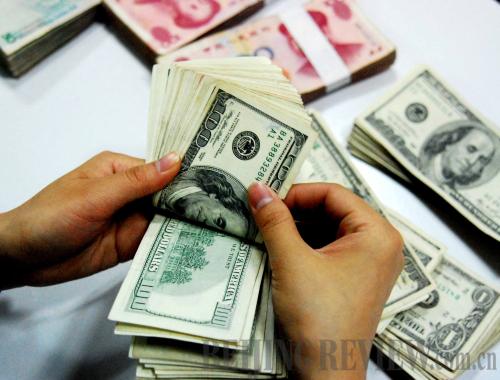 A clerk at the Industrial and Commercial Bank of China counts US dollars. Growing capital outflows have stirred a panic over capital flight in China. [Photo/bjreview.com.cn] |
Some Chinese scholars also believe in the outflow of capital. Zhang Ming of the Chinese Academy of Social Sciences, or CASS, estimates that from the fourth quarter of 2011 to the second quarter of 2012, $182.8 billion flowed out of China, with a monthly average of $20.3 billion.
Compared with the monthly average outflow of 14.1 percent from the fourth quarter 2008 to the first quarter 2009, the present capital flight is even more serious than the situation following the outbreak of the US sub-prime crisis. Zhang's estimation was made by deducting the monthly trade surplus of goods and the actual increase of monthly foreign direct investment (FDI) from outstanding monthly funds in foreign exchange.
Related: China remains top FDI destination
Zhang Yongjun, deputy director of the Department of Research at the China Center for International Economic Exchanges, says that in the second quarter foreign exchange reserves decreased despite the trade surplus and that there was a sharp decline in FDI, proving that capital is flowing out of China, likely because of the European debt crisis and of capital returning to the United States and Europe.
Accompanying capital flight are ominous messages from the international media, which hold out little hope for the Chinese economy with lurid headlines like "China Doomsayer Sees Crash Coming" and "China's Economic Situation in Its Most Critical in 30 Years."
Is there really capital flight in China? The Global Investment Trends Monitor report released by the United Nations Conference on Trade and Development, or UNCTAD, on Oct 23 takes a different view. In the first half of 2012, China absorbed $59.1 billion of FDI inflows, surpassing the United States for the first time and becoming the world's largest recipient country.
In the foreign exchange market, owing to the third round of quantitative easing being carried out in the United States, the Chinese yuan faces pressure to appreciate again. The spot exchange rate of the renminbi hit a record high of 6.2422 per dollar in morning trade on Oct 25, almost reaching the 1-percent appreciation limit per trading day allowed by the central bank.
When a large amount of hot money eyes China again, no investor is willing to transfer money out of China and abandon the opportunity for big gains while the renminbi is appreciating.
China's foreign exchange administration does not seem concerned about capital flows. An official from the State Administration of Foreign Exchange, or SAFE, who wished to remain anonymous told Beijing Review that they have a strict foreign exchange monitoring system and did not detect any circumstance that needed special attention.
Normal flows
According to the SAFE's definition, capital flight refers to the unapproved and illegal outflow of capital beyond the actual control of the government. Capital flight exists in both developing and developed nations, with the aim of avoiding foreign exchange control, country-specific economic risks and political instability, or for tax evasion, money laundering and transferring assets.
According to a statement by the SAFE, not all capital outflow is necessarily capital flight. Most flight is legal and includes approved repayment of foreign loans and interest, overseas direct investment, purchase of foreign securities, trade credit, etc. Even among capital outflows that counter regulations, some are used for legal investments and business operations, simply to evade the overly complex approval procedures or reduce other transaction expenses.
With an analysis of calculations on China's capital flight by The Wall Street Journal and some scholars, it can be said that such capital outflows follow the normal flows of investment and should not be a cause for panic.


Copyright 1995 - . All rights reserved. The content (including but not limited to text, photo, multimedia information, etc) published in this site belongs to China Daily Information Co (CDIC). Without written authorization from CDIC, such content shall not be republished or used in any form. Note: Browsers with 1024*768 or higher resolution are suggested for this site.
License for publishing multimedia online 0108263 Registration Number: 130349