The increasing wealth gap is regarded globally as possibly the most socially explosive issue of our time, responsible for the rapid radicalization of large population segments that we are witnessing worldwide.
The rising disparity between rich and poor, between the powerful and the powerless, between those who are connected and those who are cut off, between those on the inside looking out and those on the outside looking in, is highly combustible and easily seduced by political and religious demagoguery. It is the stuff revolutions are made of, which several Arab leaders have learned firsthand over the past two years.
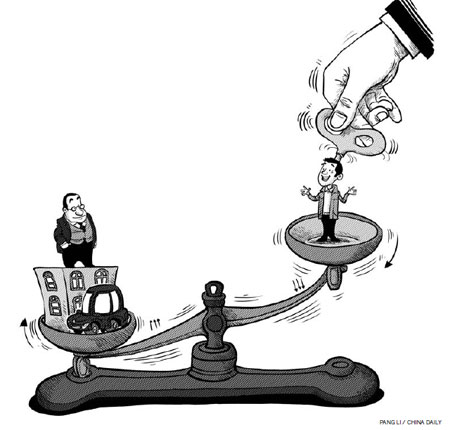
Of course, there is nothing new about this screenplay, and perhaps the only thing we can learn from history is that we seem incapable of learning from history.
The disturbing trend of a widening wealth gap is a challenge for leaders of all countries. Across the political spectrum everyone solemnly proclaims an unwavering commitment to bridging this economic divide. Unfortunately, these lofty pronouncements are rarely followed by meaningful actions. Instead, we are forced to endure an endless loop of the same recycled platitudes and grand pledges.
As we witness the debate that is raging, particularly in the United States and in Europe, between fiscal austerity and economic stimulus, those left behind financially have little to cheer about. We are way beyond the point of calibrating some synthetic balance between opposing economic theories, and instead of fact-based, accountable policies we are exposed to ideological, gospel-like declarations of allegiance to Reaganesque trickle-down formulas or quantitative easing monetary policies.
There certainly are legitimate policy discussions to be had, but for proponents of any side to claim their particular recipe to be a panacea for bridging the wealth gap is trite, bordering on the preposterous. Incomprehensibly, however, the glaring parallelism between the education gap and the wealth gap is being superciliously brushed aside, a correlation perhaps too obvious to be taken seriously by today's great thinkers.
Far too many people are cut off from their mainstream economies, and contrary to popular belief, this is as true for urban residents as it is for rural populations. Deficient public and private sector financial infrastructures certainly exacerbate this problem, though the increasing demographic penetration of technology such as mobile banking seems to be having a mitigating effect on the infrastructure shortcomings.
Far more lethal, however, is the stupefying neglect of financial literacy and public education. Vast segments of society lack even the most basic knowledge and understanding to make sound economic decisions, and the ability to control their own financial well-being and independence.
It is hardly surprising that the financial knowledge and education void is quickly filled by fraudulent actors, taking advantage of widespread ignorance and gullibility. This is fertile ground for pyramid or Ponzi schemes, preying on the uninformed with irresistible investment opportunities, whose returns come from the investors' own money or the money paid by subsequent investors, rather than from profit earned by a legitimate business. When these schemes collapse, as they all invariably do once they are unable to feed the exponentially growing money appetite of the beast they created, people are left destitute.
This phenomenon is hardly limited to socio-economically disadvantaged parts of society - as the Bernard Madoff and Allen Stanford scandals spectacularly demonstrated - but those are the ones left penniless without the ability and the opportunity to climb up from the bottom of the pit. Meanwhile, the wealth gap continues to widen.
What makes this so unforgivable is that it could be thwarted with effective financial literacy campaigns. Not with marketing gimmicks of banks, insurance companies or stock exchanges trying to sell their brands and products, or through counterproductive investment games that tend to instill reckless gambling instincts rather than convey prudence, understanding and risk awareness. Instead, there is a massive need for effective and deep public education programs targeting all segments of society, without regard to gender, age, religion or language, and using all forms of media and communication on hand.
Inexcusably, these education programs are accessible, ready to be deployed in schools, homes, factories, farms, villages or cities, and communicated through television, mobile phones, radio or the Internet. Capacity building programs, necessary to train the trainers and implement the financial literacy campaigns in a tested methodology, are just as available. But tragically, the success stories are few and far between.
Instead of enjoying the fruits of effective initiatives, we have had to endure decades of empty rhetoric and narcissistic, self-serving declarations of good intentions. Instead of concrete results, we have been lulled by an illusion that something is being done to bridge the education gap. Instead of actual financial literacy campaigns, we are inundated with a glut of conferences and economic forums on topics such as investor education or consumer protection, with speakers and panelists patting themselves on the back and feeling very satisfied by their own sense of importance and accomplishment.
In the meantime, more people are left behind, abandoned, frustrated, distraught and seething. It is hard to comprehend why anyone would be surprised when this anger explodes in violence.
Until we adjust our priorities and devote real resources to the implementation of these desperately needed financial education initiatives, words such as "bridging the wealth gap" or "stakeholder society" or "financial inclusion" will remain just that - words.
The author is a member of the Board of the Liechtenstein Foundation for State Governance.


Copyright 1995 - . All rights reserved. The content (including but not limited to text, photo, multimedia information, etc) published in this site belongs to China Daily Information Co (CDIC). Without written authorization from CDIC, such content shall not be republished or used in any form. Note: Browsers with 1024*768 or higher resolution are suggested for this site.
License for publishing multimedia online 0108263 Registration Number: 130349