|
 |
|
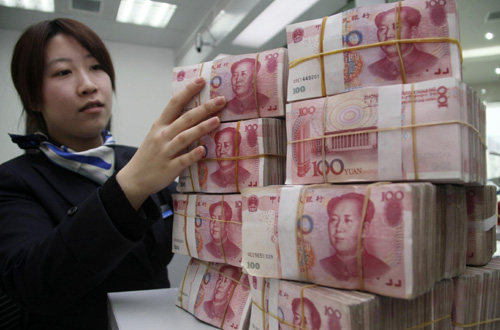
A worker stacks bundles of yuan banknotes at a bank branch in Nantong, Jiangsu province. A Standard Chartered survey has found that 76 percent of multinationals and companies in 16 markets are either already conducting business in yuan, or considering doing so. [Photo/Xinhua] |
Survey: 76% of companies favor using currency in Asia, Europe
A new index, which tracks offshore yuan business worldwide, has shown that the currency's international use has grown more than seven-fold over the past two years.
The Renminbi Globalization Index was introduced in Hong Kong on Wednesday by Standard Chartered Bank, along with the results of a survey conducted among top managers of companies across Asia and Europe, which showed that 76 percent of the respondents polled were either conducting yuan business already, or considering doing so within the next six months.
The study showed yuan foreign exchange transactions remain the most common offshore use of the currency among international and local companies, driven by hedging needs.
For trade settlement, potential users said they were mainly eyeing the benefits of better foreign exchange risk management, while existing users appreciated the improvement in timeliness or were being asked to do so by onshore counterparts.
The index is being promoted by Standard Chartered as the first industry benchmark that tracks offshore yuan business worldwide, which the bank claims will offer a quantifiable view of the latest trends as China accelerates its pace to make the yuan global.
It will measure activity in offshore yuan business in Hong Kong, London and Singapore - three cities aiming to achieve offshore yuan center status - and cover four key areas: yuan deposits, bonds and certificate of deposits, trade settlement and other international payments, and foreign exchange, the bank said.
According to the index, the seven-fold increase in offshore yuan business came between December 2010 and September 2012.
The survey results revealed that around 60 percent of respondents said they are using, or will be using yuan-denominated hedging products, based on the continuous strengthening of the currency.
At the same time, 36 percent of respondents said they were using yuan for trade settlements, and another 18 percent showed interest in adopting the yuan in future trade settlements, as "a higher share of existing users appreciate the improvement in timeliness or are doing so at the request of onshore counterparts".
Marios Maratheftis, Standard Chartered global head of macro research, said the mounting use of offshore yuan in global trade settlements is crucial to the currency's ongoing internationalization.
"The yuan is on an irreversible journey to becoming a major international currency, which will play a substantial role in international trade and central bank reserves," he said.
The survey showed that existing offshore yuan users are more ready to expand their use than non-users, and nearly half say they may start to use offshore yuan products they are not currently using, in the next six months.
Besides foreign exchange transactions and trade settlement, offshore yuan products also include deposits, loans, bonds and other types of investments.
Since the government expanded the use of yuan in cross-border settlement, exporters and importers can now choose to use the currency for pricing, settlement and payment.
Although a lot of countries have already accepted yuan for trade settlement, there is still plenty of room for growth, said Jiang Lu, a Hong Kong-based economist with JP Morgan Chase & Co.
"With more relevant products available, investors may eventually shift their priority from pure currency appreciation to investment returns.
"That would really help realize the yuan's function as an investment tool, and expand its market," Jiang added.
There are two key drivers of yuan-denominated "dim sum" bond issuance: the lower cost of funds, and the expansion of financing channels.
More than 50 percent of respondents indicated they would use any proceeds from the products to invest in the Chinese mainland market.
litao@chinadailyhk.com


Copyright 1995 - . All rights reserved. The content (including but not limited to text, photo, multimedia information, etc) published in this site belongs to China Daily Information Co (CDIC). Without written authorization from CDIC, such content shall not be republished or used in any form. Note: Browsers with 1024*768 or higher resolution are suggested for this site.
License for publishing multimedia online 0108263 Registration Number: 130349