

 Comments
  Print
Print  Mail
Mail  Large Medium Small
Students trade bottles, used books for recycled goods
A project that encourages Beijing students to recycle on campus has turned more than 100 tons of waste into useful resources in the past three years.
The Re-life University Environmental Coalition, involving more than 30 colleges, including the University of International Business and Economics, has been turning waste into wealth since 2009.
 |
|
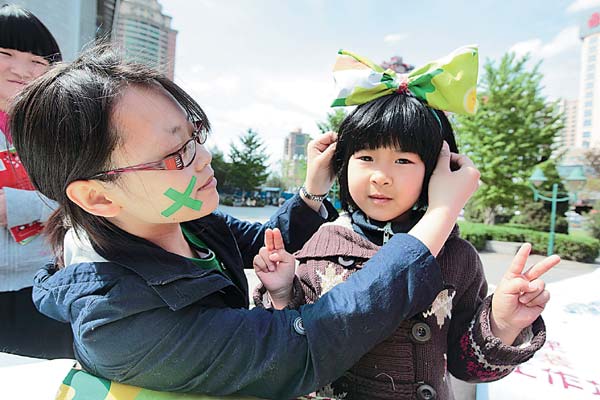
A volunteer helps a girl to put on a bow made of recycled newspaper and advertising paper at an activity to raise awareness for recycling at the Capital Library of China in Beijing in 2011. [Photo/China Daily] |
The project, jointly set up by the capital's commerce and education commissions, aims to ensure sorting and recycling on campuses by offering students recycled products for used books and discarded bottles, said Liu Quan, director of Beijing Tianlong Ttjie Resources Recycling, which is in charge of collecting and dealing with the products.
"The college is very densely populated and witnesses huge consumption of recyclable resources every day," he said. "In addition, college students, who are independent while open to new ideas, can better understand the significance of recycling and popularize the idea further through action."
The project is expected to cover at least 50 universities by the end of 2013, Liu said.
Every week, college societies and associations take up their routine of collecting wastepaper, books and bottles from dormitories, and then take the waste to a recycling station near the sports ground.
Students who bring the waste are rewarded with recycled products.
Rewards for waste
"You can discard it for nothing or for a pen and book, so there's no reason for students not to come and contribute," said Li Wei, vice-president of the Re-life University Environmental Coalition.
Li said 1 to 2 metric tons of waste, mainly used paper, is collected each month.
From the more than 100 tons of waste collected in the past three years, the union said it has retrieved 25 tons of newspaper, 20 tons of books, 9 tons of coated paper, 11 tons of paperboard and about 1 million bottles and cans. The total value is 120,000 yuan ($19,300).
The amount of paper it has recycled has significantly reduced pollutants released into the air and water, he said.
"With no other channels for the students to deal with their waste, most of the used materials will end up in the trash can or with trash collectors and illegal workshops, which will generate significant pollution in soil and air during their processing," he said.
Compared with the qualified and licensed waste recycling companies, informal ones usually offer a higher price thanks to cheaper labor.
"We have to balance the operational cost of the processing, labor cost and transportation fees, all of which far exceeds the cost for unlicensed sectors," said Liu. "In addition, they can stay outside the dorm building all day long, which is far more convenient for students than what we do."
Mao Da, an expert in solid-waste management at Beijing Normal University, said that because most illegal waste recycling workshops do not have pollution treatment facilities, their operating cost is much lower than those of their legal counterparts.
"Most waste in China is recycled informally by individuals, which threatens the quality of soil, air and water when sorted and dealt with outdoors," he said. "The country has to deal with growing environmental damage and health woes if recycling is left to the vagaries of the informal workshops."
More than 170,000 people in Beijing earn a living collecting trash with their own industry chain of collection, processing and marketing, according to an industry insider who did not want to be identified.
Scarce profit
Despite the thousands of packs of paper recycled, Liu Quan's company, however, is barely making any profit.
As one of the first pilot projects in the capital to carry out waste recycling since 2007, the company is capable of sorting some 50,000 tons of waste every year. However, supply shortages remain a headache.
Most waste ends up with the informal sectors, which can offer a higher price, Liu said.
According to Liu, most recycling business today is like public welfare, thanks to the high cost of machinery maintenances, logistics, labor, transportation and site costs, against all the fierce competition from the illegal workshops.
Taking all that into consideration, the production and sales of regenerative products barely counts.
However, now that so many universities are joining the union and more students are willing to participate, together with the policy support from the government, Liu is confident about the project's future.
And hopefully, he said, this will become a lucrative business in the near future.
Contact the writer at zhengxin@chinadaily.com.cn
 'The most beautiful bookstore' in Shanghai
 Sailing into future: Tianjin Binhai New Area
 Top 10 China's most valuable brands in 2016
 What they said during Summer Davos Forum
 Visitors try at exploration zone on Summer Davos Forum in China's Tianjin
 What next after the UK vote?
 Top 8 items graduates will spend during graduation season
 1st annual meeting of AIIB held in Beijing

 Former NBA player Kobe instructs young players in Taiwan
 Italy take revenge to send Spain packing with 2-0 win
Copyright 1995 - . All rights reserved. The content (including but not limited to text, photo, multimedia information, etc) published in this site belongs to China Daily Information Co (CDIC). Without written authorization from CDIC, such content shall not be republished or used in any form. Note: Browsers with 1024*768 or higher resolution are suggested for this site.
License for publishing multimedia online 0108263 Registration Number: 20100000002731