|
|
A model for an auto show in Taiyuan, Shanxi province, uses the Didi Chuxing car-hailing service to commute from her college to the auto show. [Photo/China Daily] |
Experts are divided over whether car-hailing will supplant auto ownership
With the car-hailing industry gaining in popularity, many are wondering if they need to buy their own cars.
Liu Qing, president of Didi Chuxing, China's largest car-hailing service provider, said one-third of car owners drive to and from work in the country, with that ratio likely to fall as new forms of transportation emerge.
By the end of 2015, China was home to 172 million cars. Among 40 major cities in the country, each had an average of more than a million cars.
"Previous generations had a compulsion to own a car. Today, it is different. Those born in the 1990s do not talk about buying cars or even houses, and it is cool to not have a car," said Liu at a forum on June 21 in Beijing.
She said Didi offered 1.43 billion rides in 2015 across the country, or 14 million rides a day.
"Didi will try to provide better services so that people will abandon the idea of buying their own cars. It is no fun to sit in traffic jams," Liu said.
William Li, founder of electric carmaker NextEV, does not agree.
He said car ownership has grown by about 40 percent in the San Francisco Bay Area since Uber was invented in the region in 2012. In 2015, 350,000 cars were sold in the region.
In Beijing, where car-hailing services are prevalent, people who registered to win a license reached 3.65 million by the end of 2015, about three times the figure in 2012.
Li said the clashing of statistical fact to the general perception of cars is the simplistic definition that a car is simply a means of transportation.
"I have more than one car, and some cars are not entirely used as a transportation tool."
He said the logic of smartphones also applies to the car industry.
"If we had seen a mobile phone as only a phone, smartphones would not have emerged and dominated."
Li said customer experience will decide the future development of the car industry.
"If our cars are autonomous, that means we have a professional driver who does not rest, and cars will become a real mobile, private and free space for us.
"That experience, I am sure, will be a reason for people to own a car, because owning such a car means more freedom."
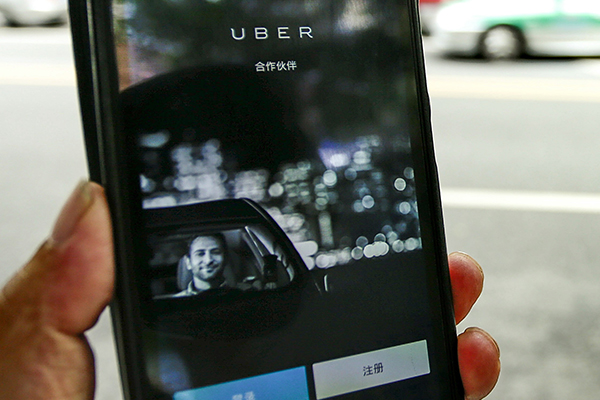
A passenger uses Uber in Zhengjia Square in Guangzhou, Guangdong province. [Photo/China Daily]
Self-driving trending up
Autonomous driving is one of three widely popular trends in the auto industry, along with electrification and connectivity, and many expect it to soon become a reality.
Lex Kerssemakers, chief executive of Volvo's North American operations, says he expects to see self-driving vehicles on the roads of Beijing or New York in about four years.
Boston Consulting Group predicts that by 2025, vehicles with some autonomous features will account for 12 to 13 percent of car sales globally, and by 2035 sales of fully autonomous vehicles will account for nearly 10 percent of the market.
Li's NextEV expects self-driving cars will be mass-produced in the US by 2020 and by 2022 in China. He also predicts that 20 million such cars will be on roads worldwide by 2025.
While Li is betting big on autonomous driving, several traditional automakers are currently making forays into the mobility industry.
Ford tried a ride-sharing program late last year in China.
The month-long pilot program saw 170,000 rides in Shanghai and Beijing, paving the way for experiments with new patterns of car ownership, said former head of Ford China operations John Lawler.
In May, Toyota said it signed a memorandum of understanding with Uber to look into ways to explore collaboration in countries where car-hailing is expanding.
Volkswagen AG announced a plan in early June to become a globally leading mobility provider by 2025 that will run parallel to its automotive business.
Volkswagen CEO Matthias Muller said the move is based on the trend that more and more young people want mobility solutions but do not want to buy a car.
But Muller does not believe that will develop overnight.
"Volkswagen will remain largely focused on the traditional automotive business over the next 10 to 20 years," he said.

Copyright 1995 - . All rights reserved. The content (including but not limited to text, photo, multimedia information, etc) published in this site belongs to China Daily Information Co (CDIC). Without written authorization from CDIC, such content shall not be republished or used in any form. Note: Browsers with 1024*768 or higher resolution are suggested for this site.
License for publishing multimedia online 0108263 Registration Number: 20100000002731