Chinese audiences are demanding a greater number of dubbed foreign films at their local cinemas, but the domestic industry faces unpredecented problems, as Zhang Yuchen reports from Beijing.
As she accompanied a group of friends on a trip to the cinema in Shanghai, Zhong Qiu found herself unable to provide a convincing answer to a question posed by one of her fellow students, a girl from overseas: "It's natural for us to watch movies in English, but why aren't more international films dubbed into Chinese so people can watch them in their mother tongue?"
|
 |
|
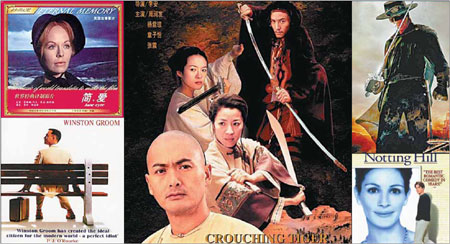
Some of the movies dubbed into either English or Chinese. [Photo/China Daily] |
|
 |
|
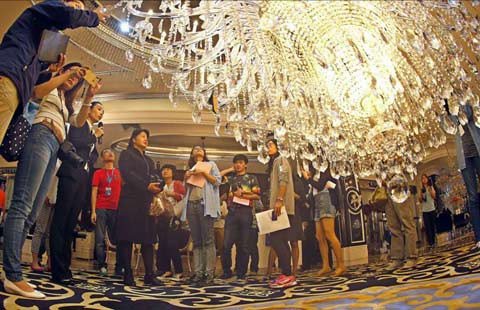
A voice-over crew works on sound post-production at a recording studio in the dubbing center of China Film Group. [Photo/China Daily] |
The group had found plenty of movies, but they were all foreign films being screened in their original formats.
Zhong, a major in Sino-US financial relations, didn't really understand the question. As far as she is concerned, it's "natural" to watch English-language films in English, without Chinese dubbing.
However, Zhong's puzzlement is hardly surprising. In China, it's rare to find international movies dubbed in Chinese after 7 pm. Although many cinemas arrange a few daytime screenings of dubbed films, there are dozens of showings in the original language every day.
Since 2001, Shanghai Dubbing Studio, established in 1957, has dubbed only around 20 films from other regions in Chinese annually.
"As a cultural phenomenon, films dubbed in Chinese have suffered financial and talent problems in recent years, but that's not the whole picture," said Yang Heping, director of the dubbing center at China Film Group Corp.
The golden age
Born in the 1990s, Zhong missed out on the "Golden Age" of Chinese-dubbed movies. During the mid-1980s, the reform and opening-up policy saw the country import around 1,300 movies from all around the world. All were dubbed in Chinese, with the lines delivered by famous "voice actors".
The first foreign films came to China in 1896. The language problem wasn't an issue in those days because the movies were all silent productions, filmed before the invention of "talkies". Although foreign films with Chinese subtitles began to appear on the big screen in 1922, the real breakthrough came in 1949 when Chinese audiences were treated to a Soviet film featuring Western-looking actors, who, crucially, spoke in Mandarin.
During the 1950s and 60s, around 50 foreign movies were dubbed in Chinese every year, but the audience was limited to senior officials. Very few, if any, members of the general public were able to see these movies, which were almost exclusively productions of the Soviet Union or its satellite states, which shared China's communist ideology.
The Golden Age arrived in the 1980s, when Chinese audiences were able to see a wide range of films from different parts of the world, all dubbed in Mandarin.
Many foreign actors became popular with Chinese audiences. For example, Zorro won a large number of fans when it was first screened in China in 1985, with the voice of a Chinese actor replacing that of Alain Delon, who played the eponymous hero.
"At that time, the voice represented, to a large extent, the image of the hero," said Shi Chuan, a doctoral advisor at the School of Film & TV Arts and Technology at Shanghai University.
When Delon visited China in the late 1980s, he made a point of thanking Tong Zirong, an actor at the Shanghai Dubbing Studio whose sparkling vocal performance added greatly to the appeal of Zorro, originally portrayed as a Spanish speaker.
It wasn't until his visit that regular Chinese moviegoers actually heard Delon's real voice. Apparently, it was a disappointment to many, according to Shi, as the Frenchman didn't sound as glamorous as the character he portrayed.
During that period, dubbing allowed Chinese cinema audiences to become familiar with the marital predicament facing Jane Eyre and the famous "Life is like a box of chocolates" line, uttered by a wistful Forrest Gump, played by Tom Hanks.
A whole crew of professional voice actors were widely known for their excellent voice-over performances.


Copyright 1995 - . All rights reserved. The content (including but not limited to text, photo, multimedia information, etc) published in this site belongs to China Daily Information Co (CDIC). Without written authorization from CDIC, such content shall not be republished or used in any form. Note: Browsers with 1024*768 or higher resolution are suggested for this site.
License for publishing multimedia online 0108263 Registration Number: 130349