Taking the reins of great change


 |
|
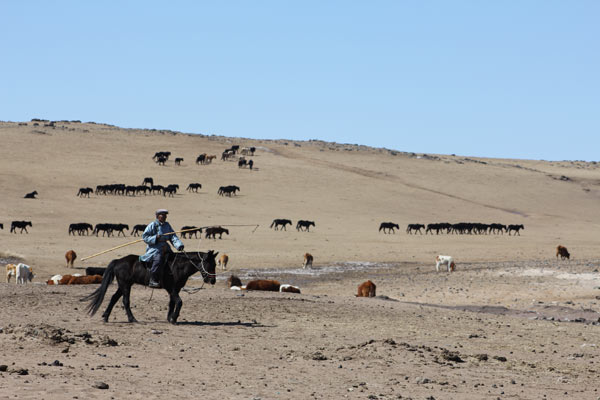
Chuluu oversees his horses in Bayantug. [Photo / China Daily] |
Breeders witness ups and downs of trade in their beloved horses, report Wang Kaihao and Yang Fang from Abag Banner, Inner Mongolia autonomous region.
About 20 kilometers from the Sino-Mongolian border, yurts are scattered around the vast greenness of one of the best-known pasturelands in the region.
Qinglin, an ethnic Mongolian, will pack his yurts in a couple of days and move his horses to a nearby meadow in Abag Banner, the Inner Mongolia autonomous region.
Born into a family that raises the traditional breed of horse, known locally as khar adium, he doesn't know how many previous generations have followed the family trade. But the 45-year-old can't imagine life without the black horses.
Working several meadows with a combined area of around 1,200 hectares, Qinglin raises more than 100 black horses. Severe arthritis means he's unable to ride every day, but he stills rushes to take every opportunity to saddle up.
"Only a regular rider can possibly understand and raise these horses," he said.
After struggling for more than 20 minutes to put a saddle on an unbroken horse, Qinglin looked tired. Nevertheless, he said the work is easier than tending cattle and sheep, because horses have strong spirits.
Qinglin is one of Abag's 800-plus horse breeders and has witnessed the waxing and waning of the trade in his beloved steeds.
The khar adium, noted for its stamina and hardiness in winter, is one of four major traditional Mongolian horse breeds. In the 13th century, the ancient nomadic tribe of Abag was led by Belgutei, a half-brother of Genghis Khan, and according to local legend, the kharadium breed can be traced back to the warhorses of that time. Approximately 50 percent of the 30,000 horses raised in Abag today belong to the breed.
"It is purely for my love of horses," said Qinglin, lighting a cigarette and sighing, as he explained his vocation. His five siblings have all moved from the grasslands and now work in town.
"Tourists usually take it for granted that this is a hub for horses, but they may not know that horseback riding is not common nowadays," said Erdensang, Party chief of Bayantug Sumu, or township, the district's biggest horse center.
Modernity intrudes
He explained that the decline of horseback riding as a mode of transport is one of the main reasons for the downturn. Motorcycles and autos have become increasingly popular since the 1990s and although almost every local family raised horses in the old days, most shepherds now prefer to travel by modern methods.
"The climate also seems to have become drier," said Erdensang. "The grassland isn't flourishing as it did a few decades ago, and horses eat a lot of grass."
In 2012, the Abag government dug 41 wells to help the locals water their horses. Qinglin has to move his yurts around the meadow three or four times every year to help prevent the grasslands from becoming denuded.
Although the khar adium has a long history and a good bloodline, its high value has been ignored. Qinglin said the horses have even been sold for meat. Around a decade ago, one horse he sold for its meat fetched 3,000 yuan ($488).
 |
|
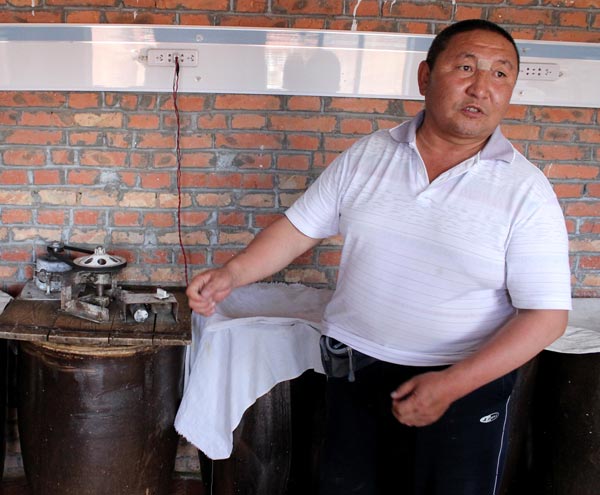
Sukhbaatar, one of Abag's leading mares' milk entrepreneurs, in his workshop at home. [Photo / China Daily] |
Reviving the culture
The khar adium gained national fame in 1960 when the Abag Black Horse Company, a 120-person militia that patrolled the border, was granted a meeting with Chairman Mao Zedong in Beijing and was widely eulogized by the media.
The militia's glory was overshadowed by a decline in interest in raising horses, but the situation is not unique to Abag. In 1975, there were more than 2 million horses in Inner Mongolia, but their numbers had plummeted to less than 500,000 by the end of 2010, and fewer than 100,000 were pure breeds according to the Inner Mongolia Statistical Yearbooks.
Still, when Abag was named "The Hometown of khar adium" by the autonomous region's government in 2008, Qinglin cheered up. Abag launched an annual Khar Adium Cultural Festival in July, 2009, which attracts more than 30,000 visitors. The festival features demonstrations of lassoing skills, exhibitions, sporting competitions and even an equine beauty pageant. It's now the biggest arena for the promotion of the black horses in the area.
Horses owned by Hugjiltu, 43, another black-horse breeder in Bayantug Sumu, have taken the laurels at the beauty pageant for the last few years.
"The color must be pure," he said, revealing the secret of his success. "The body must be in good shape and strong, and of course, I also dress their manes carefully."
A climax of the festival is an endurance race. Children take the reins to minimize weight differences among the riders and fully reflect the horses' capabilities. The owner of the winning horse receives a prize. Although Hugjiltu's horses have also won this event, he always allows the child jockeys to take the cash.
"Honor is more important than money," he said, smiling.
He added that the event's presentations and performances, including dressing the manes, demonstrating branding marks and making harnesses, help keep these almost forgotten traditional skills alive. He keeps an elaborately decorated saddle in a glass cabinet at his home and never tires of explaining its unique Abag characteristics to visitors.
Abag's equestrian culture has also attracted national attention. It is listed by the China Photographers' Association as a "creative base for horse culture", and attracts 50 to 60 groups of photographers every year, according to Hunusut, the chief of Abag's Federation of Literary and Arts Circles.
"Traditions were restricted within individual families and gradually faded away," he said. "So it's great to revive people's love of horses through this combination with