Taking the reins of great change


Milking opportunities
The revival of the horse culture has been accompanied by an increase in business for related industries. In addition, the growing demand for racehorses has seen prices rocket in the past decade. Qinglin said that his racing horses sell for an average 30,000 yuan each, but his 20-plus mares constitute a bigger gold mine.
Every summer morning, he rises at 4 am to milk the mares. Each mare can produce 3.5 liters of milk per day. Each liter sells for about 25 yuan, but the price is often much higher at tourist hotspots. Qinglin earns more than 200,000 yuan per annum via this new, healthy drink.
Mares' milk is widely used in traditional Mongolian medicine and is believed to be especially effective in the treatment of tuberculosis, diabetes, and hypertension, according to Batbileg, the head of the Abag Hospital of Traditional Mongolian Medicine. The treatments were usually restricted to members of individual households, but Batbileg has experimented with introducing them into clinical treatment to "revive this crucial part of the ethnic group's culture".
|
 |
|
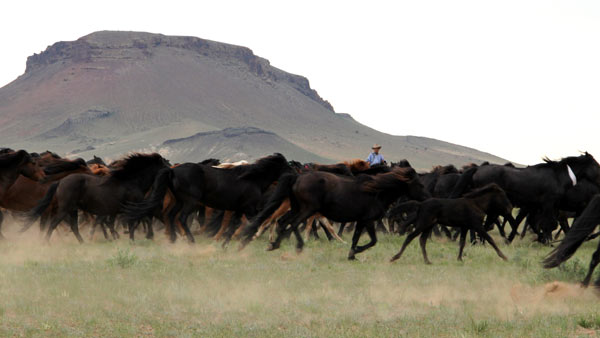
A herdsman drives horses close to Bogd Uul, a mountain regarded as holy by the locals in Abag. [Photo / China Daily] |
Although mares' milk is growing in popularity, the pioneers of the trade once faced skepticism and, often, contempt.
"People from the Mongolian ethnic group use mares' milk to receive guests, and nobody made money from it at first," said Sukhbaatar, 51, one of the first people to sell the milk in Abag, recalling his early days in business during the 1990s. "I was despised, because traditionally merchants do not have high status in Mongolian culture.
"Nobody came to buy my milk, so I had to travel around Inner Mongolia to sell my produce," he said. Sukhbaatar has had rheumatoid arthritis since his 20s, meaning he is unable to undertake heavy labor. It was the main reason he began selling mares' milk. "Finally, this is a golden season for it."
He still uses the traditional fermentation method to make mares' milk yogurt at home, and although his output is too low to satisfy market demand, he prides himself on the high quality of his produce. The boom in business has seen him close his guesthouse and concentrate on his dairy.
"Only Abag has such good black-horse blood, and we have perfect conditions for producing fine mares' milk. We cannot afford to allow the value of this brand to decline," he said, referring to counterfeit mares' milk sold at the local market at a lower price.
In Abag, 58 families process mares' milk, producing 240 metric tons annually, according to the local agriculture and husbandry bureau. However, most of the producers are individual operations, so the banner is building a modern factory to combine their efforts and better maintain the freshness of the milk.
In spite of Abag's booming equestrian industry, a number of issues could hamper the gallop to a brighter future. A lack of financial support from the local government is a major problem.
"It's been four years since Abag first held the cultural festival, but horse breeders are generally inspired by praise rather than money," said Erdensang, the Party chief of Bayantug, barely hiding his disappointment. "Herders who raise sheep and cattle receive agricultural subsidies, but there are none for horse breeders."
Locals who buy black stallions for stud purposes receive 1,000 yuan per horse, but that's the only subsidy they receive. Abag's annual revenue is roughly 200 million yuan, one of the lowest among Inner Mongolia's banners and counties, which means the local government has little cash to spare for subsidies.
Chuluu, 66, is one of Bayantug's most experienced horse breeders. His horses always head the parade at the cultural festival, but even this great honor can't dispel the look of concern on his face
"Horses used to run wild on the grassland, but now they can only live within the wire fences and the limited space will result in inbreeding," he said.
The fences were erected in 1983 to mark the boundary of each family's meadow. Chuluu has considered introducing other types of horse to prevent inbreeding, but he is worried that new breeds will eventually result in fewer pure-blooded black horses.
He established the town's first breeding cooperative, involving eight families, in 2011. But after waiting in vain for more than two years for financial assistance promised by the government to expand their business, the cooperative's work has ceased.
"Abag has promised to build a public farm covering an area of 300,000 mu (20,000 hectares) and get more people involved," said Erdensang, who acted as an interpreter during the interview, with slight embarrassment.
Having originally imposed a quota to preserve the grasslands, the local government has now lifted the restriction on the number of horses allowed on each hectare of land to encourage the industry to develop.
Chuluu will not increase his herd, because a high-quality grassland is the basis of his livelihood and he respects the laws of nature.
"There are many black rocks in this area. I am a black rock who raises black horses," said the old man, whose name means "rock" in Mongolian. For once, he smiled: "Isn't that part of nature's plan?"
More China Daily Cover Stories