Railway cities staying on track


 |
|
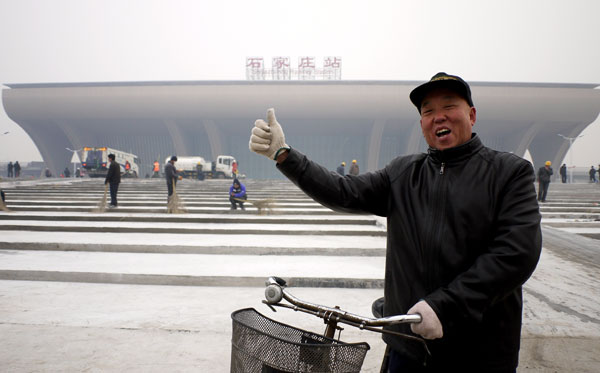
A resident shows his appreciation of Shijiazhuang's new railway station. [Photo / Provided to China Daily] |
His company purchases bulk goods, such as soda ash, in the Inner Mongolia autonomous region and the northwestern province of Qinghai and transports them by rail via Beijing to clients in Hebei. When a high-speed rail link between the source areas and Beijing opened in 2012, the journey time for the raw materials was cut to seven days from 20, allowing Li to increase the frequency of his purchases of raw materials.
"We plan to explore the huge market in Beijing, because it's easy and convenient to transport the materials to customers there. Some potential clients have realized that and have approached us with orders," said the 28-year-old, whose company has an average annual trade volume of 20 million yuan per annum. "We plan to cooperate more fully with companies in Beijing," he added.
Like many decision-makers in local companies, Li regards Beijing as a gold mine and is making moves to tap the huge potential market. The speed of travel between the Chinese capital and Shijiazhuang is a boon for business cooperation, especially for Shijiazhuang, because of the obvious advantages enjoyed by the capital in terms of talent, financing and technology, among other factors.
In 2012, Beijing invested 219 billion yuan in Hebei, about 43 percent of the provincial total, according to government statistics. Meanwhile, on May 22, Beijing and Hebei signed a contract listing the main areas of cooperation in the next two years. They include the local economy, environmental protection, and the transfer of certain industries from the capital to the province - the growth of the high-speed rail network is a priority item on the agenda.
Resource imbalance
The relationship is not without friction, though. While Shijiazhuang and other cities in Hebei understand the strategic importance of supporting the capital, by providing water and energy for example, there have been complaints that Beijing is draining the pool of local talent and other resources.
"In the early stage of regional cooperation, there exists an imbalance in the flow of resources, not just in this area, but also in the Yangtze River Delta and other areas. It's a phenomenon that's also been seen in other countries and is a general trend during development," said Xing Tianhe, deputy chief planner at Hebei's department of housing and urban-rural development.
The cities in these economic clusters need to pursue different routes of development, utilizing a variety of resources to avoid unnecessary competition, said Xing, who noted that the financial gap separating Shanghai, and the cities of Hangzhou and Nanjing is not as wide as that separating Beijing, Tianjin and Shijiazhuang.
"Shijiazhuang should take advantage of the shared resources, but it must pursue its own path and then it will be able catch up with the two municipalities," said Xing.
Throughout the development period, the railway acted as a lifeline and in several transport hubs, the main rail routes pass through the downtown areas. In Shijiazhuang, large open markets have grown around the railway station, raising the numbers of local passengers, especially during rush hours.
The city government has ploughed money into the transport infrastructure, building overpasses and bridges to connect districts separated by the rail line.
"The cities where expansion was fueled by the railway share similar space restrictions on urban planning," said Xing. His preferred solution is the one adopted by Shijiazhuang; relocating the railway stations away from the downtown areas.