

 Comments
  Print
Print  Mail
Mail  Large Medium Small
E-commerce is considered an effective way to build a new competitive edge and avoid trade protectionism as it directly ships goods to consumers, Li Jiabao reports
As China's foreign trade faces rising costs at home and sluggish demand abroad, flourishing e-commerce services are expected to boost cross-border trade and change the image of Made-in-China products, experts said.
China's cross-border e-commerce companies are being confronted with challenges of credibility, varying standards, talent shortage and insufficient intellectual property rights protection.
Wang Kaiyuan, deputy director of the China International Electronic Commerce Center of the Ministry of Commerce, said at a forum on Nov 2 that the country should pay more attention to cross-border e-commerce services, which are developing in line with China's economic restructuring process.
"China's foreign trade is now facing a difficult time, not only because of a reduction in global demand but also because of rising trade friction and trade segmentation due to regional economic integration," Wang said.
Overall trade rose 6.2 percent year-on-year in 2012 and went up 7.6 percent year-on-year in the first 10 months of the year, compared with double-digit growth in the past decades, according to the General Administration of Customs.
The autumn session of this year's Canton Fair - a barometer of China's exports - posted the lowest export volume since the fair's autumn session in 2009, suggesting weak overseas demand and a grim outlook for the world's largest exporter.
"Cross-border e-commerce will be an effective way for China to build a new competitive edge as it will directly ship goods to consumers and avoid trade protectionism," Wang said.
Li Xiaogang, chief engineer of the customs agency, said that cross-border e-commerce has great significance in expanding overseas demand and transforming the country's trade developing model, as well as upgrading China's economy.
"Boosting cross-border e-commerce, especially under the current circumstances, will help small- and medium-enterprises reduce costs and solve urgent challenges such as tax rebates," Li said.
In late August, the State Council, China's cabinet, issued policies to support the development of cross-border e-commerce. Those measures include increasing payment services, easing customs inspections and improving the tax rebate regulations.
Planning for the China (Shanghai) Pilot Free Trade Zone also took into account the acceleration of cross-border e-commerce services as well as the trial of a supportive system including customs supervision, inspection and quarantine, tax rebates, and cross-border payment and logistics services.
Data from the ministry showed that the trade volume of China's cross-border e-commerce rose 25 percent to 2 trillion yuan ($328.4 billion) from 2011 to 2012. Experts estimated that the trade volume will hit 3.1 trillion yuan in 2013 and 6.5 trillion yuan in 2016, with annual growth of about 30 percent and accounting for nearly one-fifth of the country's overall trade volume.
Surging business
Zhang Guofang, chairman of Qingdao Mingyue Seaweed Group Co Ltd, said that overseas orders for the second half of the year were significantly lower than in the first half due to rising costs for raw materials, labor and fees and taxes.
"We started our cross-border e-commerce services a couple of years ago, and the new business has brought us rewards and will be our major business model in the future," Zhang said.
"We've long been a processor and supplier of seaweed products for big overseas buyers. Good quality and low prices were the major competitiveness factors, but now we're becoming a manufacturer of new products, such as cosmetics made of seaweed and we directly sell them to consumers with the help of e-commerce services.
"As the company grows, we must have our own consumer products, our own brands and sales networks. It's not easy, but e-commerce is the way forward," he added.
Xu Cheng, administrative deputy director of Bosideng International Holdings Ltd and Shanghai Bosideng International Fashion Co Ltd, said that the down clothing producer started its e-commerce services in 2008. Sales surged from around 30 million yuan in 2008 to about 400 million in 2012 and are expected to hit 500 million yuan this year.
"Cross-border e-commerce is still at an initial stage in China, but it will develop very fast as long as the trust problem is resolved," said Zhang Tianran, senior manager of Global Market Group, a global platform that connects Chinese manufacturers with overseas buyers and consumers.
A survey made by the company that polled 20,000 buyers showed that they spent more than 85 percent of their time on the platform sorting out the right suppliers as China has more than 42 million companies, according to Zhang.
"Overseas buyers don't lack information, but their main issue is sorting. The key is the credibility of domestic suppliers. The credibility issue is the most important one to change the Made-in-China image," Zhang Tianran said.
In 2005, the group launched a standard known as the Global Manufacturer Certificate, joining hands with T0 5V Rheinland AG and Underwriters Laboratories Inc. The standard evaluates Chinese manufacturers on eight areas including effective quality control, standard social and environmental responsibility and professional research teams.
"As for the M2B business, which connects Chinese manufacturers with overseas buyers, we now have 30,000 domestic manufacturers, mostly SMEs, and 1.08 million overseas buyers. The manufacturers are all the leading suppliers of different industries. When the buyers send us their full-year orders, we can get them the right suppliers within a week," Zhang said.
Challenges
Unlike China's overall trade performance in the past two years, the trade volume of Chinese companies, especially small ones, engaged in cross-border e-commerce services has maintained fast growth, said Yang Jianzheng, director of the Institute for Economic and Trade at the School of Commerce of the University of Shanghai for Science and Technology, noting a survey of 1,009 trade companies in the spring session of this year's Canton Fair.
But most companies engaged in cross-border e-commerce services have low-level logistics capabilities and poor ability to use e-commerce platforms for effective network marketing, while they remain unfamiliar with electronic customs clearance procedures, Yang said.
"We don't have enough professional talent for cross-border e-commerce, which is a big challenge. In addition, it's more difficult to protect our IPR during online transactions," Xu from Bosideng said.
Li Wenkai, director of Ecovacs Robotics (Suzhou) Co Ltd, added that the advertisement costs on e-commerce platforms are also becoming higher.
Also, Ni Zugen, chairman of Lexy Electric Appliances Co Ltd, noted that consumer loyalty is not solid for brands that made their name in the e-commerce space.
 Model with German luxury cars
 Getting in the mood
 Models at Mercedes pavilion at 2013 Auto Guangzhou
 Buick Riviera concept car at 2013 Auto Guangzhou
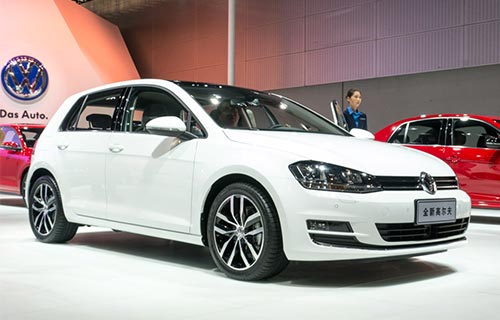 FAW-VW all-new Golf at Guangzhou auto show
 VW donates more than 5k child safety seats
 Honda models at 2013 Guangzhou auto show
 Honda Jade at the 2013 Guangzhou auto show
Copyright 1995 - . All rights reserved. The content (including but not limited to text, photo, multimedia information, etc) published in this site belongs to China Daily Information Co (CDIC). Without written authorization from CDIC, such content shall not be republished or used in any form. Note: Browsers with 1024*768 or higher resolution are suggested for this site.
License for publishing multimedia online 0108263 Registration Number: 20100000002731